

A free press, under pressure
The risks aren’t always visible—but they are reshaping what gets said.

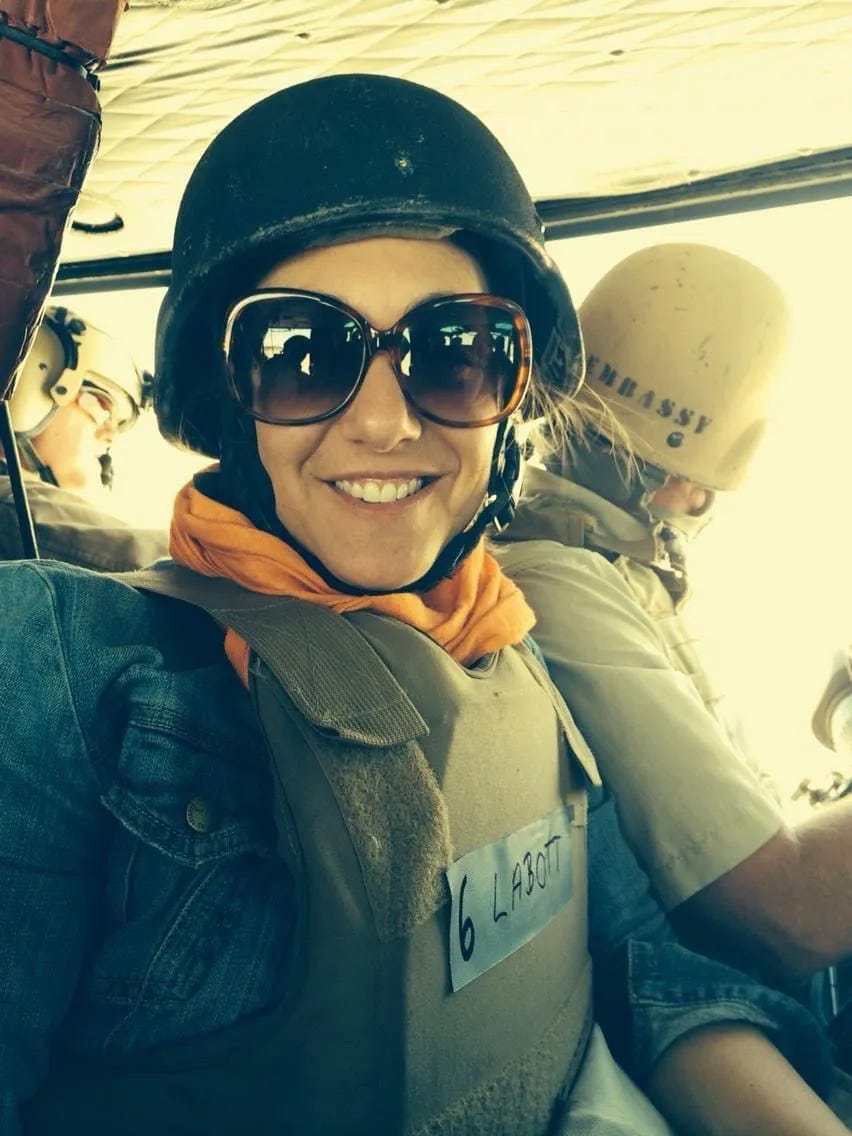
If you’ve been following me for a while, you may have seen this photo before.—one of my favorites from my CNN days, snapped in a Blackhawk heading to the Green Zone in Iraq. The flak jacket and helmet capture the real risks journalists take to get the story. The smile captures why I’ve never stopped loving this work.
May 3rd was World Press Freedom Day—an annual observance the UN established more than three decades ago to highlight the importance of a free press. Over the past few years, it’s become less of a celebration than a warning.
The threats to journalism are real and growing. It’s also harder to ignore how much the profession itself is under strain.
According to UNESCO, 310 journalists were killed between January 2022 and September 2025, many in conflict zones from Ukraine to Gaza to parts of Africa. Reporting the news is increasingly dangerous work. And when those attacks are not investigated or punished, it reinforces a system where silencing the press carries little consequence.
The broader environment is deteriorating as well. The 2026 World Press Freedom Index from Reporters Without Borders shows more than half the world’s countries now fall into “difficult” or “very serious” categories. Less than one percent of the global population lives in a country where press freedom is considered “good.” The global score is now at its lowest level in 25 years.
The United States is not exempt. This year, the US dropped to 64th out of 180 countries—its lowest ranking ever. The reasons are familiar: political hostility, economic pressure on news organizations, weakening legal protections, and growing safety concerns. Press freedom rarely disappears all at once. It erodes over time, through sustained pressure and changing incentives.
That pressure is becoming more direct. Trump has continued to harass media outlets that criticize him: lawsuits against outlets whose coverage he dislikes, threats to revoke broadcast licenses, the removal of independent journalists from access, and a constant effort to delegitimize the press as an institution.
This doesn’t require formal censorship to be effective. The pressure reshapes behavior on its own.
At the same time, the information environment itself is becoming harder to navigate. Outlets that present as legitimate are increasingly blurring the line between reporting and advocacy, or aligning with those in power rather than holding them accountable. The result is a landscape where propaganda and journalism can be difficult to distinguish.
That confusion has consequences. When people are no longer sure what to trust, the role of journalism weakens—and so does accountability.
The echo chamber problem
Compounding this, much of the media ecosystem has narrowed into partisan framing and reflexive dismissal. We are less engaged with competing ideas and more inclined to sort ourselves into positions that reinforce what we already believe.
I’ve seen that dynamic play out directly. I’ve lost subscribers because they disagreed with the politics of some of my guests. This saddens me, but it reflects a broader trend—we’re reverting to our corners and rejecting other points of view, seeking only confirmation bias just as we do on other social media platforms.
None of this is an argument for pulling punches or softening coverage. The stakes are too high for that. But it does point to the need for a more serious way of engaging—one that prioritizes understanding and context over reaction.
Why Cosmopolitics exists
Foreign policy and international issues are complex by nature. They require context, historical grounding, and a willingness to sit with uncomfortable or competing truths. After nearly two decades at CNN, I went independent in part because that space for deeper, more nuanced coverage was shrinking. Too often, the range of topics—and the way they are framed—is driven by assumptions about what audiences will engage with. In foreign policy, that range can be surprisingly narrow.
Now, I am accountable only to you. That means reporting, researching, and drawing on experience to provide analysis that cuts through the noise rather than reinforces it. It means serious interviews that don’t paper over the problems but aren’t whining sessions either—conversations focused on solutions, not just complaints.
There is enormous pressure in today’s media environment to pick a side, tell audiences what they want to hear, and move quickly to the next story. That approach may drive engagement, but it rarely leads to clarity.
Three decades covering foreign policy has taught me that the story is almost never as simple as any one side would prefer. My goal is to reflect that reality—clearly, directly, and without tailoring it to a particular audience.
Why your support matters
That kind of work does not fit neatly into the current media ecosystem. And it does not sustain itself without support.
I have been keeping most Cosmopolitics content beyond the paywall because access matters. At the same time, this is a reader-supported publication, and maintaining that independence depends on the people who find value in it.
That is why, in recognition of World Press Freedom Day, I am offering 25% off annual premium subscriptions through Tuesday.
It is a straightforward way to support independent reporting and analysis that is not driven by political alignment or algorithmic incentives.
If this kind of work matters to you, subscribing makes a tangible difference. It’s how independent journalism survives. If you are already a paid, subscriber, a gift subscription is a great way to introduce another foreign policy enthusiast into our community.
With gratitude,
Elise
P.S. If cost is a barrier to joining premium, please reach out. I never want finances to prevent anyone from being part of our conversation.
Your manifesto is spot on. I came to Substack for ideas and conversations. I found both on your platform. I am thrilled to be here and be a paid subscriber. Your questioning often causes me to think about things differently. I have no friends that are interested in foreign policy or foreign affairs, and find myself feeling isolated at times (yes here in Manhattan). Everyone, it seems, is only into their own flavor of outrage. It’s a real joy to be part of your conversations with wide ranging guests who speak my language, I especially enjoy your podcast with Dany. Wishing you continued success!
Ms. Labott, I do appreciate your independent reporting and your ability to speak to and with differing opinions. The problem with journalism today is that there is no common grounding in the American creed. A free press must hold authority to account for not being faithful to those principles and the Constitution as well as themselves. A free press must work to further freedom for individuals from government overreach if they wish to be a free press. Take care.