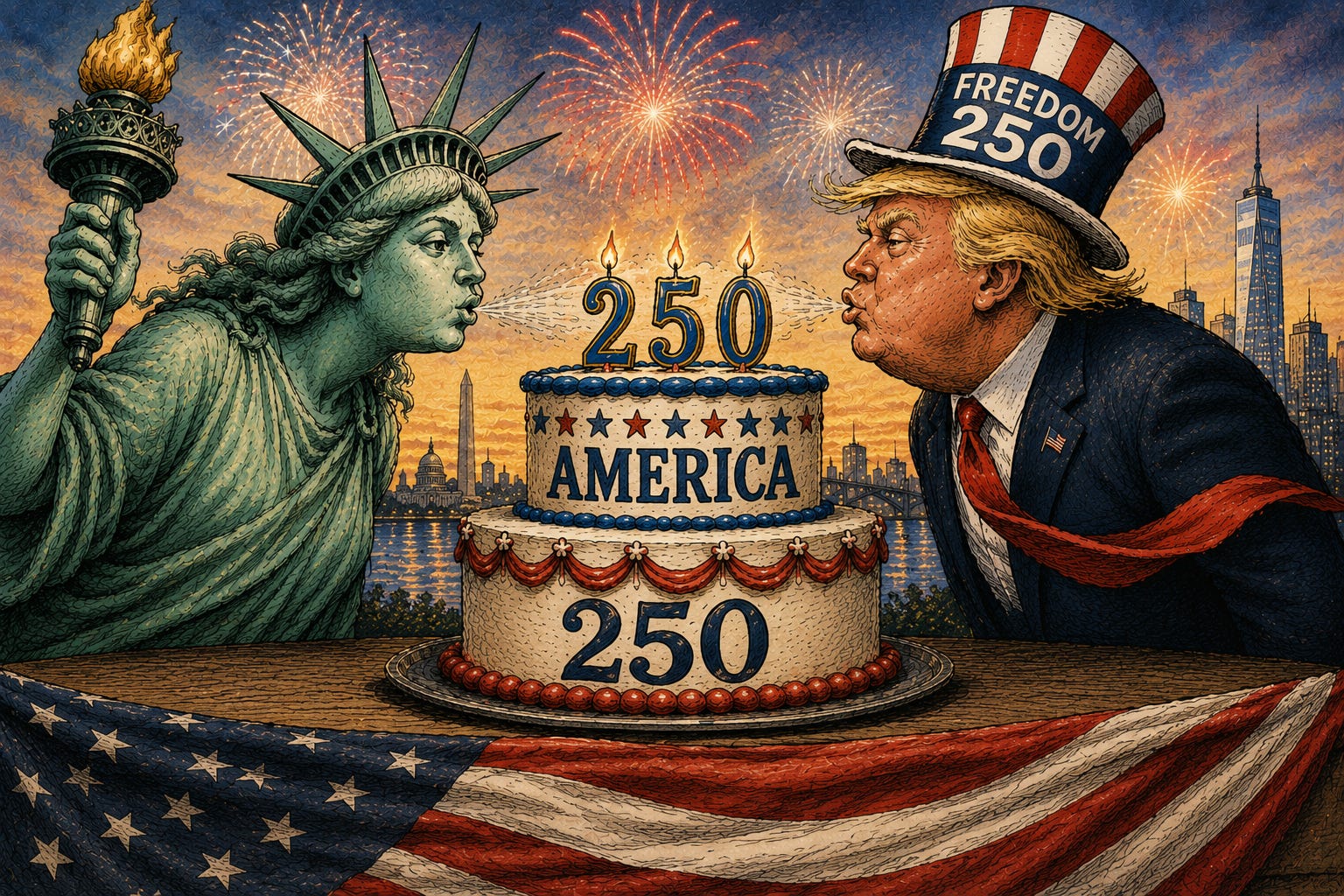
America at 250 is a rorschach Test
The party was hijacked, but the idea hasn't. It endures
As America marks its 250th birthday, I’m also celebrating the community we’re building here at Cosmopolitics. This has always been a place for people who want to think beyond the headlines and have smarter conversations about America’s role in the world—where we’ve been, where we’re headed, and why it matters. In honor of America 250, I’m offering 25% off an annual subscription through Sunday. I’d love for you to join us. It’s also a great time to give a gift subscription and invite a fellow traveler into our community.
Ask ten Americans what they feel about the country turning 250 this year, and you’ll get eleven answers. At least nine of them will really be answers about Donald Trump.
That’s not an accident. America’s semiquincentennial was supposed to be one of those rare moments when the country paused long enough to reflect on where it has been and where it is going. Instead, even the celebration became polarized. Congress created a bipartisan America250 commission nearly a decade ago to organize the anniversary. The Trump orbit responded with Freedom250, a parallel effort that has competed for donors, sponsors, and attention while House Democrats allege contributors were quietly steered away from the official celebration.
The result was almost inevitable. A national birthday became yet another referendum on one man. Before the candles were even lit, America at 250 had become a Rorschach test, revealing less about the country’s history than about how exhausted Americans have become by its politics.
The real missed opportunity isn’t that Americans can’t agree on what to think about themselves. It’s that they never really got the chance to try.
But there is a larger audience watching this anniversary unfold. For much of the past century, the rest of the world has treated America’s story as more than America’s story. Whether they admired it, resented it, or competed against it, countries measured themselves against an idea the United States projected: that democracy, openness, alliances, and individual liberty were not simply American values but aspirations with global relevance. America’s founding became part of the world’s political imagination.
Which makes this birthday worth asking a different question: What has America meant to the world—and what does it mean now?
The architect questions its own blueprint
For eighty years, America did more than dominate the international system. It helped design much of it. From the alliances, institutions, and security guarantees to the global financial architecture and the dollar’s central role, the assumption was that, whatever Washington’s mistakes, the United States intended to remain the indispensable power behind the system it built.
That assumption is now under review—not only in Washington, but everywhere else. The Economist recently described Trump’s foreign policy as a “wrecking ball revolution,” arguing that the United States is dismantling much of the order it spent generations constructing. The Trump administration itself makes much the same point, albeit approvingly. Its National Security Strategy declares that “the days of the United States propping up the entire world order like Atlas are over.”
But the more interesting story isn’t simply that America is stepping back. It’s what decades of American leadership taught everyone else.
Washington often described globalization as a force for peace and prosperity. In practice, it also demonstrated something else: interdependence creates leverage. Through sanctions, tariffs, dollar dominance, export controls, and its privileged access to the global financial system, the United States showed that if other countries depended on you, they could also be pressured by you.
The rest of the world took note. China has spent years building alternatives to American economic dominance. Russia has searched for ways around Western financial pressure. Iran uses shipping lanes and regional proxies to create its own forms of leverage. The lesson America taught the world wasn’t simply that interconnectedness creates stability. It was that interconnectedness creates power.
Today’s debate isn’t just about whether America still wants to lead the system it built. It’s about what happens when other countries begin applying the same logic.
Allies updating their emergency contacts
The evidence is no longer anecdotal. America’s allies are preparing for a future in which Washington may be less predictable, less engaged, or simply less interested.
A committee of Britain’s House of Lords concluded this year that the United Kingdom can no longer assume the United States will guarantee European security in the way it has for generations. A Pew survey across 36 countries found that roughly half of respondents no longer see the United States as a reliable partner, while nearly two-thirds believe it contributes little or nothing to global peace and stability.
Perhaps the clearest assessment came from former NATO Secretary General Anders Fogh Rasmussen, writing for the George W. Bush Institute’s own America250 series. The democratic world, he argued, is already preparing “Plan B” in case the United States abandons its traditional leadership role.
Notice who is saying this: Not Beijing or Moscow, but America’s allies. This isn’t triumphalism. It’s contingency planning—the geopolitical equivalent of quietly updating your emergency contacts, not because you want the relationship to end, but because you’re no longer certain someone will answer the phone.
The old postwar order probably isn’t coming back in its original form. Nor should anyone assume America will—or should—continue underwriting every alliance indefinitely. But that isn’t the same question as whether America still believes in the principles that made that order possible.
Trump’s answer has largely been transactional. Partnerships become deals. Security becomes something closer to a subscription service. Loyalty is measured less by shared purpose than by immediate returns. But rejecting the role of Atlas does not require abandoning the principles that made America’s leadership attractive in the first place. Those are different choices.
A country can ask allies to shoulder more responsibility while still defending democracy. It can reduce military commitments without abandoning human rights. It can stop trying to solve every international crisis without surrendering the belief that liberty and accountable government matter beyond its own borders.
Washington increasingly sounds as though it has decided to quit the first job before deciding whether it still wants the second.
America’s self-correcting mechanism
It’s tempting to read this anniversary as evidence of irreversible decline. History suggests something more complicated.
America has never been defined by the absence of contradictions. It has been defined by its willingness—however unevenly and painfully—to confront those contradictions. Slavery gave way to abolition. Segregation yielded, imperfectly, to the civil rights movement. Vietnam forced a reckoning over presidential power. Iraq prompted another over intelligence, intervention, and accountability. The point isn’t that America gets everything right. It’s that the country has repeatedly proved capable of arguing with itself, correcting course, and moving forward.
The distance between American ideals and American practice has always been real. But that gap has never been proof that the American experiment failed. It has been the mechanism through which the experiment keeps renewing itself.
Nadia Murad, the Yazidi genocide survivor who later became an American citizen and won the 2018 Nobel Peace Prize, captured that idea beautifully in an essay for the Bush Institute’s America250 project. America, she wrote, is “not a nation without contradiction, but one with the courage to confront it.”
For generations, America convinced the world that ideas matter and that democracies are capable of confronting their failures, arguing with themselves, and changing course. Perhaps that’s the better definition of American exceptionalism—not perfection, but the ability of a democracy to wrestle with its own contradictions and keep moving forward. Whether that remains true is the real question of America’s 250th birthday.
Happy birthday, America. The party may have been hijacked, but the idea hasn’t. It endures.
Three decades covering foreign policy has taught me one thing: the story is almost never as simple as your side wants it to be. That’s why I call balls and strikes without keeping score.
That means you get reporting and analysis that makes partisans on both sides a little uncomfortable. Clear-eyed, fact-based, and beholden to no one.
If that’s the kind of coverage you want to read- I hope you will take advantage of our holiday discount and subscribe.


It cannot be the case that the 250-year old democratic experiment is about to end. The midterms must be protected by enforcing democratic principles and constitutional rights against corrupt, authoritarian oligarchs. Otherwise, ninety-plus percent of Americans and their descendants are about to be seriously screwed.