

Ceasefire selfies in the Strait
We are entering the Iran war's slower, harder, less made-for-television phase

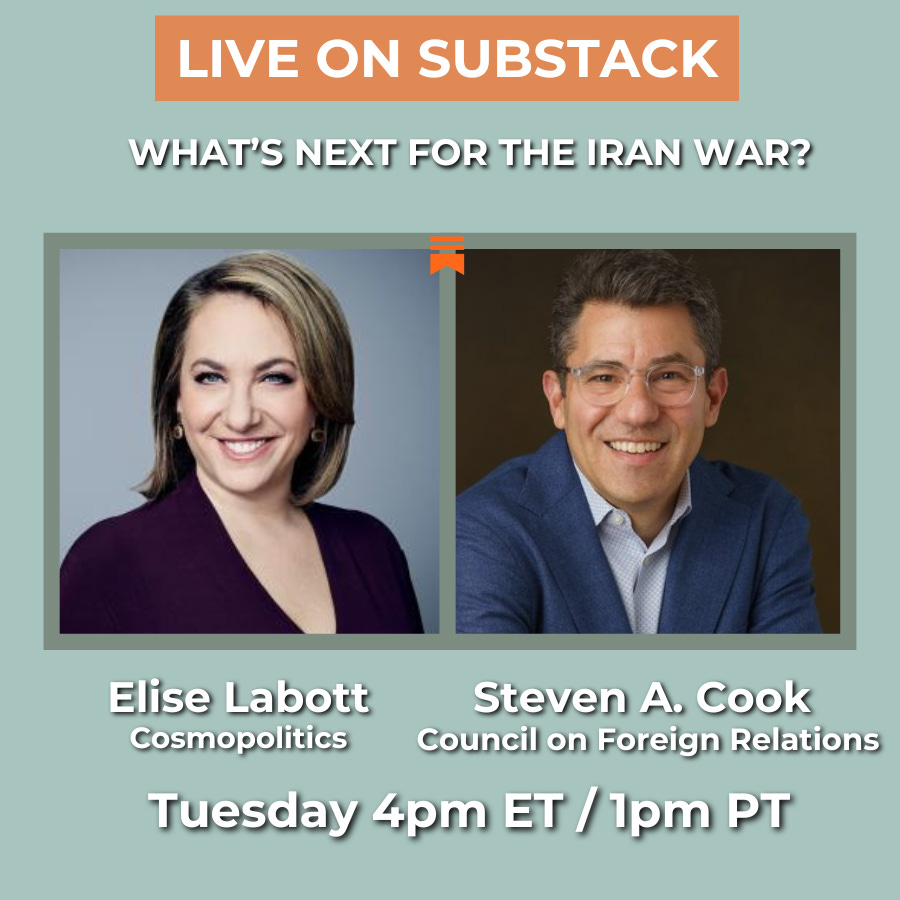
Friends: Steven A. Cook is back this afternoon to discuss the latest developments in Iran. If you’ve joined us before, you know Steven always delivers incisive analysis with supreme wit — and we might even have a laugh or two along the way. We hope you’ll join us TODAY at 4pm ET. Send us your questions in the comments.
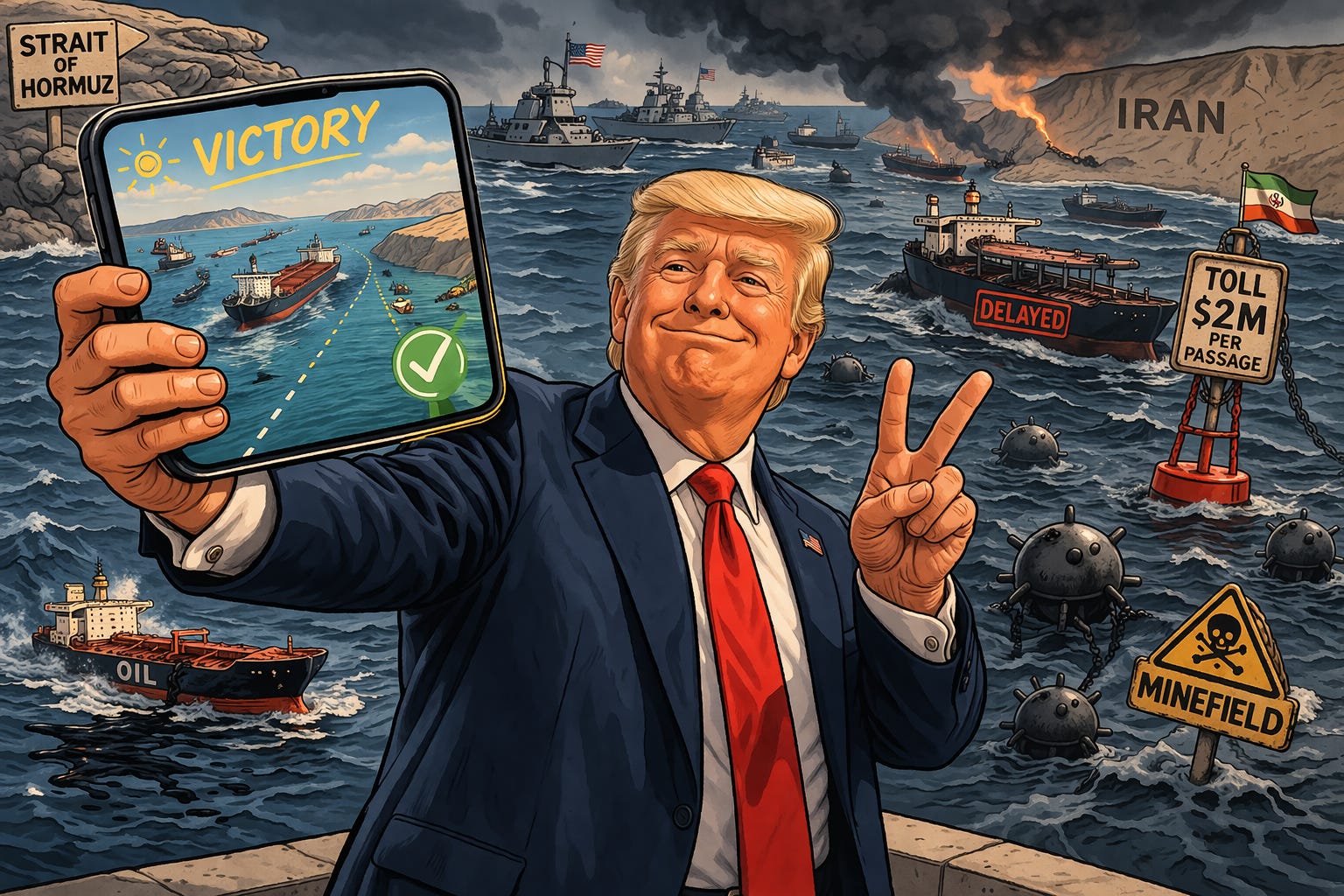
There’s a certain perverse genius to what Donald Trump tried to do at the Strait of Hormuz. Iran spent months turning the world’s most important oil corridor into a cash register — extorting ships a toll to pass through a minefield of Tehran’s own making, pocketing reconstruction money from a crisis it created. And Trump looked at it and thought: I want that.
For a brief, strange moment, the logic almost held. If you can’t clear the mines fast enough — and the Navy, embarrassingly, cannot; it has no serious mine-clearing capability to speak of and the Europeans aren’t helping — why not beat Iran at its own game? Stand up a competing safe corridor. Force buyers to pick a side: Tehran’s route or Washington’s. Winner takes the oil market.
It was the kind of move that makes sense for about thirty seconds, until you remember that America’s entire strategic position in the world was built on the opposite premise.
We are in a new phase of this war. The dramatic chapter — the strikes, the escalation, the moment when an American-Israeli operation changed the geography of Iranian power — is over. What comes next is grimmer and less legible: a blockade, a throttled strait, a slow squeeze on a global economy that was already limping. The question is no longer whether the U.S. can break Iran’s military capacity. It’s whether Washington can force open a waterway that Iran has effectively colonized through cheap, asymmetric pressure that didn’t exist before the war started.
Iran’s hold on the Strait was never really about military dominance. It was about psychology. You don’t need to sink tankers when you can spook the insurance market into refusing to cover them. You don’t need to fire missiles when a few mines and a toll booth are enough to redirect global shipping. Iran figured out, years before this war, that the cheapest form of leverage is uncertainty.
The ceasefire deal codified that arrangement. Under the peace plan brokered with Pakistani mediation, Iran and Oman retain the right to charge ships transiting the strait. Let that sink in: a month of American and Israeli bombardment, the death of the Supreme Leader, the closure of Hormuz to global commerce — and the settlement includes Iran keeping a tolling system that the U.S. Secretary of State, just weeks earlier, called “illegal” and “dangerous for the world.”
Yes, dear reader. Marco Rubio said that. Out loud.
The oil picture is what makes the politics almost impossible to manage. Markets are pricing in optimism. The analysts are less sanguine. The crude deficit runs to roughly 7 million barrels a day, with another 4 million in products. Every week the strait stays functionally closed, that gap compounds. The LNG crunch hitting Europe will arrive in the United States as inflation, not as a news story about someone else’s crisis. Trump keeps saying that when this is over, oil prices will come down. He’s not wrong. He’s just describing a scenario that could be a year or more away.
And yet, somehow, nuclear talks are back on the table. There’s a version of this you could tell charitably: the diplomatic track never fully dies, maximalist positions are opening bids, and Trump’s zero-enrichment demand is just leverage before a deal. Vance was already softening it in Islamabad — “maybe you can have the right but not enrich” — before Trump slapped it back to zero. The optimists say that’s negotiating theater.
Maybe. But here’s the question worth sitting with: what exactly is Iran negotiating from now?
Before this war, Iran’s nuclear program was the leverage. Centrifuges spinning, enrichment at 60 percent, a breakout timeline that kept Washington up at night. Iran’s leadership understood something the hawkish case for military action never fully grappled with: a nuclear program you haven’t weaponized yet is more valuable as a bargaining chip than as an actual weapon. The moment you test a bomb, you’ve cashed the chip. The moment the U.S. destroys your facilities, someone else has cashed it for you.
What Iran holds now is more immediately coercive. The Strait of Hormuz isn’t a theoretical future threat — it’s a live throttle on the global economy, one that doesn’t require enrichment timelines or IAEA inspections or arguments about breakout capacity. It requires a minefield and a willingness to hold the line. Iran has both.
So the question is whether Trump has, in the course of trying to eliminate Iran’s nuclear leverage, handed Tehran something more tangible — leverage that can be turned on and off depending on how negotiations are going. If the next round of nuclear talks happens, Iran will arrive at that table with a hand it didn’t hold before. The bomb was always hypothetical. The blocked strait is not.
Trump may genuinely believe he has Iran on the ropes. The list of targets hit, weapons destroyed and officials killed reads like victory if you don’t look too closely at the terms. But the terms matter. And the terms say that the country that just absorbed a month of American and Israeli bombardment gets to keep charging ships to pass through the world’s most important oil corridor while it rebuilds. If that’s losing, Tehran will take it.
Here is what the new phase actually requires. A credible multinational force to escort commercial shipping — not just U.S. destroyers trying to look confident, but a genuine coalition with standing and legal backing. Economic pressure calibrated to change behavior, not just to hurt. And a day-after plan for what Iranian governance looks like if the regime collapses under pressure from its own people — which is, at this moment, not a fantasy.
Unfortunately, the Trump administration has spent the better part of a year weakening the alliances and institutions that would generate it. NATO is managing its own trust deficit. Gulf partners are watching Washington and hedging. China, which buys most of Iran’s oil, has every incentive to keep the tolling system alive.
So what we have is a blockade that depends on resources America doesn’t fully have, enforcing rules the administration can’t consistently articulate, in a strait that Iran has already proven it can hold at a fraction of the cost.
Trump said on Truth Social that “big money” would be made by the U.S. “hangin’ around” the Strait of Hormuz — that it could be “the Golden Age of the Middle East.” That’s the verbal equivalent of a ceasefire selfie, a way of declaring victory before the conditions for victory exist.
The strait is not open. The mines are not cleared. The oil is not flowing. The peace plan being discussed gives Tehran a reconstruction fund and a tolling concession. The United States gets a pause in the bombing. That’s not a Golden Age. That’s a breather.
The question for the next phase — the slower, harder, less televisual phase — is whether the administration can build the coalition and the credibility to actually reopen the strait on terms that don’t simply transfer Iran’s leverage to the next crisis.
Words in hindi