

This is not the Wizard of Oz
The head of the snake is gone. What grows back is an open question

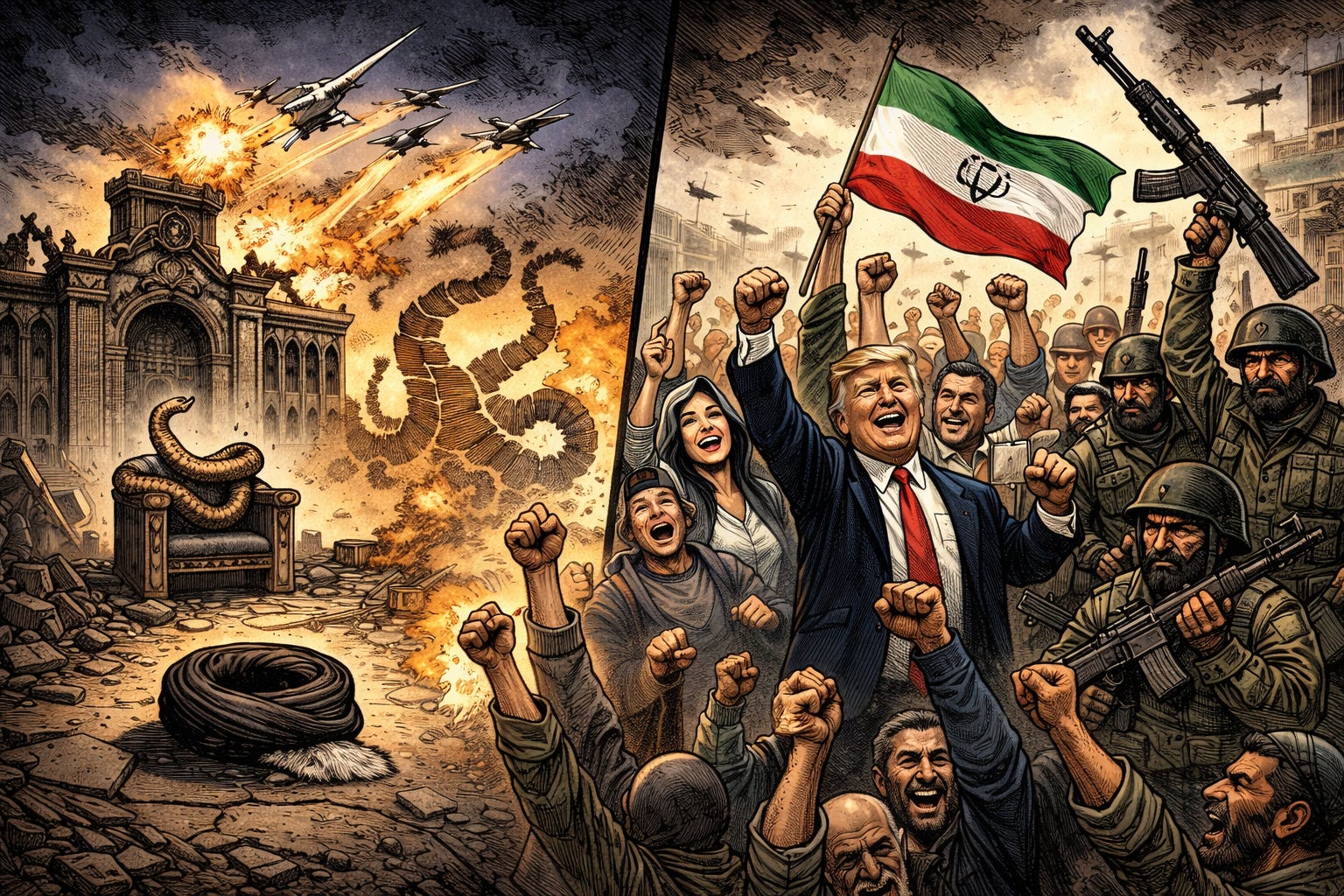
Let’s start with what everyone is thinking: Ayatollah Ali Khamenei’s death, like those of Hassan Nasrallah, Muammar Gaddafi, and Saddam Hussein before him, was earned. Karma, eventually, is a bitch. The man presided over the murder of thousands of his own citizens, funded terrorism that killed Americans across decades, and built a regional empire of destabilization and proxy violence. There are no tears here.
But satisfaction and strategy are different things. And right now, the United States has one without the other.
Iran has now confirmed what Israeli and American officials began signaling within hours of the opening strikes: the Supreme Leader is dead, killed in a joint American-Israeli operation targeting leadership gatherings across Tehran. It is an earthquake — the longest-serving dictator in the world, eliminated. For Iranians who have been shot, imprisoned, and tortured under his rule, and for the families of Americans killed by Iranian-backed terrorism, this is a moment of undeniable significance.
It is also not the end of the story. Not even close.
There will be plenty of time to examine how we got here and whether the threat was truly imminent enough to justify it. That accounting matters and it will come. But right now, with a window that will not stay open long, the most urgent question is not how we got here. It’s what we do next.
This is not the Wizard of Oz
Reports of celebrations in Tehran are real. So are reports of Revolutionary Guard forces firing on those same crowds. That split screen is your answer to anyone expecting a “ding dong the witch is dead” moment — where the regime simply melts away, Iranians join hands in the streets, and the Islamic Republic dissolves because its leader is gone.
It won’t happen that way. And anyone telling you otherwise hasn’t been paying attention.
When Gaddafi was killed, his regime collapsed with him — because Libya was a personal dictatorship built around one man. When Maduro was captured, Venezuela’s government was thrown into crisis for the same reason. Iran is different. The Islamic Republic is a revolutionary system, forty-six years old and institutionally entrenched. The Islamic Revolutionary Guard Corps controls the guns, the money, the oil, and the repressive apparatus of the state. It was built explicitly to outlast any single leader.
The CIA reportedly assessed before these strikes that even if Khamenei was killed, hardline IRGC figures were ready to step in — though, frankly, that is a scenario serious Iran experts have been predicting for years. Names like Ali Larijani — former head of the Revolutionary Guard, senior security official — are already circulating as potential successors. What fills the vacuum could be a more pragmatic figure. Or it could be a military junta with none of the theological constraints the ayatollahs nominally observed. An IRGC dictatorship replacing the clerical system is not regime change. It is a new problem.
The head of the snake may be gone. What grows back is an open question.
The missing piece
Trump called on the Iranian people to rise up. “Let’s see how you respond,” he said. “America is backing you with overwhelming strength and devastating force.”
But backing who, and with what, exactly? There is no credible, organized opposition force waiting to fill a vacuum. The civil society activists, the women’s rights organizers, the ethnic minorities, the monarchists rallying around Crown Prince Reza Pahlavi, the son of the former Shah — these groups exist but are fragmented, unarmed, and have not been meaningfully supported. The Trump administration spent the past year actively dismantling the tools that could have helped: defunding Iranian human rights groups, gutting Radio Farda, installing partisan leadership at Voice of America’s Farsi channel.
When Trump called on Iran’s military leaders to lay down their weapons, there was an implicit hope behind the request — that some within the IRGC and armed forces might break ranks and side with the Iranian people. It has happened before in other revolutions. It is not impossible here. But it doesn’t happen on its own. It requires cultivation, back-channel contact, and years of groundwork with potential defectors.
Bottom line: Trump told Iranians help was on the way. There is little evidence that the work has been done to make that promise real.
And for Iranians, American promises carry a very particular weight. In 1953, the CIA and British intelligence orchestrated a coup that toppled Mohammad Mossadegh, Iran’s democratically elected prime minister, and restored the Shah to power. That intervention became the founding grievance of the Islamic Revolution — the original wound around which the entire theocratic system was built. For nearly half a century, the regime has justified every act of repression by pointing to American interference. When an American president now promises liberation, Iranians hear it through that history. They want to believe it. They have reason to be cautious.
America’s record on regime change is zero for three. Iraq. Libya. Lebanon. In each case the military operation worked and the political plan didn’t exist. In Iraq, we disbanded the military and exiled the entire administrative class. The void was filled by sectarian militias and eventually ISIS. In Libya, we helped topple Gaddafi from the air, declared victory, and walked away. The country has been in civil war ever since. Iran is two and a half times the size of Iraq, with 92 million people, multiple ethnic groups — Kurds, Baluchis, Azerbaijanis, Persians — and competing visions for what comes next. The question is not only whether the regime falls. It’s whether Iran holds together as a country when it does, or whether it fragments into something even more dangerous.
Trump has shown little interest in the slow, unglamorous work of supporting democratic transitions. A “win” here could mean the same as it has in Venezuela so far: regime management that leaves Iranians to face whatever comes next largely alone.
A narrow window
Iran made a catastrophic miscalculation in its retaliation. Rather than confining its response to Israel and American targets, it struck six nations in the region, hitting civilian targets in Dubai and Doha. The Gulf states were never enthusiastic about this operation — Iran had a chance to drive a wedge between Washington and its Arab allies. Instead it attacked them. That is not strategic thinking. That is panic. And panic at the top creates cracks.
Those cracks are a window. A narrow one that will not stay open long. This is the moment to work urgently with the Iranian opposition — to help credible voices find each other, communicate, and organize. Only the Iranian people can ultimately change this regime. It cannot be done with airstrikes. But the outside world can create conditions that give Iranians a fighting chance. The United States has not done that work. It needs to start now, today, while the window is open.
Was this necessary now?
That question deserves an honest answer, and the honest answer is: not obviously. The threat posed by Iran is real, no question. But it was not presenting an imminent threat to the United States. The most alarming intelligence claim floating around — that Iran could have an ICBM capable of hitting the American homeland — was a straight-line projection to 2035, not an imminent danger. Secretary of State Marco Rubio spent weeks laying the rhetorical groundwork for “preemptive” strikes, but preemptive implies a ticking clock that the intelligence did not entirely support.
What appears to have actually happened is that diplomatic talks in Geneva collapsed. Trump’s envoys came back from nuclear talks last week empty-handed — the Iranian proposal was insulting and nowhere near acceptable to the Americans — and the diplomatic off-ramp closed. “My preference is to solve this problem through diplomacy,” Trump said at the State of the Union, just days ago. When diplomacy failed, he went to the maximalist option.
When asked weeks ago what his endgame was, the President said simply: “To win.”
That is not a strategy. Winning means something different if the objective is nuclear disarmament, something different if it is degrading Iran’s missile capability, something different again if it is regime change. Each carries a different price, a different timeline, a different definition of success. Right now, those objectives are being conflated - and that conflation is dangerous.
“I have several off-ramps,” Trump told Axios’ Barak Ravid on Saturday. “I can go long and take the whole thing. Or I can go on for another two or three days and tell the Iranians: we’ll see you again in a few years if you try to rebuild.” It suggests Trump is thinking about this less as a war with a defined endpoint and more as a demonstration of consequences, with the terms still being written in real time.
What comes next
The strikes are not over. The Strait of Hormuz remains at risk — 20 percent of the world’s oil moves through that corridor, and Iran still has the ability to threaten it. Hezbollah retains significant missile capabilities to Israel’s north. Terrorism against American citizens and diplomatic targets abroad is a live possibility. The USS Gerald R. Ford is positioned in those waters for a reason. Fifty thousand Americans are in harm’s way. Whatever your politics — say a prayer.
Khamenei’s death is significant. His removal, like Nasrallah’s before him, does real damage to the architecture of Iranian power and has the potential to result in a dramatic reshaping of geopolitics in the Middle East.
But the Revolutionary Guard is still armed. Nuclear material is still somewhere underground. The opposition is still fragmented. And the United States — with Israel as its only declared partner, no coalition, no congressional authorization, and no public strategy for the morning after — is at the beginning of the beginning.
The Iranian people deserve the world’s support. The brutal regime they have lived under deserves to fall. That much is clear. What is not clear is whether Trump’s approach will help them or harm them. His rhetoric has raised expectations he may not meet.
The history of American promises to Iran is not a happy one — and Iranians know that better than anyone.They’re hoping this chapter ends differently.
Thank you for this great article, Elise!
Very smart and informative piece.