


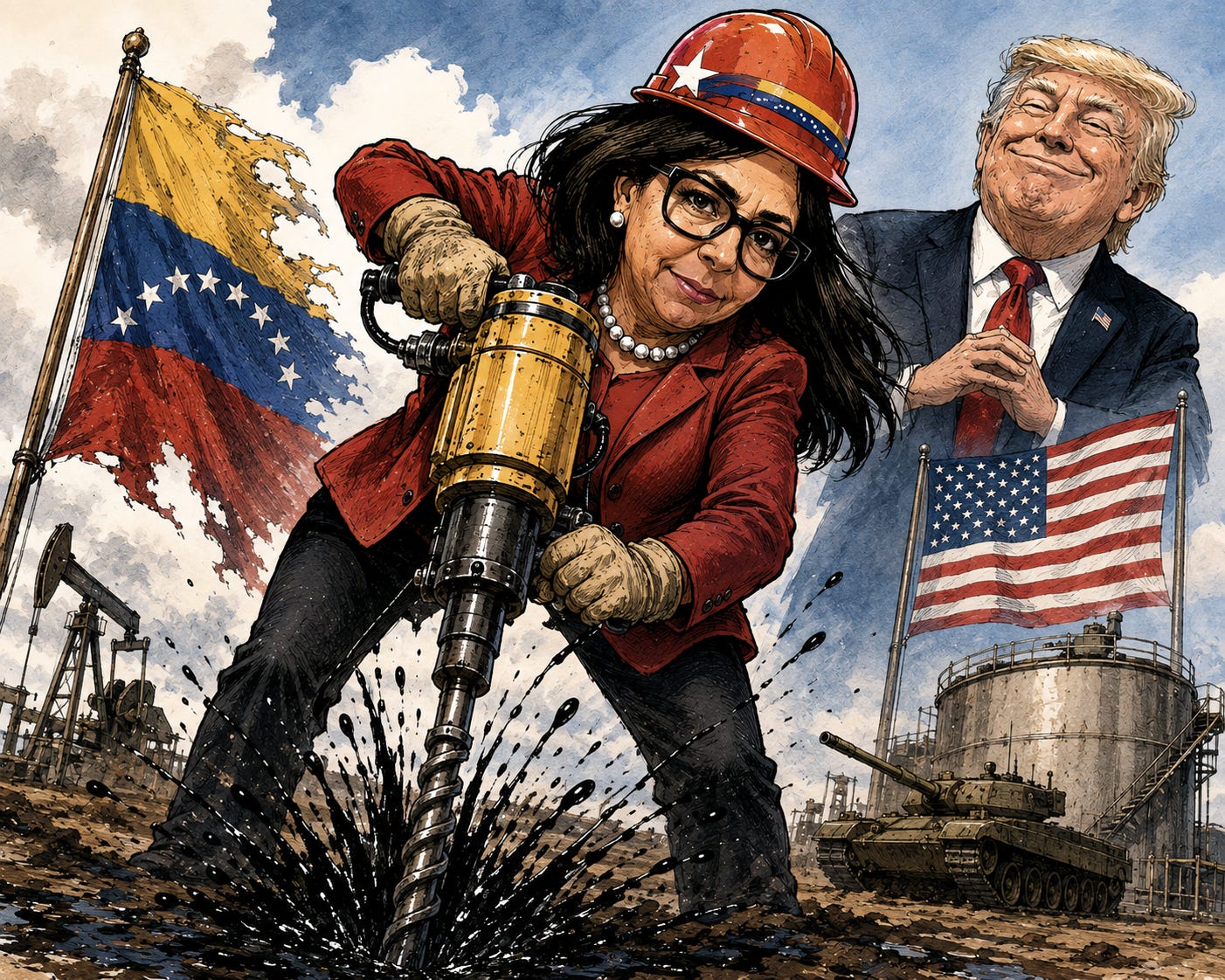
Nine months after U.S. forces captured Nicolás Maduro, Trump announced what he’s calling the “biggest oil deal in world history,” giving Americans majority control over a venture involving some 65 billion barrels of Venezuelan crude. When American oil companies considered Venezuela too risky and failed to move, the administration apparently decided the U.S. government could become the investor itself, with the Pentagon helping to finance the venture.
This isn’t Chevron, currently the only major U.S. oil company actively producing in Venezuela, signing another production contract. The administration created an arrangement involving a private Venezuelan company through which the U.S. government would obtain a majority stake and access to oil from 17 strategic fields.
Venezuela’s interim president, Delcy Rodríguez, said the agreement runs 25 years, with an initial goal of pushing production above 1.5 million barrels per day and turning the country “into an oil-producing power, for the benefit and happiness of the Venezuelan people.”
The federal government doesn’t normally own stakes in foreign oil ventures, nor does America have a national oil company the way Saudi Arabia has Aramco or Mexico has Pemex. The Trump administration reportedly turned to the Pentagon’s Office of Strategic Capital, an entity designed to finance national-security priorities, to help solve the problem.
So our president isn’t merely asking American companies to return to Venezuela. His government is trying to make Venezuela investable by putting the power and money of the American state behind them.
But reserves aren’t inventory. Trump talks about 65 billion barrels as though somebody just discovered a gigantic Strategic Petroleum Reserve beneath Caracas. The oil has to be drilled, pumped, transported and refined. Venezuela’s infrastructure has deteriorated after years of mismanagement, underinvestment and sanctions, and will require billions in investment to significantly increase production.
The consensus among oil analysts is that meaningful production gains are measured in years, not months, and the barrels capable of actually moving U.S. pump prices could be five to 15 years away. All of this is awkward because Trump needs cheaper gasoline before November, not sometime during the second term of President Whoever-Comes-Next.
There’s also the Iran problem, which Trump started and now needs Venezuela to help him solve. The Strategic Petroleum Reserve has fallen sharply amid supply disruptions from that very conflict, and Trump now says Venezuelan crude will help refill it. Call it vertical integration: start a war that drains the reserve, then launch a separate intervention to top it back off. It’s the foreign policy equivalent of borrowing from one credit card to pay off another - except the collateral is a foreign country’s oil fields.
Frankly, whether the oil ever arrives isn’t the deal’s biggest problem to me. I need gas and am going to fill my car regardless. I’m more concerned about whether America has the authority to take the oil and who in Venezuela had the authority to give it away.
Delcy Rodríguez wasn’t elected president - she became interim leader after U.S. forces removed Maduro. Yet before Venezuelans have elected his replacement, her government is locking in an enormous economic arrangement governing the country’s defining national resource, potentially for decades, with the country that put her in power.
That’s what makes the deal so revealing. We were told Maduro had to go because of drugs, security, authoritarianism and the threat his government posed. Well, Maduro is gone, but much of his governing apparatus isn’t. Rodríguez was his vice president; now she could arguably be considered Washington’s partner. And before Venezuelans have had a chance to choose their next president, the government left behind by Maduro has struck one of the largest resource agreements in modern history with the country that removed him.
The opposition understands the problem. You can’t build a durable oil economy without elections, rule of law and legitimate institutions. Why should the next government honor a generational agreement negotiated by an unelected predecessor, no matter how much has already been invested?
Now let’s widen the lens. The Pentagon becoming financially invested in foreign oil production raises another question entirely. The institution responsible for applying American military power would now potentially have a financial interest in an industry located in a country where American military power just removed the president. Meanwhile, our own secretary of state has emerged as the de facto power broker overseeing Venezuela’s transition, with the old president’s deputy serving as Washington’s partner on the ground. That doesn’t really need much editorializing.
For something Trump calls the largest oil deal in history, an astonishing number of basic legal and contractual questions remain unanswered - about how it was awarded under Venezuela’s constitutional framework and about the absence of a competitive process or meaningful transparency. We are still waiting for the administration to convincingly answer those questions.
Two years ago, I wrote that Latin America had become Washington’s overlooked wallflower - noticed only when migrants arrived at the border or cocaine arrived in Miami, while China understood that infrastructure, commodities, technology and trade made the region strategically important. Trump apparently agrees with me. I just wish he hadn’t taken the lesson quite so literally.
This is being sold as an energy deal, but it’s really another window into his emerging doctrine for the Western Hemisphere. Trump is correcting decades of American neglect of Latin America by resurrecting an equally old American mistake: confusing engagement with dominion. It’s the same spheres-of-influence logic Washington condemns when Russia applies it to Ukraine or China applies it to Taiwan.
Maybe Venezuelan oil eventually does flow in huge quantities to American refineries, and American investment helps rebuild a country whose leaders spent decades destroying its greatest economic asset. That would be good for Venezuelans and good for the United States.
But if Washington really wants Venezuela to become a stable American partner, the one commodity more important than oil is legitimacy. And we can’t drill our way to that.
Three decades covering foreign policy has taught me one thing: the story is almost never as simple as your side wants it to be. That’s why I call balls and strikes without keeping score.
That means you get reporting and analysis that makes partisans on both sides a little uncomfortable. Clear-eyed, fact-based, and beholden to no one.
If that’s the kind of coverage you want to read- I hope you will support my work and subscribe.
You with these pictures are genius and brilliant.!!!!!!!!!!!!!