


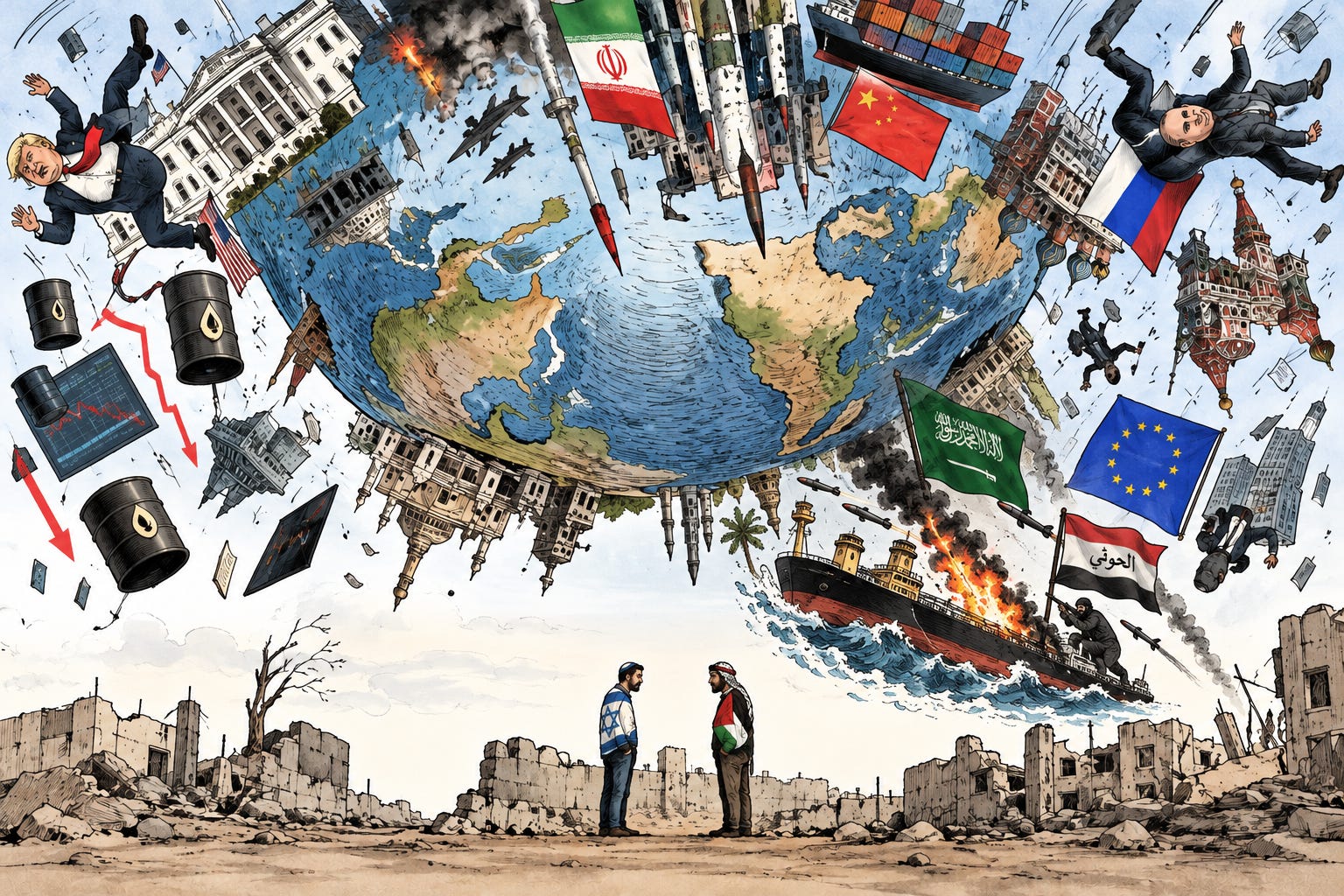
For an event that turned the Middle East upside down , the anniversary of the October 7 attacks barely registered beyond Israel this year.
The world was too busy worrying about Iran, gas prices and what another Middle East war might mean for the American midterms to dwell on how we got here.
Here’s the thing: The world hasn’t moved on from October 7. It’s just moved on to everything October 7 unleashed.
Three years later, Israel has done what few thought possible. It has decimated Hamas and Hezbollah, battered Iran and emerged as the undisputed military heavyweight of the Middle East. The wars unleashed by Hamas’s attack have shaken governments, upended alliances, disrupted the global economy and even rewritten the politics of Israel’s closest ally, the United States.
Quite a return on three years of war.
For decades, Iran built a network of armed proxies to keep Israel under threat while keeping the fighting away from its own doorstep. Israel turned that strategy on its head. Hamas and Hezbollah lost their leaders and much of their fighting power, giving Lebanon’s government its best opportunity in decades to wrest control from Hezbollah. And the war finally reached Iran itself. Tehran spent decades building a regional deterrent. Israel dismantled much of it in three years.
But Israel’s victories have consequences far beyond the battlefield. Unable to match Israel or the United States militarily, Tehran has demonstrated that it can still wreak havoc on the global economy. Threats to shipping through the Strait of Hormuz, coupled with Houthi attacks near the Bab el-Mandeb, have disrupted energy markets and trade routes around the world.
Gulf powers, increasingly wary of depending on Washington to protect them from a conflict they didn’t start and couldn’t control, are forging new security partnerships. The upheaval has also created openings for Russia and China as American allies reconsider their security.
So yes, Israel did what it set out to do: It transformed the regional balance of power. What it hasn’t figured out is how to turn that military dominance and the tectonic geopolitical shifts it unleashed into lasting security — or how to keep winning wars without losing friends.
In some ways, it’s moving in the opposite direction. The devastation in Gaza and Israel’s policies in the West Bank have made it increasingly difficult for even its closest partners to defend its actions. Arab governments may be quietly celebrating Iran’s humiliation, but they’re hardly lining up to embrace an Israel that seems increasingly willing to use force whenever and wherever it deems necessary.
For decades, Israel could count on bipartisan American support almost as reliably as it could count on its own military. Not anymore. On the left, criticism has moved well beyond Netanyahu to questions about the occupation, Palestinian rights and whether American military assistance should come with conditions. On the America First right, Israel is increasingly being asked to justify why it deserves special treatment when every other foreign commitment is under scrutiny.
The military alliance remains exceptionally strong. But the political consensus beneath it is cracking, and Israel would be foolish to assume that American support is an inexhaustible resource.
October 7 also unleashed a wave of antisemitism that had clearly been lurking much closer to the surface than many of us wanted to believe. As the war in Gaza unfolded, outrage over Israel’s actions became entangled with old prejudices about Jews. Jews thousands of miles from Israel were held responsible for the decisions of an Israeli government they never elected, while accusations of antisemitism were increasingly used to dismiss legitimate criticism of the devastation in Gaza.
Somewhere along the way, acknowledging the suffering of Israelis became, for some, a betrayal of Palestinians. And acknowledging Palestinian suffering became, for others, a betrayal of Israel. Compassion has become a zero-sum game in a world of selective humanity.
Trump’s Board of Peace offers the first serious opportunity in years to give Palestinians control over their own future. But it’s hard to build a future in Gaza when there’s barely anything left to build on, or to talk about Palestinian statehood while Israel steadily makes it less possible in the West Bank.
Palestinians also have a responsibility to shape what comes next — to build accountable leadership capable of governing, rejecting violence and offering their people a future defined by more than resistance to Israel.
Israelis have paid an enormous price to feel safe again; Palestinians have paid an enormous price for a war that has left them further from freedom. Three years later, both are still waiting for something that looks like peace.
For all the extraordinary changes October 7 unleashed, one stubbornly ordinary fact remains: Israelis and Palestinians still have to live next to each other. Neither is going anywhere. Neither can bomb, blockade or wish the other out of existence.
Israel has never been more capable of imposing its will on the Middle East. Whether it can build a future in which it doesn’t have to keep doing so is another matter.
Three decades covering foreign policy has taught me one thing: the story is almost never as simple as your side wants it to be. That’s why I call balls and strikes without keeping score.
That means you get reporting and analysis that makes partisans on both sides a little uncomfortable. Clear-eyed, fact-based, and beholden to no one.
If that’s the kind of coverage you want to read- I hope you will support my work with a paid subscription.
Why are you trying to confuse people with facts?
That's a really good piece, but I think that strategically speaking both Israel and America are worse post October 7 - Israel is losing its closest ally (definitly under the Netanyahu government) which is the source of our national power while all our enemies are still standing, and America has been exposed as a world power who cannot take out the weakest of its enemies, all while pushing oil prices up and expanding too many munitions that could have been reserved for a war over Taiwan.