


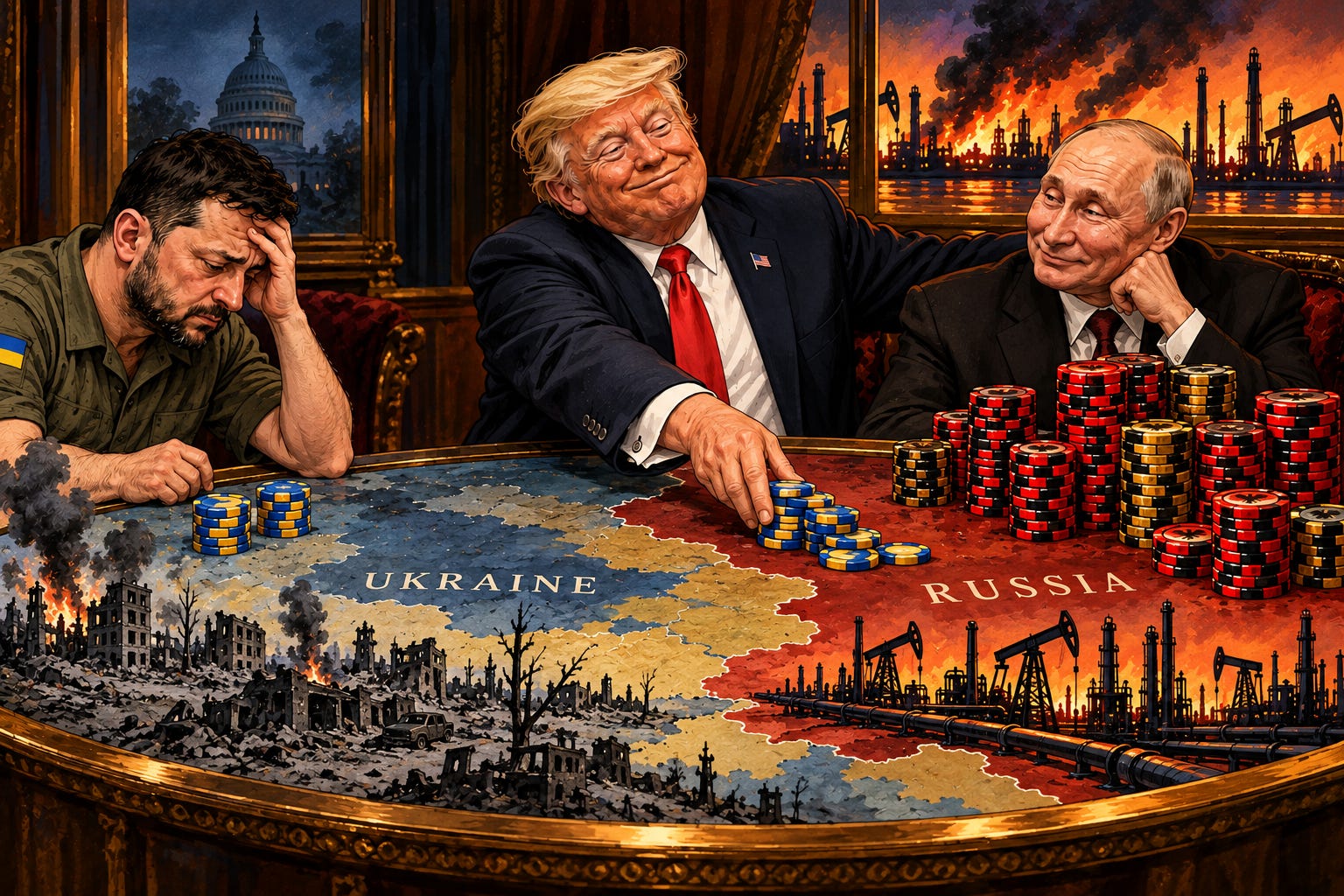
President Donald Trump says Russia and Ukraine have agreed to stop attacking each other’s energy infrastructure.
How does he know? “They agreed because I said they agree,” he told reporters this week.
Apparently nobody told Ukrainian President Volodymyr Zelenskyy, who learned about his own ceasefire on social media. Or Vladimir Putin, whose forces continued launching missiles and drones at Ukrainian cities and power plants, killing civilians and leaving hundreds of thousands in the dark.
That’s the logic of Trump’s latest push to end the war: lean on the side that’s listening. He has demanded that Kyiv stop hitting Russian oil refineries, threatened to restrict American intelligence-sharing and suggested Ukraine find itself a new president, one more willing to make a deal.
Ukraine has spent this war outmanned and outgunned. But its campaign against Russian refineries has made Russians feel the war. It has caused lines at the pump and forced one of the world’s biggest diesel suppliers to suspend exports. Russia’s oil and gas tax revenues have also fallen 17 percent this year, although refinery strikes are only part of the explanation.
Kyiv can’t outfight Putin, but it can make the war more expensive. That’s called leverage. Trump is stripping the Ukrainians of what little they have, while handing Moscow every reason to wait them out.
Then came the missiles. For two straight nights since Zelenskyy disclosed the threat to suspend intelligence-sharing, Russian ballistic missiles have hit Kyiv. Each time, he says, Ukraine got no warning from its partners. He didn’t name Washington. He didn’t have to. Trump insists intelligence is still flowing, and a senior Ukrainian official blamed a “failure,” possibly the weather, rather than a deliberate cutoff. Maybe so. But early warning is exactly what Washington is supposed to provide.
Declining to help Ukraine hit targets inside Russia is one thing. Whether Washington is still reliably warning Ukraine about incoming missiles that threaten civilian lives is another question entirely.
So why squeeze Kyiv? The war with Iran has disrupted shipping through the Strait of Hormuz and pushed diesel to $6.27 a gallon, up more than 70 percent in a year, three weeks before the midterms. Trump needed someone to blame. He chose Ukraine.
His fix is to ease sanctions on Russian diesel exports, including shipments to the United States. Last week he undercut a sanctions law he signed just last month, one championed by his late friend, Senator Lindsey Graham. Twelve senators from both parties want the deal scrapped, warning it bankrolls Putin’s war. Economists say it won’t do much for American drivers, either. One estimate puts Russia’s November pledge at about one day of U.S. diesel demand.
Putin, in other words, is profiting from two wars at once. The Iran war pushed oil from around $60 a barrel to over $100 and drained the Patriot interceptors Ukraine needs to protect its cities. Ukraine’s refinery strikes were one of the few things cutting into that windfall. Now Trump wants them stopped, too.
Then there’s the ceasefire that wasn’t. Zelenskyy offered a simple trade: Ukraine stops hitting Russian energy if Russia stops hitting Ukraine’s. The White House wants Ukraine to go first. Trump’s truce also reportedly covers only oil refineries. Russia has plenty of those. Ukraine has one major refinery, and Russia knocked most of it out years ago. So Kyiv gives up its best weapon and Moscow gives up... nothing.
Ukraine says it has stopped striking Russian refineries. Russia keeps pounding the power plants that will keep Ukrainians warm this winter. Only one side, it seems, got the memo.
Not to worry. “Bottom line, it’s going to work out,” Trump posted. “You know why? It always does.”
Trump has enormous leverage over Kyiv, which depends on American weapons, intelligence and diplomacy. He has leverage over Moscow too, starting with the sanctions he is now easing. He is using the first and shelving the second. He can pressure Zelenskyy to comply, but he cannot simply declare that Putin has agreed and expect Moscow to fall in line.
You don’t need to divine Trump’s motives to see who benefits from his approach. Right now, it’s Putin.
Sanctions relief is only the start. Trump plans to host Putin in December at the G20 summit at his own golf resort in Doral, Florida, potentially giving the Russian leader his first multilateral summit in a Western country since the invasion.
And for an America First president, Trump has been remarkably quiet about Russian strikes on Ukrainian facilities tied to American companies, including Coca-Cola, PepsiCo and McDonald’s. The American Chamber of Commerce in Ukraine sought a meeting with Steve Witkoff and Jared Kushner but says it never heard back.
To be fair, Washington hasn’t abandoned Kyiv. For now, Ukraine still gets American intelligence and weapons. But Trump is holding them over its head, and the threat alone weakens Kyiv’s negotiating position.
There is a legitimate case for ending this war. No one wants the fighting to stop more than Ukrainians. But wars don’t end because an American president says so. They end when the side who started them decides the fight costs more than it’s worth.
Putin is betting he can outlast Ukraine and its Western backers. Economic pain, battlefield setbacks and the prospect of more losses are among the few things that might change his mind.
Stripping Ukraine of the means to inflict them isn’t how you build leverage over the Kremlin. It’s how you give it away.
Three decades covering foreign policy has taught me one thing: the story is almost never as simple as your side wants it to be. That’s why I call balls and strikes without keeping score.
That means you get reporting and analysis that makes partisans on both sides a little uncomfortable. Clear-eyed, fact-based, and beholden to no one.
If that’s the kind of coverage you want to read- I hope you will support my work by subscribing.
I'm continually impressed by Ukraine's resolve and its innovation. Rather than working against Ukraine, we should be supporting them and learning from them. Their use of AI and drone warefare is bleeding edge. We have the opportunity to do what is morally right and strategically forward thinking by allying with Ukraine. We would rather benefit an autocrat to pass blame for our own failings.