


Friends: The piece below was published today as a Washington Post guest essay. With things heating up again in the Strait of Hormuz and Trump now threatening Oman, the Red Sea angle feels especially timely — but it’s one we aren’t hearing nearly enough about.
Since the war began, Hormuz has been the fear everyone named. The quieter threat is playing out in the Red Sea, thanks to the Houthis, who are emerging Iran’s strongest remaining surrogate. Washington still sees them primarily as a military threat and is missing their strategic evolution.
This is what you get with Cosmopolitics: reporting and analysis that challenges conventional wisdom and gets beyond partisan talking points. Isn’t that the kind of journalism you want to support?
The response to my birthday sale has been overwhelming, so I’m extending it through the week. I’ve heard you: everything costs more, money is tight and the subscriptions are piling up.
So $25 gets you a year of Cosmopolitics — forever. Just over $2 a month. You can’t even ride the Metro, subway or Tube for that!
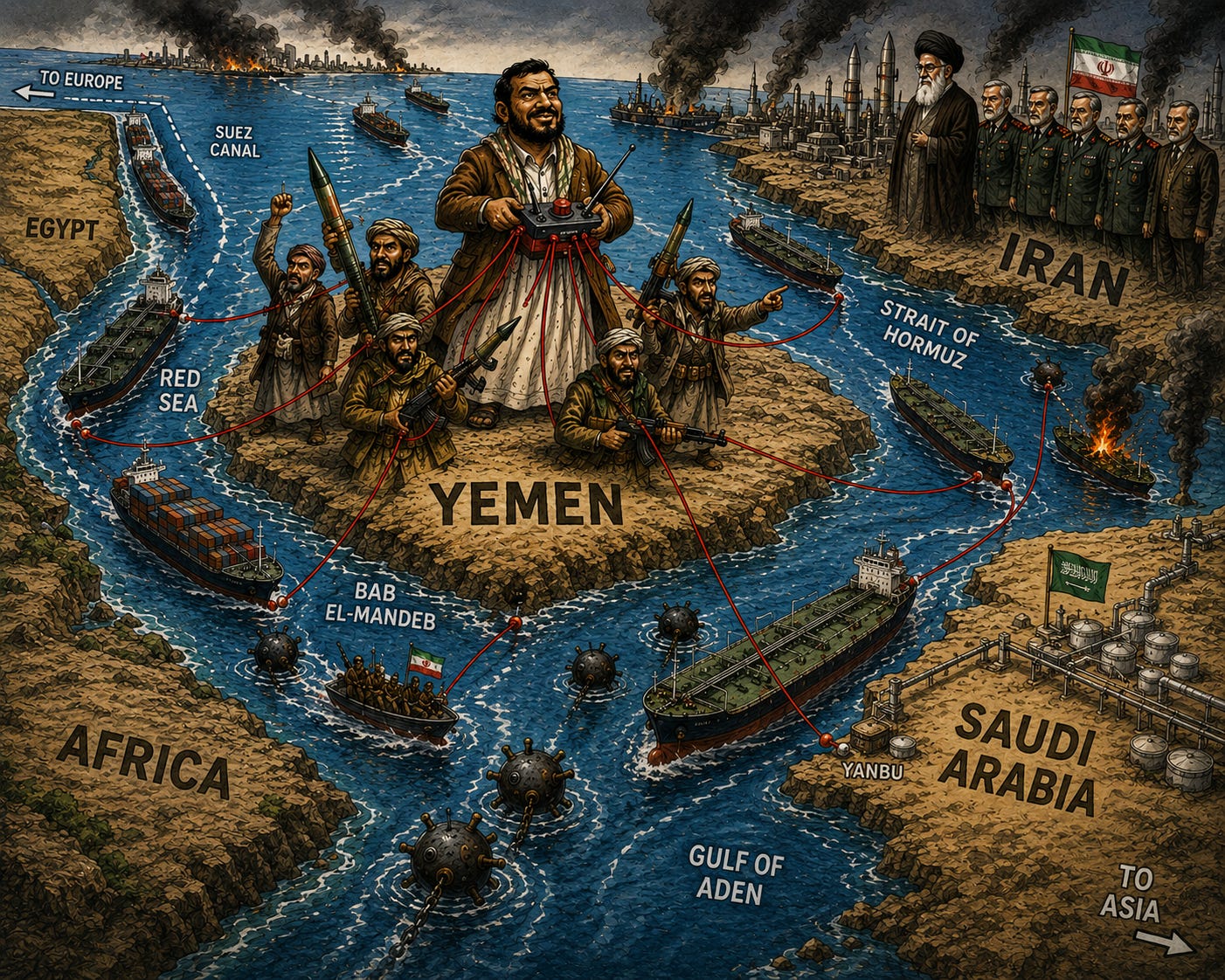
Last month, Yemen’s Houthi militia declared a maritime blockade of Saudi Arabia. Saudi tankers in the Red Sea rerouted north to Yanbu, and earlier this month, the group’s attacks reached them there.
But Yanbu isn’t just another Saudi port. It is the kingdom’s insurance policy: the terminus of a pipeline that carries Saudi crude to world markets without ever touching the Strait of Hormuz. That route now carries more than 80 percent of the kingdom’s roughly 4.6 million barrels of daily exports, and Riyadh is working to link other Gulf oil producers to the same line. Shippers have already fled both routes — proof that the Houthis are central to Iran’s ability to weaponize the global economy, even as Washington struggles to keep up.
Globalization depends on a small number of choke points — Hormuz, Bab el-Mandeb, Suez, Panama Canal, the Taiwan Strait — and none of them need to be seized to become leverage. Washington long assumed that if these vulnerabilities were weaponized, it would be by China or Russia. Instead, the Houthis got there first. Washington is still treating them as a military threat and missing their strategic evolution — under the mistaken assumption that insurgent groups don’t develop interests of their own, or the patience to act on them.
Before the war, Hormuz carried 130 to 140 ships a day; on Aug. 11, traffic fell to eight, according to Reuters. Bab el-Mandeb traffic fell from 20 ships to one. Days earlier, the Houthis had struck Red Sea facilities owned by Aramco, Saudi Arabia’s state-owned oil company; striking Yanbu itself underlined the point. An informal understanding sparing Saudi ships has technically held since shortly after Oct. 7, 2023. But Houthi spokesman Yahya Saree now says operations against Saudi shipping will “continue and escalate.”
The Houthis inserted themselves into this war at the moment their leverage was greatest, but aimed most of it at Saudi Arabia, not the United States or Israel — a deliberate choice that keeps the fight contained to a war they believe they can win.
April Longley Alley of the Washington Institute for Near East Policy told me the timing reflects both Saudi Arabia’s new vulnerability and the Houthis’ own ambitions: With the peace process stalled, they see a chance to press Riyadh for concessions that would help them consolidate control at home and expand their reach beyond Yemen. “They know they have a strong hand to play,” Alley says, “so they’re going to see how much they can get.”
Gregory Johnsen, a nonresident fellow at the Arab Gulf States Institute who tracked Iranian arms shipments to the group on the U.N. Security Council’s Yemen panel, told me he considers the Houthis “more of a junior partner” to Iran, rather than a proxy. The distinction comes down to agency — Iranian support has expanded Houthi capabilities dramatically without ever buying control over their decisions. Years of war built a self-sufficiency the rest of Iran’s network never achieved: their own weapons production, command structures and political relationships, negotiating directly with Saudi Arabia and even Washington when it served their interests.
Hezbollah was long regarded as Iran’s most capable surrogate, largely on the strength of its arsenal. That’s no longer the only measure of influence: The Houthis command one of the world’s busiest maritime corridors, and geography can matter as much as firepower. The longer route around the Cape of Good Hope adds more than a week to each voyage, so the same ships can complete fewer trips — effectively shrinking global container shipping capacity by 15 to 20 percent, without a single vessel being taken out of service. Suez Canal tonnage, meanwhile, last year remained roughly 70 percent below levels from before late 2023, when the Houthis began attacking Israel-linked shipping in the Red Sea in solidarity with Gaza. All this was achieved by a group with no navy.
It’s a bitter pill for Riyadh. Saudi Arabia fought the Houthis for nearly a decade, and criticism of the civilian toll helped end that war in 2022 with the group still standing. Some officials gripe privately that had they finished it, the Houthis wouldn’t pose the same threat today.
Saudi Arabia wants to finally break that leverage and strip away one of Iran’s last functioning sources of regional power. But Riyadh can’t do it alone. It’s playing this quietly and publicly at once: quietly, funding and pushing Yemen’s fractured anti-Houthi forces toward a ground offensive the kingdom won’t lead, while at the same time assembling a multinational maritime coalition to secure passage through the Red Sea. Washington has made clear to Riyadh that it sees Iran as the central threat and doesn’t yet consider the Red Sea a priority. By the time that changes, the Houthis may have made it one — and this time, there won’t be a backup plan.
Great reporting.
Ms. Labott, has your reporting determined if the Military, or some other, advised Trump that the Iran campaign would open this can of worms? The current operation had a good chance of success if there were resolve to finish it. But alas, I suppose resolve is so last century. Take care.