In Iran, a promise Trump can't wing
The Iranian people need real help , not a stunt.
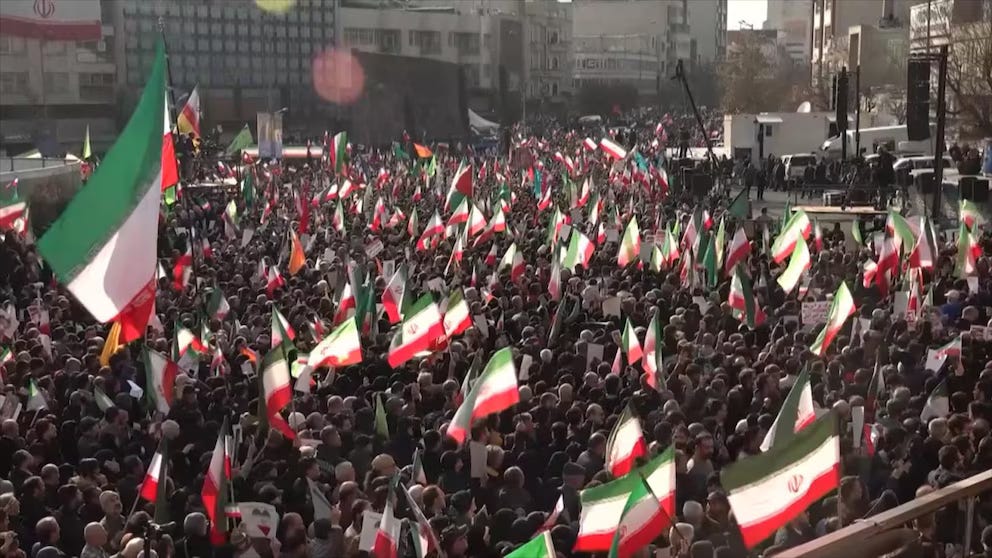
The images coming out of Iran, despite an internet blackout designed to keep the world blind, suggest something chilling and historic: a country in open revolt, and a regime answering with bullets, prisons, and silence.
As many as roughly 2,500 people are estimated to have been killed. Thousands have been arrested. Families are searching for the missing. The government is trying to sever the movement from itself - locking down communications, flooding the public with propaganda, and branding protesters as terrorists backed by foreign powers.
This is not just repression. It is murder. It is state violence intended to terrify a population back into submission. And now President Trump is signaling that the United States may intervene.
Trump has escalated his rhetoric in recent days, hinting at “strong options,” suggesting Washington could respond to the crackdown, and pairing his threats with new pressure meant to isolate Tehran. His posture is straightforward: the killings must stop, and he is willing to raise the stakes.
On one level, his instinct is right. The people are making a clear call for an end to the Iranian regime and it should fall. The world has watched brave protesters rise up for decades - in 2009, in 2019 and in 2022 - only to be crushed by the same machinery of fear. If there is a moment when outside pressure could matter, it is when protesters are being hunted, disappeared, and erased behind a blackout.
But “helping protesters” is not a slogan. It is a policy choice, and in Iran, it could be a dangerous one. Trump is not just expressing solidarity from a safe distance. He has urged protesters to intensify and confront the regime directly. “To all Iranian patriots, keep protesting. Take over your institutions if possible and save the name of the killers and the abusers that are abusing you,” he wrote on social media.
For people risking their lives, that kind of language can be electrifying. In a movement being suffocated by a blackout and fear, encouragement from the most powerful office in the world can help sustain momentum. It can give protesters courage. It can make them feel seen. It can convince fence-sitters that the regime is wobbling, and that history is moving. But it can also put them in greater danger.
“Take over your institutions” is not a metaphor in a police state. It is an invitation to escalation that Tehran can exploit, fuel for the regime’s narrative that the uprising is foreign-directed sedition, and justification for harsher repression. And “save the name” of killers and abusers, while morally understandable, can be interpreted by Iran’s security apparatus as evidence-gathering for outside powers - an accusation that can be fatal for ordinary people.
Worse, Trump is boxing himself in. When a US president tells protesters to push forward, they do not hear it as commentary. They hear it as a promise. They begin to believe that something is coming. That belief can keep people in the streets longer than they otherwise would have stayed, and it can raise expectations in a way that changes the movement’s risk calculus.
If Trump does not act, he risks looking weak. But more importantly, he risks leaving those who counted on him exposed. In other words, the president’s words can give people courage and sustain a revolution, or help get them killed.
What is the US endgame?
Trump is framing this moment as an atrocity question: stop the crackdown, stop the killing, stop the brutality. And he is right to do so. No American president should shrug as a regime massacres its own people.
But stopping a crackdown is not the same thing as supporting democracy.
The real question is whether Trump sees the Iranian people as the point, or whether he sees them as leverage. Because “help” can mean many things. It can mean keeping protesters alive. It can mean weakening the repression machine. It can mean pushing toward regime change. Or it can mean using the crisis to force Tehran into a deal that serves US interests, while leaving Iran’s political future unresolved.
That is what makes Trump’s own language so revealing. Asked by CBS what the endgame would be in any action against Iran, he said it was simply “to win.” But what does “winning” mean here? Is it the end of the Islamic Republic, and a path to a freer Iran? Or is it something narrower and more transactional - regime management dressed up as victory, where Tehran stays in place so long as it bends, pays, or capitulates?
We have seen this movie before. Venezuela is the clearest warning: removal and leverage are not the same as democratic follow-through. Trump may be comfortable using power to reshuffle leadership and declare victory. Building a stable democratic transition is slower, harder, and far less cinematic.
And there is an even harder question hovering over all of this. Is Trump truly interested in democracy for Iran when he has shown so little patience for democratic norms elsewhere - including at home?
Iran is not Venezuela
Iran is a nation of nearly 90 million people with a hardened security state, sophisticated missiles, and nuclear know-how. It has ideological enforcement networks and parallel military structures. It also has regional partners and asymmetric tools designed to retaliate.
That makes this moment historic, and dangerous and Trump cannot shoot from the hip.
This is not a contained uprising on the margins. The protests have spread across the country, with unrest reported in all 31 provinces and crowds taking to the streets even as the regime tries to shut the country down and crush dissent city by city.
A US strike could degrade the regime’s ability to repress. Or it could unify the elite, validate the government’s foreign-plot narrative, and justify even bloodier crackdowns. It could trigger retaliation against US forces and allies across the region. It could spiral into a confrontation neither side truly controls.
Even the best-case scenario, regime collapse, demands humility. Collapse can produce freedom. It can also produce fragmentation, revenge, and chaos. The modern cautionary tales are familiar: Iraq, Libya, Syria. Removing a ruler is one thing. Replacing the machinery of coercion, and preventing the most violent actors from filling the vacuum, is another.
And in Iran, there is a particular risk that cannot be wished away: the Islamic Revolutionary Guard Corps. If the clerical state fractures or falls, there is no guarantee that what follows is liberal democracy. The IRGC could splinter, seize, or reconstitute power in a harsher form, turning a collapsing theocracy into a militarized state, and creating precisely the kind of instability that could leave ordinary Iranians trapped between rival armed factions.
Regional allies, particularly in the Gulf, are quietly urging the administration to slow down, warning that a rushed strike could turn retaliation into a chain reaction - against US bases, shipping routes, and energy infrastructure - and pull the region into a war it has spent years trying to outrun.
Non-kinetic options are real and powerful
The United States does not have only two settings: do nothing or bomb Iran. There is a wide range of non-kinetic options that could shift the balance inside Iran without turning this into an American war.
Cyberattacks and information operations against Iran’s censorship and surveillance infrastructure are reportedly being considered. Connectivity support and coordinated pressure campaigns are on the table. And the most obvious step, the one with immediate impact, is also the simplest: break the blackout. Loudly. Relentlessly. At scale.
Information is oxygen in a leaderless uprising. Connectivity is how protesters coordinate, how abuses are documented, and how the regime loses its monopoly on reality. It is also how global attention is sustained, and how the regime’s most effective weapon, fear, begins to erode.
Washington can also increase funding to civil society and opposition-linked networks, expand support for NGOs that help activists and dissidents, and boost broadcasting and independent media aimed at Iran. These are not glamorous tools. But they are the tools that can keep a movement alive without handing Tehran an easy propaganda victory.
The US toolbox
Here is the central contradiction: Trump is talking like he wants leverage, but governing like he does not believe in the instruments of leverage.
Over the past months, the administration has gutted key US messaging capacity and cut democracy funding, the ecosystem that helps sustain civil society movements in closed states. At the same time, staffing cuts at the State Department and the National Security Council have thinned out the bench of Iran expertise that would normally execute this kind of coordinated support-and-pressure strategy. Even if Trump wanted to pursue the most effective non-kinetic path, the infrastructure is weaker than it was.
That creates a dangerous default: degrade the soft-power tools, then jump to the hard-power option, not because it is the smartest, but because it is the loudest lever left. That is not strategy. It is impulse disguised as strength.
Define the objective, plan for consequences
Military force may have a role. But if Trump is seriously considering kinetic action, he should have to answer three questions before the first missile is launched.
What is the objective? Atrocity prevention? Deterrence? Regime fracture? Regime change? Those are different missions requiring different commitments.
What targets actually protect protesters? A symbolic strike risks maximum blowback with minimal benefit if the repression machine remains intact.
What happens next? You cannot flirt with regime collapse without planning for vacuum dynamics, security fragmentation, nuclear risk, and regional spillover.
The bottom line
Iran’s protesters deserve support, and the regime deserves to fall. But moral clarity does not excuse strategic recklessness.
If Trump truly wants to help, he should begin with the tools that can immediately shift the internal balance: break the blackout, degrade censorship, surge broadcasting, fund civil society, preserve evidence, and coordinate with allies. If he wants to be taken seriously as a defender of Iranian protesters, he also needs to quickly rebuild the capacity to wage that kind of sustained, non-kinetic campaign, rather than defaulting to the most escalatory option on the board.
And he should be honest about what he is doing, and why. Because once an American president tells people to “take over” their institutions, he is no longer a spectator. He is shaping the risk people take with their lives.


Once again, spot on analysis of this complex situation unfolding in Iran. Thank you Elise.
It is a very tricky situation. Thank you for analyzing it! The only question I have is, why does trump encourage something in Iran that he is trying to quell at home?