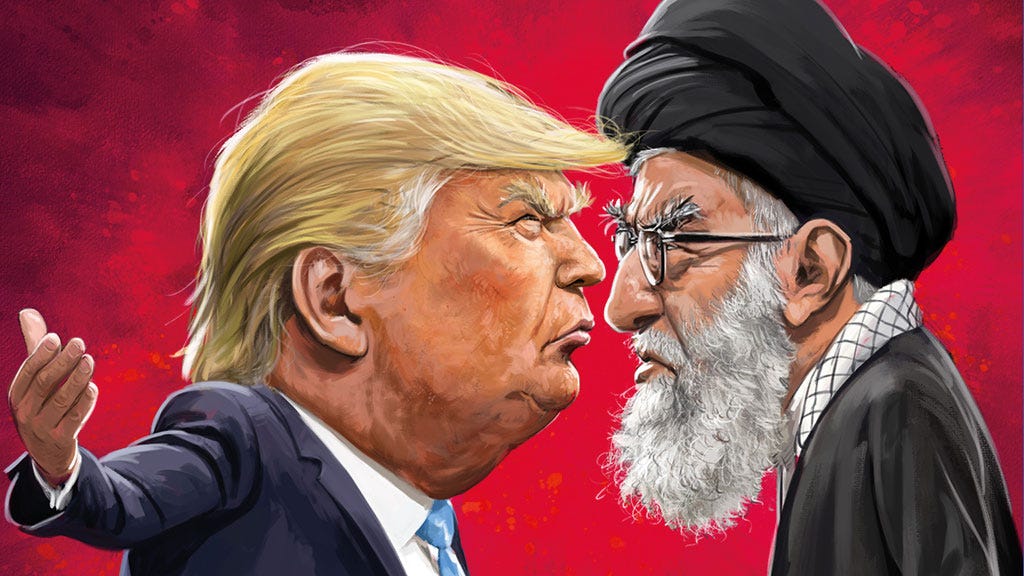
Iran can't count on a taco
Big ships, big promises, possible talks. What's Trump's objective?
Friends: With the exception of Hot Takes Happy Hour with Danielle Pletka, I took a beat last week. After the seizure of Maduro, the showdown over Greenland, the Davos dumpster fire, and the upheaval in Minneapolis - which has consumed the country and captured global attention - I needed to step back, do some reporting, and talk to people smarter than me about where exactly US foreign policy is headed in year two of this administration. Because honestly? I’m not sure anyone knows - including the people making it. I have thoughts. Lots of them. More coming in the days ahead.
And of course, hope to see you Thursday for Hot Takes!
But first: Iran.
For the third time since returning to office, President Trump is seeking a nuclear deal with Tehran. And for the third time, nobody - possibly including Trump himself - seems to know whether he actually wants one.
White House envoy Steve Witkoff and Iranian Foreign Minister Abbas Araghchi are scheduled to meet Friday in Istanbul, with foreign ministers from the region expected to attend. Jared Kushner will be there too. On paper, it looks like diplomacy is winning.
But here’s the thing: Trump has assembled what he calls an “armada” in the Gulf - the USS Abraham Lincoln carrier strike group, three guided-missile destroyers, F-35s, F/A-18 Super Hornets, and additional air defense systems repositioned across regional bases. That’s not the force posture of a president who has decided to talk his way out of a crisis. That’s the force posture of a president keeping his options very, very open.
The question consuming Washington, Jerusalem, the Gulf - and especially Tehran - is simple: What exactly is that mission?
The leverage play
Trump’s approach has all the hallmarks of gunboat diplomacy - military pressure, rhetorical escalation, and economic coercion designed to extract concessions without committing to war.
It’s worth remembering how we got here. When protests erupted across Iran in late December, initially over a collapsing currency and quickly escalating into calls for regime change, Trump promised protesters that “help is on the way.” He urged them to “take over your institutions” and warned that killers would “pay a very big price.”
Then came the crackdown — at least 2,500 dead by conservative estimates, possibly far more, under a total internet blackout. Trump threatened strikes. The Pentagon prepared options. Allies were alerted. Personnel at al-Udeid Air Base in Qatar were advised to evacuate.
And then... Trump pivoted. He received word through Witkoff that Iran had canceled planned executions. “We’re going to watch and see,” he told reporters.
The protesters, many of whom had stayed in the streets believing American intervention was imminent, were crushed. The regime survived. And now the conversation has shifted entirely - from helping protesters to negotiating over uranium.
Just a few weeks after massacring thousands of its own citizens, Tehran finds itself back at the diplomatic table, haggling over enrichment levels. Not a bad outcome for a regime that was supposed to be on the ropes.
The deal that may not exist
The problem is that the deal Trump wants may not be available.
Witkoff has said Iran would need to permanently end enrichment, impose significant constraints on its missile program, and cease support for its proxies. Iran has categorically rejected all three.
Tehran is now trying to narrow the Istanbul talks to the nuclear file alone - no missiles, no proxies - and move the venue to Oman for bilateral discussions without regional observers. The Iranians want to look like they’re negotiating with Washington, not capitulating to a regional coalition.
Iran may offer to hand over its stockpile of 60 percent highly enriched uranium to a third party like Turkey or Russia - the same concession it floated last fall to avoid UN snapback sanctions. The US and Europe rejected it then. Whether Trump accepts it now depends on what he’s actually trying to accomplish.
Iran has long balked at zero enrichment as a nonstarter. But given that’s roughly how much they can enrich after the twelve-day war turned much of their nuclear infrastructure to rubble, they suddenly seem more flexible. Funny how that works.
But that’s still a far cry from the comprehensive deal Trump has publicly demanded. Tehran could offer some compromises on the nuclear file while refusing to budge on missiles or its regional network of proxies - even though both are arguably weaker than at any point in decades. Between an economy in free fall, a population that just rose up against the regime, and a proxy network that’s been decimated since October 2023, you’d think Tehran might realize it doesn’t - as Trump likes to say - “have any cards.” And yet here they are, still trying to set the terms.
The military options
If diplomacy fails, Trump’s options range from targeted to catastrophic.
At the lower end: strikes on Revolutionary Guard facilities, Basij militia bases, or commanders directly implicated in the protest crackdown. These would be punitive but unlikely to produce political change.
At the higher end: broader attacks on Iran’s missile infrastructure, remaining nuclear facilities, or economic targets like Kharg Island oil terminals. These would get Tehran’s attention - and almost certainly trigger massive retaliation against US bases, Israeli cities, and Gulf energy infrastructure.
Washington has seen a revolving door of regional officials in recent days. Israel’s military chief came to discuss potential targets with the administration. Saudi Arabia’s defense minister and top UAE officials followed, urging de-escalation while passing messages between Washington and Tehran.
The Gulf states have all delivered the same message: tread carefully. They live inside the blast radius. Iran has warned that any strike would be treated as “all-out war” and that US bases in their countries would be legitimate targets.
The uncertainty strategy
Trump’s unpredictability is, in some ways, the point. Iran doesn’t know if he’ll strike. Neither do U.S. allies. Neither do his own advisers, by some accounts. That uncertainty is leverage.
But it’s also dangerous. US credibility erodes if threats aren’t followed through. External pressure may strengthen hardliners in Tehran by reinforcing narratives of foreign orchestration. And the protesters Trump once championed? They’ve been largely forgotten in the pivot to nuclear diplomacy - which is exactly what the regime wanted.
There’s also a practical problem: the armada can’t float there forever. It’s expensive, it leaves US forces exposed as sitting ducks, and it pulls resources and personnel away from other national security priorities. Trump may have given himself maximum leverage, but leverage has an expiration date.
Some observers point to what they call TACO - Trump Always Chickens Out. The pattern is familiar: maximum aggression, then retreat. Tariffs. Venezuela. Greenland. Each time, the most extreme threat gets walked back once the headlines land. But that framing misses something. Even when Trump backs down, he’s moved the baseline. Each cycle makes the next provocation feel a little more normal — and tests just how soft the underbelly of norms really is.
The armada is ready. The question is whether Trump knows what he wants it to do. He has assembled enormous firepower, made enormous promises, and now faces a familiar bind: act without a clear objective, or back down and watch the regime he threatened consolidate its survival.
Iran’s streets are quiet after a bloody crackdown. But the economy remains in free fall. Another round of protests appears increasingly likely. And when they come, Iranians - and the rest of the world — will remember what happened the last time an American president promised that help was on the way.


Very smart Elise. I like your outlook.
Sharp take on the TACO paradox. The point about backing down still shifting baselines is key, like each cycle normalizes behavior that wouldve been unthinkable before. The armada sitting there indefinitely does have that expiration date problem though. Can't maintian that posture forever without either escalating or looking weak, and Tehran knows it. Wonder if the protesters realize they got used as leverage then dropped the moment it became diplomatically inconvenient.