Reading wars between the lines
Trump’s State of the Union — and the hidden foreign policy speech
Folks: Danielle Pletka and I hope to see you tomorrow at Hot Takes Happy Hour. My take on President Trump’s marathon State of the Union below, but Dany and I promise some more spicy takes on the speech!
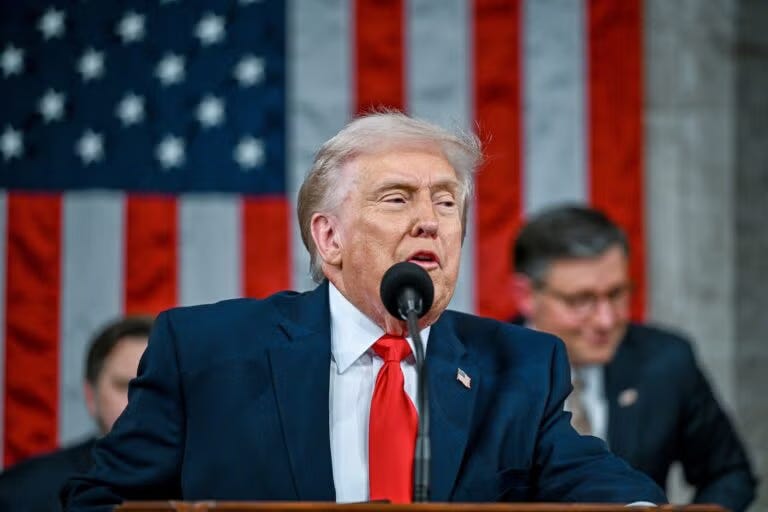
If you stayed up for all 108 minutes of President Trump’s State of the Union, you saw the full production: medals, standing ovations, campaign-style applause lines, and long stretches focused squarely on domestic politics.
What you didn’t get — at least not in any sustained way — was a clear explanation of where American foreign policy is headed, even as the United States sits at the center of multiple global crises. And notably, for the first time in years, China — usually a centerpiece of these speeches — was virtually nonexistent. Foreign policy was mentioned mostly in passing — referenced, rarely explained.
That’s striking because I was expecting, in many ways, a foreign policy speech dressed in domestic wrapping. Trump’s second term has been defined less by legislation than by events abroad: a grinding war in Ukraine now marking its fourth anniversary, a fragile ceasefire in Gaza, Venezuela entering an uncertain phase after the removal of Nicolás Maduro, and a growing possibility of military confrontation with Iran.
The Atlantic’s Tom Nichols captured the mood afterward, writing that while the president played “ringmaster” in his own variety show, the “only thing Trump did not do was explain his policies—especially about war and peace—to Congress or the American people.”
The omission didn’t feel accidental. It felt like the point.
Wars got the short stick
Ukraine, despite the timing, was dispatched quickly. On the fourth anniversary to the day of Russia’s full-scale invasion, Trump spent roughly twenty seconds on the conflict — mourning the death toll, repeating that it wouldn’t have happened under his leadership, and moving on.
No discussion of negotiations. No sense of endgame. No explanation of what success would even look like. For European allies — and Americans trying to read his true intent — the brevity spoke louder than the words themselves.
Gaza received more attention, but was mostly framed as a diplomatic achievement. Trump highlighted the return of hostages — one of the administration’s clearer foreign-policy wins. But the harder questions — governance, reconstruction, who holds the security reins once the cameras move on — remained largely untouched.
Notably absent was any mention of the newly launched Board of Peace, unveiled only days earlier as a framework for reconstruction funding and long-term stabilization. Whether or not it succeeds, leaving it out reinforced a broader theme of the night: victories highlighted, complexity deferred.
Venezuela, meanwhile, was where the speech briefly slowed down and found emotional weight. Trump spotlighted opposition figure Enrique Márquez — recently freed from prison — and orchestrated a surprise reunion with his niece Alejandra in the chamber, a rare moment that cut through the political choreography and drew genuine applause across the room.
It was powerful storytelling — the kind State of the Union speeches are built for. But it also underscored the unfinished nature of the story itself. Maduro may be gone, but the broader system remains, and Venezuela’s future — politically and economically — is still very much unsettled.
A short, loaded Iran paragraph
Then came Iran — brief, but significant. Trump said negotiations are underway but that Washington has not heard the “secret words”: “We will never have a nuclear weapon.”
Here’s the irony. Iranian officials — including the foreign minister as recently as this week — have said precisely that, insisting Tehran does not seek a bomb. Even if few in Washington believe them, the words themselves have been said.
Still, the line mattered because it felt less like explanation than framing. The U.S. military posture in the region is expanding. Internal debate reportedly centers on escalation risks and the possibility of a prolonged conflict. None of that complexity appeared in the speech. No articulation of objectives. No explanation of what success would even look like.
Historically, presidents prepare the country before major wars. Franklin Roosevelt did it before World War II. Lyndon Johnson did it during Vietnam. George W. Bush spent months making a case for invading Iraq — however flawed that argument later proved.
This time, Americans heard signals, not strategy. If war is on the horizon, the argument for it hasn’t reached the public yet.
Strength — and the limits of the message
The speech’s through-line on foreign policy was strength. Trump framed American power in familiar terms: fear equals respect. It’s a worldview he has embraced for years — deterrence through dominance, leverage through unpredictability.
But that message lands differently abroad. After the past year of friction over tariffs, NATO spending, Ukraine, and Greenland, many European governments aren’t talking about fear or respect so much as exhaustion. The question in allied capitals isn’t whether the U.S. is powerful; it’s whether it’s predictable.
Trump sees fear as respect. Many allies increasingly see instability. That gap — between Washington’s rhetoric and allied perception — hovered quietly beneath the speech.
Rubio, Vance — and the signals
One moment, though, landed loudly inside diplomatic circles. Trump singled out Secretary of State Marco Rubio, calling him possibly the best ever — prompting one of the strongest ovations of the night.
Vice President JD Vance, by contrast, received only a brief factual mention tied to a domestic fraud initiative.
The contrast sharpened an emerging divide inside Republican foreign policy thinking: Rubio’s outward-facing internationalism versus Vance’s more skeptical America-First instincts that resist deeper global entanglements.
Foreign diplomats watch these moments carefully. They’re not just looking for policy signals, but for power maps — who has influence now, and who might shape the next phase of the administration. Even when foreign policy wasn’t explained, the political subtext was unmistakable.
The speech we’re waiting for
The State of the Union was long, energetic, and unmistakably theatrical. But as a foreign-policy address, it felt like a placeholder — an acknowledgment that the world is unstable without fully explaining how Washington intends to navigate it.
The decisions ahead will define more than headlines. They will shape how American leadership is measured — by allies, rivals, and voters alike.
And after 108 minutes, the lasting impression wasn’t what the president said about America’s role in the world.
It was the sense that the real foreign policy speech — the one explaining where the country is heading, and what it might cost — still hasn’t happened.


