Saluting the man who made news the star
Ted Turner built CNN to make the world better. That idea is lost - but not gone for good.
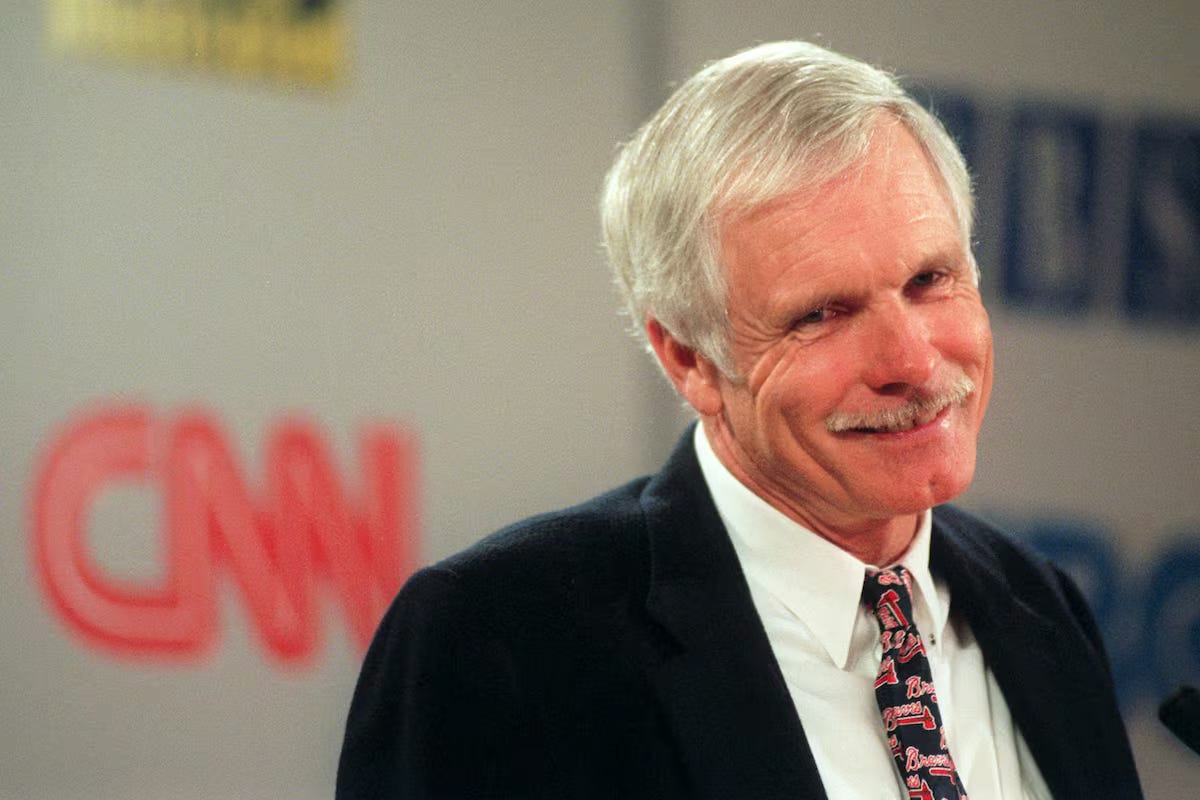
CNN founder Ted Turner died Wednesday at his home near Tallahassee, Florida. He was 87, and had been living with Lewy body dementia for years. Ted invented 24-hour news, built a broadcasting empire from nothing, and changed forever how the world understands itself. But the idea he pioneered - that news itself could be the star - has already been gone for a while.
I spent most of the day watching CNN as everyone paid tribute to the man who turned me into a news junkie. They brought out the legends - anchors and correspondents I grew up watching, some I had the privilege of working alongside - as they described how Ted Turner ushered in the golden age of news. The tributes poured in from across the industry, leaders praising his vision and his courage, even as many of them have spent years working toward the fullest expression of everything he stood against.
I became a journalist because of CNN. In my senior year of high school, I took an honors class called Global Studies - learning about international relations, reading Foreign Affairs magazine, the whole thing. My teacher would come in every morning talking about stories from faraway places he’d heard about on CNN. Countries I’d barely heard of. Conflicts I didn’t know existed. I thought: I want to work for this CNN one day.
It was the late ‘80s, and cable was just getting started. Watching CNN’s coverage of the Gulf War from my college apartment only deepened that resolve.
What drew me wasn’t the anchors. It was the news.
Ted built something radical on that premise - but to understand what CNN really was, you have to understand who Ted Turner really was. He was a disruptor before the word existed. A risk-taker who mortgaged everything, repeatedly, on bets nobody else would make. A blue-sky thinker who saw around corners. But underneath the bravado and the brashness was something rarer: moral courage and a genuine commitment to making the world better.
CNN wasn’t his most profitable venture - it lost $2 million a month in its early years. But Ted kept faith with it because he believed, fundamentally, that an informed citizenry was the foundation of a functioning world. He donated a billion dollars to support the UN’s work around the world. He founded the Nuclear Threat Initiative to reduce the danger of weapons of mass destruction. He bought two million acres of land and turned it into nature preserves. These weren’t the hobbies of a rich man. They were the actions of someone who actually believed the world could be improved - and that he had an obligation to try.
CNN was his philanthropy too. Bringing the world to people’s living rooms in real time, from Baghdad to Tiananmen Square to the Berlin Wall, wasn’t a business strategy. It was a calling. News as a public good. Journalism as a form of citizenship.
That’s why I joined. And for 18 years, I tried to live up to it.
A few years after the AOL-Time Warner merger effectively pushed Ted out of the company he’d built, I ran into him in a New York elevator during UN General Assembly week. It was the first time I had met him, and talk about a celebrity sighting! I told him CNN wasn’t the same without him. He smiled and told me to keep the faith - that he was going to make a comeback.
Too bad he didn’t.
Because what came after him - at CNN and across the industry - was the slow substitution of performance for reporting. Personalities became the star. Then outrage became the star. Now influencers who have never broken a story, knocked on a door, or sat across from a difficult source aggregate the work of actual journalists and call it journalism - and often attract larger audiences than the reporters who did the work.
I knew it was time to leave CNN when a manager told me, flatly, that “nobody cares about issues and analysis.” That was the eulogy - not for my career, but for the ethos Ted had instilled in us. The idea that explaining the world carefully and honestly was itself a service worth providing.
And increasingly, legacy media is learning the wrong lessons from what replaced it. Not every journalist - but enough that it’s noticeable. Righteous indignation hardening into snark. Cynicism mistaken for rigor. Anger performing as accountability. The audience, already primed for outrage and hungry for confirmation of what it already believes, rewards the performance over the reporting. Clicks follow heat, not light.
There are journalists - some I came up with at CNN, some who came after - who still carry Ted’s ethos. Who still believe the story is the point. But they are fighting against a current that runs the other way, shaped by people brought in over the years who turned the network into something Ted Turner scoffed at.
His vision is needed now more than ever. We are living through wars, accelerating climate emergencies, the rise of artificial intelligence, and a great power competition that will define the next century. In that environment, facts aren’t a luxury - they are the architecture of any response. We need to know what is actually happening, reported straight, without the filter of performance or the distortion of outrage.
Ted Turner believed a better-informed world would be a better world. It was considered naive. It was also correct. And it is, in the current media environment, almost countercultural.
What died this week isn’t just a chapter in media history. It’s a particular faith - that news, done right, could be enough. That facts delivered straight would find their audience. That the story was the point.
News is no longer the star. But it should be. And if we return to the values that drove Ted - and why - it can be again.
Ted Turner believed journalism was worth investing in.
In that spirit, I am extending my World Press Freedom Day discount through Thursday- 25% off annual premium subscriptions.
This is a straightforward way to support reporting, analysis and conversations that are not driven by political alignment or algorithmic incentives. If this kind of work matters to you, subscribing makes a tangible difference.
If you are already a paid subscriber, a gift subscription is a great way to bring another foreign policy enthusiast into our community.


