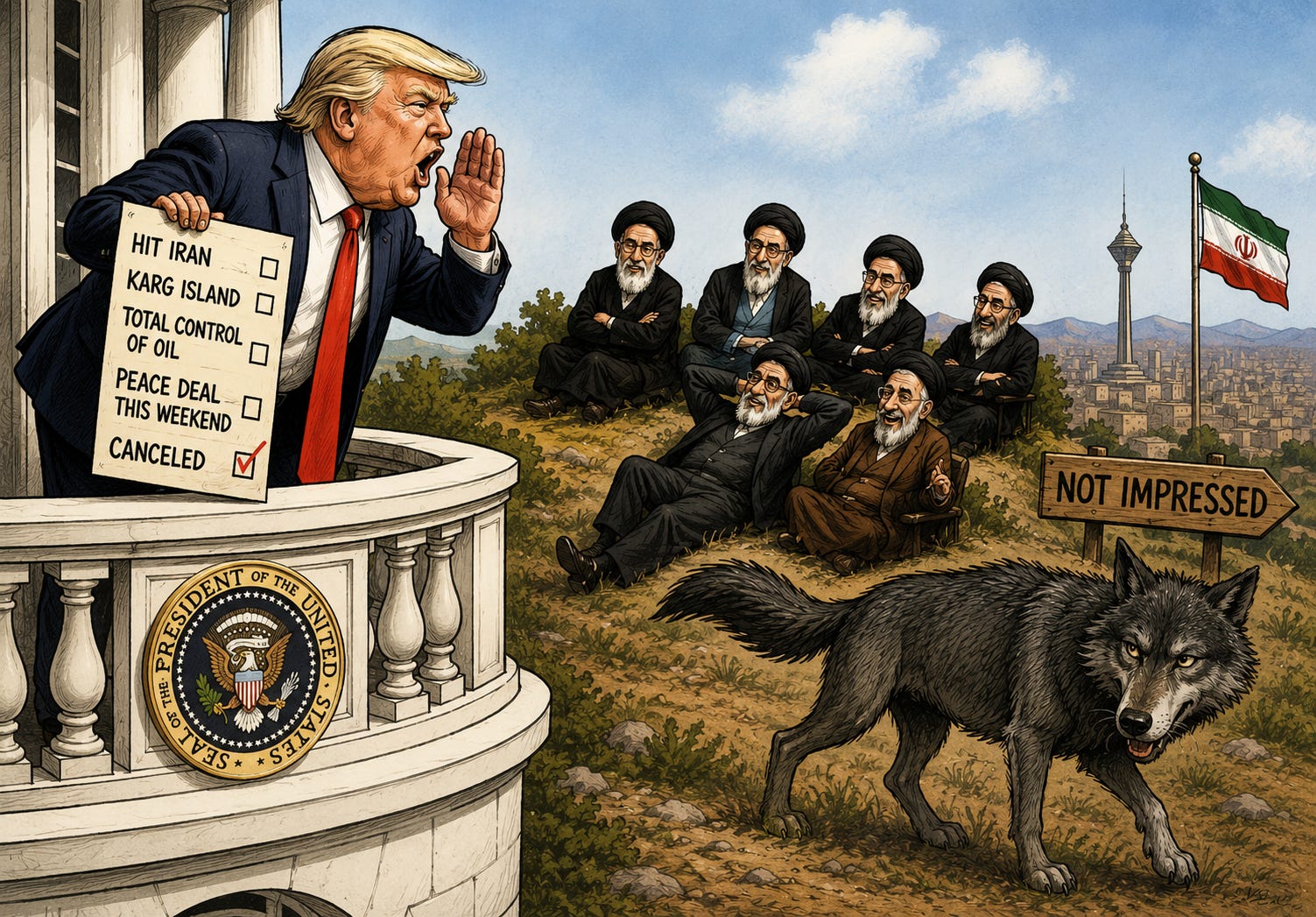
The boy who cried deal
Four months into this war, I stopped listening. So has Iran.
Yesterday President Trump threatened to hit Iran “VERY HARD TONIGHT,” floated seizing Kharg Island and taking “total control” of Iran’s oil and gas industry, canceled the strikes, and announced that a peace deal could be signed in Europe as soon as this weekend. All before lunch ended in Washington.
And it was only the latest whiplash. For days now, U.S. forces have been shooting down Iranian drones over the Strait of Hormuz - the same strait Trump keeps promising will reopen any day - while the president swings between deals, threats, and victory laps.
Other presidents took months to move through deterrence, escalation, and de-escalation. Trump now runs the entire cycle between breakfast and the closing bell. It is less a strategy than a mood ring.
Aesop got here first. The shepherd boy cried wolf so many times that when the wolf finally came, nobody ran. Trump has spent four months crying in both directions at once - wolf and deal, annihilation and signing ceremony, sometimes in the same news cycle - and the audience that matters most stopped running long ago.
Since mid-April, Trump has claimed something like thirty times that an agreement was imminent, that Iran had “agreed to everything,” that all significant differences were bridged. On Thursday he told a Georgia tele-rally that “we ended the war with Iran today” and that “we got everything we wanted.”
Tehran’s reply came from Foreign Ministry spokesman Esmail Baghaei: “So far, Iran has not reached a final conclusion on the agreement.”
It’s all what former Secretary of Defense and CIA Director Leon Panetta has called “a kabuki dance.” Which seems unfair to kabuki, an art form that at least follows a script.
Consider what Tehran sees: a president eager for a deal, a war that has become politically draining at home, and a pattern in which every Iranian counterpunch is followed less by escalation than by renewed declarations that peace is just around the corner.
Every drone launched toward the Strait. Every missile fired at a Gulf base. Every provocation is met not with the promised hellfire but with another announcement that negotiations are making progress.
To be fair, Trump has not simply talked. Over the past week, the United States launched new strikes after Iranian attacks, and Iran responded with strikes of its own. But listen carefully to how the Pentagon described them: not as an escalation, but “defensive strikes” - a phrase that does for bombing roughly what “pre-owned” does for used cars.
That’s what Tehran notices. Even when Washington uses force, it simultaneously signals restraint. Even when Trump escalates, his own administration is explaining why the escalation is limited. The message is not “we are prepared to widen this war.” The message is “we are trying very hard not to.”
The Iranians can read that as well as anyone. The regime absorbed an air campaign that killed senior commanders and crippled military infrastructure. It absorbed defensive strikes. It absorbed threats of overwhelming retaliation. And the lesson it appears to have drawn is simple: the threats Trump is willing to execute, he’s already executed. The ones that would fundamentally change the conflict, he does not want to execute.
Which brings us to Thursday’s entry in the catalogue: Kharg Island, the small island that handles roughly 90 percent of Iran’s oil exports. Thursday morning, Trump was publicly discussing the possibility of taking it. By Thursday afternoon, asked whether the idea was off the table, he replied: “It would be. If we sign this agreement.”
That sentence is the whole problem. A military operation announced in advance and then dangled as leverage is not really a threat. It is a bargaining chip. If a reporter published the timing and target of a pending U.S. military operation, the Justice Department would be drafting indictments. When the commander in chief does it on social media, it’s called negotiating.
So if Trump is serious, he has telegraphed an operation whose success depends partly on surprise. If he is not serious, he has reinforced Tehran’s belief that the loudest threats are negotiating theater.
The Iranians can do the same math as the Pentagon. Seizing an island twenty-one miles off the Iranian coast means American forces holding territory under missile and artillery fire in a war that much of the public already wants to end. Tehran is betting Trump will never take that risk and, so far, the bet keeps paying.
Only the markets still seem to flinch. Every social media post moves oil prices, and Thursday’s deal talk sent crude tumbling on cue. Somewhere on Wall Street, there is now a trader whose entire job is refreshing the president’s feed at 2 p.m. But even there, the faith is beginning to erode. One petroleum analyst went on CNN yesterday and wondered aloud whether Trump had become “the boy who cried wolf.”
When the oil analysts are quoting Aesop, the spell may be breaking. Though the lesson of the fable was not that the boy lied. It was that eventually nobody listened.
Maybe the deal really does get signed this weekend. I’d welcome it. But after four months of imminent breakthroughs, final ultimatums, last chances, and almost-there agreements, Tehran seems to have concluded that Trump’s threats are negotiable and his deadlines movable. Coercive diplomacy runs on credibility, and credibility is a currency you cannot print.
Wake me when there’s a signature. Better yet, wake me when the deal holds.
Three decades covering foreign policy has taught me one thing: the story is almost never as simple as your side wants it to be. That’s why I call balls and strikes without keeping score.
That means you get reporting and analysis that makes partisans on both sides a little uncomfortable. Clear-eyed, fact-based, and beholden to no one.
If that’s the kind of coverage you want to read- I hope you will subscribe.


I never thought it would be possible to be embarrassed by our government but here we are. The Republicans are complicit in this. They could have stopped this demented old man, and end this insanity. But they choose to keep him in power for what reason? Congress has done nothing for the people. republicans have no cards to scream about Graham Platner and then support their mob boss.
Ms. Labott, It is likelyer and likelyer that any deal with Iran puts the big L (LOSER) on Trump's forehead. And the world must endure the evil regime of Islamist Iran indefinitely. Whatever potential good from the attack on Iran will be erased by a "deal." Take care.