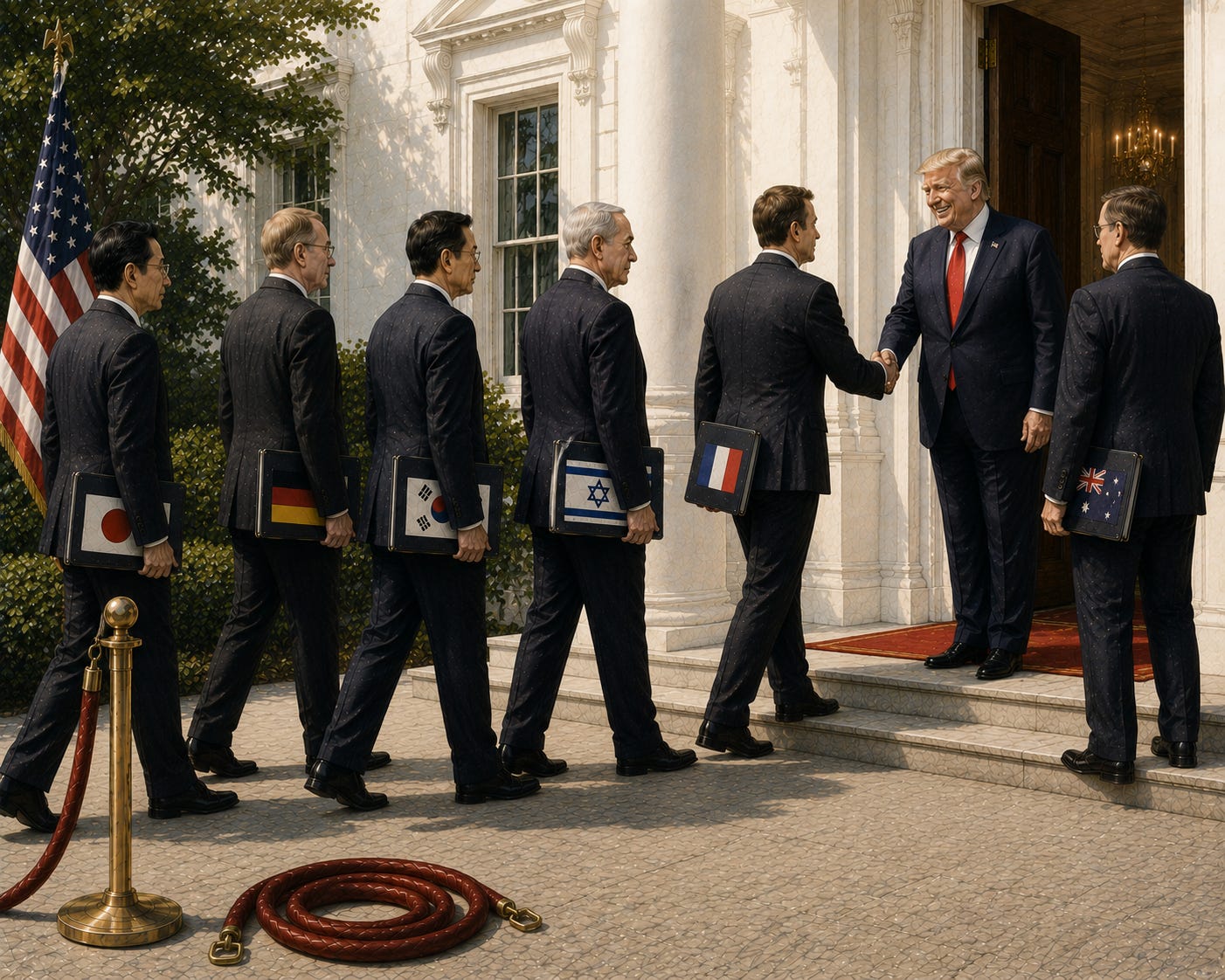
The end of the Israel exception
The alliance isn't ending. The rules that governed it may be.
Every few years, someone declares the U.S.-Israel relationship broken. Usually they’re wrong. This time I’m not so sure—though not for the reason you think.
The media is treating this as a personality clash—with Trump and Netanyahu at odds over Iran, and Vance reminding Israel it has one friend left and should act like it.
I’ve sat through enough of these spats to know the choreography: they fight over settlements, over Lebanon, over whichever war happens to be current, then paper it over with whatever metallurgical metaphor for the relationship—”ironclad,” “unbreakable” or “no daylight”—is fashionable that year.
Those fights were never the story, and the latest ones between Trump and Bibi aren’t either. The alliance isn’t ending, but the assumption that Israel doesn’t have to make its case the way every other ally does may be.
For decades, Israel was exempt from the same questions Washington asks of Germany, Saudi Arabia, South Korea—or just about anyone else receiving $3.8 billion a year. That exception is expiring, not because Trump and Netanyahu finally ran out of patience with each other, but because America changed, Israel changed, and the coalitions holding the old arrangement together changed with them. This isn’t an obituary. It’s a recalibration.
Washington broke the bipartisan consensus before the American people did. Netanyahu struck the match in 2015, bypassing Obama to address Congress and torch the Iran deal—a breach so brazen at the time it turned “support for Israel” from a reflex into a partisan cudgel. Obama answered by letting the U.N. settlements resolution pass. Trump finished the job, embracing Netanyahu more closely than any president before him, right up to Mike Pompeo addressing the Republican convention from Jerusalem, making a foreign capital a campaign backdrop.
By October 7, Israel wasn’t an ally anymore. It was a jersey—and which one you wore said less about the Middle East than about which side of America’s culture war you’d already picked. Support for Israel stopped being a foreign policy position and became a loyalty test.
Israeli officials saw some of this coming. I remember interviewing Israel’s then-deputy foreign minister, Idan Roll, in Washington in 2022. I expected to hear about Iran and Hamas. Instead, he wanted to talk about Tel Aviv’s tech scene, its Pride parades, and its climate startups—all things he assumed would resonate with younger American progressives.
But younger Democrats didn’t grow up on Entebbe or Oslo. They grew up watching the occupation calcify and Netanyahu cozy up to the GOP like a second marriage.
Israel diagnosed that it had a problem. It just misdiagnosed what kind of problem. You can’t fix this with more hasbara.
Then came Gaza. Everyone wants a clean causal story: October 7 happened, the war followed, American opinion collapsed. It was tidier than the truth. Gaza didn’t cause the shift—it accelerated one that had been building since the Obama years and made it impossible to look away from.
Which is how you get Chuck Schumer—yes, Chuck Schumer—calling for new Israeli elections from the Senate floor in March 2024. In three decades covering this relationship, I can’t think of a stranger sentence. But when I called Israeli officials and former diplomats that day, the outrage wasn’t what struck me. Even Schumer’s harshest critics heard the subtext. This wasn’t an enemy turning on Israel, but an old friend worried Israel was turning on itself.
The Democratic shift has received most of the attention, but the Republican shift may ultimately prove even more consequential. Republicans were supposed to be the exception’s last reliable guardians. They still are, mostly: 70 percent sympathize more with Israelis than Palestinians, according to Gallup, though down 10 points in two years.
The Reagan Institute’s own polling keeps finding Republicans want America engaged in the world by wide margins.
America First doesn’t mean isolationism, whatever the caricature says—It means no more exceptions.
Engagement, yes. Blank checks, no—not even for the ally you like best. A growing slice of the coalition has stopped believing any ally, however beloved, deserves a permanent exemption from the same standard Washington claims to apply to every other ally: Does this serve American interests?
That is, ironically, the exact argument Israeli governments have made about themselves for seventy years. Israel insisted on acting in Israel’s interests, whether Washington approved or not—bombing Iraq’s nuclear facility, expanding settlements and lobbying against an American president’s Iran deal. Americans are increasingly asking why they shouldn’t do the same. That isn’t anti-Israel. In many ways, it’s Israel’s own logic applied back to the United States.
Vance said the quiet part out loud: “Donald Trump is the only head of state in the entire world who is sympathetic to the nation of Israel at this moment.” Israeli officials were rattled—not because American leaders have never criticized them, but because a sitting vice president said, on camera, what used to stay in cables: support for Israel isn’t a given. It has to be re-earned. My quarrel with Vance isn’t the diagnosis. It’s the delivery—Tehran has spent forty years trying to sell the region on a fraying American-Israeli lifeline, and he just handed them the pull quote for free.
The war with Iran brought all of these tensions back into view. Over the past few months, I’ve come to think we’ve been arguing about the wrong thing since October 7—or rather, three different things at once, thrown into one political blender.
One is about Israel’s conduct of the war—its proportionality, humanitarian access, and methods. Trump stumbled into this debate when he questioned whether Israel needed to level a Beirut apartment block to eliminate a single Hezbollah operative. He wasn’t making a legal argument about proportionality or the laws of armed conflict. He was giving voice to a question a lot of Americans had already started asking: Was there really no other way? Curiously, Trump was much slower to ask that question about Gaza.
The second debate is about antisemitism—real, rising, and increasingly mainstream. The third is about American interests: whether any ally, however close, should be exempt from the question Washington asks of everyone else—does this serve us?
These are not the same debate.
Criticizing a tactic isn’t bigotry. Worrying about antisemitism isn’t cover for occupation. Asking what America gets from an alliance isn’t abandonment.
Each side just prefers fighting one battle with the other’s ammunition.
The tragedy is that both sides have made it harder to confront the real thing. Genuine antisemitism has surged since October 7 in ways that should alarm anyone who believes in a pluralistic democracy. At the same time, Netanyahu and many of his supporters have too often treated criticism of Israeli policy as evidence of antisemitism itself. One cheapens the accusation. The other exploits it. Both leave Jews less safe.
I feel all three of these most days, sometimes in the same hour, and it makes me like most American Jews I know. We are still not through October 7. I don’t think we are supposed to be. We ache for the hostages, for the dead, and for a country that lives minutes from people openly committed to its destruction. Many of us are heartbroken for Gaza—for children who had nothing to do with Hamas and lost everything in this war, and for Lebanese families who’ve spent decades living with Hezbollah the way Gazans have lived under Hamas: trapped by forces they neither chose nor control.
And most of us are exhausted by the expectation that we answer for decisions made by a government we didn’t elect, don’t vote for, and often criticize ourselves. That’s not solidarity. It’s just another form of collective guilt.
So here’s what I think we have all been missing: what’s actually collapsing isn’t one relationship. It’s a set of assumptions at once.
The assumption that Democrats would support Israel reflexively is gone. The assumption that Republican support was automatic is weakening—especially among younger voters. The assumption that criticism of Israeli policy is inherently antisemitic is collapsing under its own weight, cheapening the charge when the real thing appears. And the assumption that this relationship exists outside normal politics is ending too.
I still believe Israel should remain one of America’s closest allies. I just don’t believe close allies should be treated as exceptions. The strongest alliances are built on shared interests, shared values, and enough resilience to survive honest disagreement.
The question isn’t whether America should keep standing with Israel. It’s whether both countries are ready for a relationship that no longer runs on habit or assumption, but on trust—and whether Israel is ready to be treated like America’s closest ally instead of our exception.
Danielle Pletka are back later today with a special holiday Hot Takes Happy Hour and we hope to see you there. Note our new summer time - 5:00pm ET/2:00pm PT. Let’s get our America 250 grove on!!
Three decades covering foreign policy has taught me one thing: the story is almost never as simple as your side wants it to be. That’s why I call balls and strikes without keeping score.
That means you get reporting and analysis that makes partisans on both sides a little uncomfortable. Clear-eyed, fact-based, and beholden to no one.
If that’s the kind of coverage you want to read- I hope you will subscribe.


Excellent. The romanticism and admiration for Israel the older generation was brought up has indeed been eschewed by younger Americans. They are very clear eyed with what they see….
Schumer is who the Democrats have selected to be the Senate minority leader. He has some obligation to adopt positions held by a big majority of his party if he doesn’t want to lose that position.