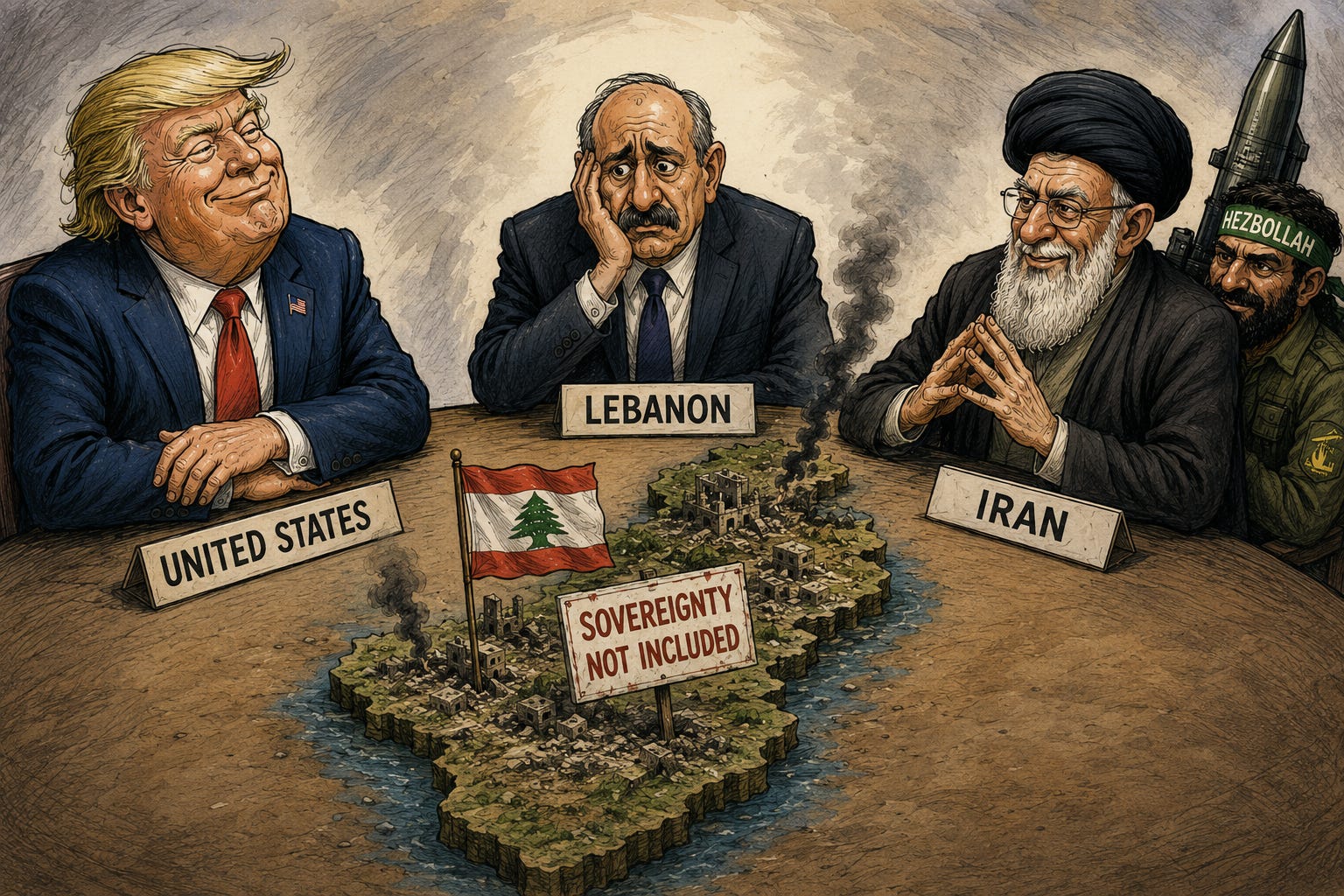
The Iran deal’s inconvenient math on Lebanon
Hezbollah remains the central fact that nobody can quite agree how to discuss.
There’s a fiction being maintained in Washington right now, and it’s getting harder to sustain by the week.
The fiction is this: that the Lebanon-Israel talks happening in Washington this week - the fifth round since April - are somehow separate from the broader U.S.-Iran framework. Secretary of State Marco Rubio said as much on Tuesday, arguing that the Lebanon track is distinct because Lebanon is a sovereign country with its own government, and that’s who Washington is dealing with.
That would be fine, except the actual text of the Iran memorandum doesn’t agree with Rubio. The agreement explicitly declares “the immediate and permanent termination of military operations on all fronts, including in Lebanon.” That’s not a side issue. It’s item one of the deal.
So which is it? Is Lebanon separate, or is it part of the foundation of the U.S.-Iran agreement? The answer, inconveniently, is both - and that contradiction is exactly the problem.
Iran’s insistence on including Lebanon wasn’t generosity toward an ally. It was leverage. Tehran gets to claim it secured protection for Hezbollah, its most important regional asset, as part of a deal with Washington - without actually giving up the thing that makes Hezbollah valuable in the first place.
That’s the part Iran has no intention of surrendering. Iran provides Hezbollah with most of its funding, training, and weapons. Since the assassination of Hassan Nasrallah, the group has reportedly been managed even more directly by Iran’s Revolutionary Guard. Hezbollah isn’t a freelance militia. It is Tehran’s most important regional proxy and one of its primary sources of leverage against Israel.
Which makes the entire framing of these Washington talks - Lebanon and Israel, two sovereign states negotiating bilaterally - somewhat beside the point. Hezbollah isn’t at the table. It has explicitly told the Lebanese government it would rather bet on Iran’s negotiating track than on direct talks with Israel. And it has made clear it considers any agreement reached without Iran’s blessing to be, functionally, irrelevant.
President Trump is half right about Israel. He has pushed back on Israel’s conduct in Lebanon in ways that are, on the merits, correct. He’s reportedly told Prime Minister Netanyahu directly that Israel needs to stop picking fights with Lebanon and publicly called recent strikes in Beirut “vicious” and “too much.” Vice President Vance has been even blunter, telling Israeli officials that a country of nine million people “can’t just kill your way out” of every national security problem.
That’s a fair critique. Israel’s pattern of leveling apartment buildings to target individual Hezbollah operatives - often on the grounds that the buildings may also contain weapons or fighters - raises serious questions about proportionality. Civilians are not interchangeable with the militants Israel says it’s pursuing, and the theory that more force automatically produces more security has a mixed record at best.
This is, notably, the same playbook Israel ran in Gaza - flatten broadly, sort out the rubble later. Trump didn’t seem especially troubled by that version of the strategy. The difference is that Lebanon sits next to a fragile Iran deal, shipping lanes, and oil markets.
But here’s where Trump’s framing breaks down. He keeps talking about this as a Netanyahu problem - a temperament problem, an Israel-needs-to-calm-down problem. What he’s not saying is that Hezbollah is not an independent actor making its own strategic choices. It is an Iranian proxy.
The Israeli military announced this weekend that it had uncovered a large underground Hezbollah tunnel complex near the border - stocked with anti-tank missiles, explosives, and drones reportedly capable of reaching deep into Israeli territory, not just the border towns. That’s the kind of discovery that makes “just trust the process” a hard sell in Netanyahu’s cabinet, and it’s why every time Trump suggests Bibi will simply fall in line with Washington, the answer from Jerusalem is effectively: not while that’s still being dug thirty minutes from the border.
Iran could constrain Hezbollah’s behavior tomorrow if it decided that was in its interest. It hasn’t. Tehran’s preferred response is to threaten the thing that actually moves markets: the Strait of Hormuz. Iran has repeatedly suggested it could close the strait, or walk away from negotiations altogether, whenever Israel strikes Hezbollah targets in Lebanon - without mentioning that many of those strikes are responses to Hezbollah attacks. It’s a convenient omission.
Iran gets to outsource the appearance of moderation to Washington’s frustration with Jerusalem while changing nothing about Hezbollah’s arsenal or position inside Lebanon. Israeli officials see this clearly, even if they’re not always saying it diplomatically. Israel’s ambassador to the talks, Yechiel Leiter, described the process as a “train wreck” and suggested Hezbollah has been emboldened by the broader U.S.-Iran framework rather than constrained by it.
Leiter is probably right about the emboldening part. Hezbollah’s leverage has only grown since Iran successfully inserted Lebanon into its own negotiations with Washington - the opposite of what was supposed to happen if the goal was de-escalation.
There’s a deeper asymmetry here that Israel may not have fully priced in when it went to war. Israel’s aim was never just to degrade Hezbollah for its own sake - it was to dismantle Iran’s broader capacity to threaten Israel, including the network of proxies built precisely to do that. For Trump, the win conditions look different: the Strait reopening, a nuclear deal closing, and the war ending, on a timeline that lets him claim credit.
If Tehran offers Washington a clean exit on those fronts in exchange for leaving Hezbollah’s arsenal largely intact, there’s little reason to assume Trump says no. Israel went to war to remove Iran’s ability to threaten it by any means available. Trump may be negotiating toward an outcome where one of those means - arguably the most immediate one - gets quietly left off the table.
Lebanese officials, meanwhile, are stuck in an impossible position. They’re trying to negotiate directly with Israel while simultaneously watching Iran negotiate over their heads. President Joseph Aoun has said Lebanon will accept nothing less than an end to Israeli occupation and “the simultaneous collapse of all foreign tutelage” - a pointed reference to Tehran as much as Jerusalem.
To his credit, Aoun has shown more willingness than any recent Lebanese leader to challenge Hezbollah: backing efforts to restrict its military activities, targeting Iranian arms routes, and pursuing direct talks with Israel. But intent is not capacity. Disarming a force that outguns the Lebanese army is not something Beirut can accomplish through presidential statements alone.
What’s striking is that this is no longer just Israel’s complaint. Increasingly, it is Lebanon’s. A growing number of Lebanese political leaders, business figures, and civil society organizations are arguing that their country cannot recover so long as decisions about war and peace are made in Tehran rather than Beirut.
That doesn’t mean they support an indefinite Israeli occupation. Most don’t. It means they’re tired of Lebanon functioning as everyone else’s battlefield. Five rounds of Washington talks and there is still no durable ceasefire because the negotiations are built on a contradiction nobody can resolve.
The United States wants to treat Lebanon as a separate issue between two sovereign states. Iran wants credit for ending the war in Lebanon without giving up Hezbollah. Israel wants security guarantees without trusting either Hezbollah or Tehran to provide them. And Lebanon is left trying to reclaim sovereignty while everyone else negotiates over it.
Hezbollah remains the central fact that nobody can quite agree how to discuss. Iran treats it as a Lebanese political movement. Israel treats it as an Iranian military asset. Washington tends to alternate between the two depending on the conversation. But Hezbollah cannot simultaneously be important enough to include in an Iran deal and irrelevant enough to exclude from the negotiations meant to secure it.
For now, that contradiction remains unresolved. Which is why, after five rounds of talks, everyone is still negotiating Lebanon while pretending they’re talking about something else. Expect the same in round six.
Three decades covering foreign policy has taught me one thing: the story is almost never as simple as your side wants it to be. That’s why I call balls and strikes without keeping score.
That means you get reporting and analysis that makes partisans on both sides a little uncomfortable. Clear-eyed, fact-based, and beholden to no one.
If that’s the kind of coverage you want to read- I hope you will subscribe.


