

The Israel litmus test
Israel is a proxy for political fights the parties are having with themselves

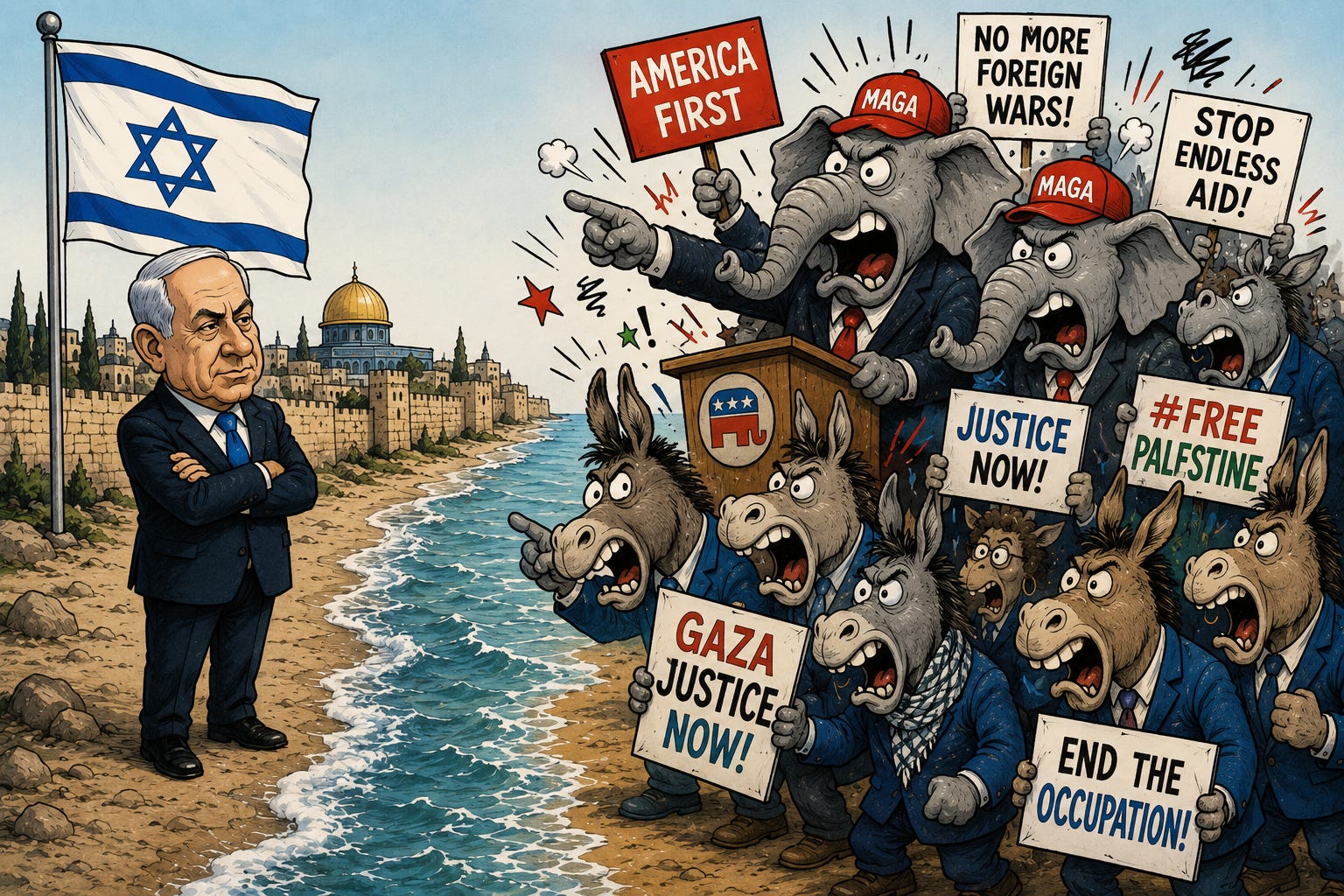
For half a century, Israel was the water’s edge issue — the one place bipartisan consensus actually held, even as everything else in Washington came apart. That’s over. And what’s ending isn’t support for Israel. It’s the assumption that support for Israel could sit outside the realignment reshaping everything else in American politics.
Michigan is the clearest case. Haley Stevens, running as the establishment pick in the Democratic Senate primary, spent a debate this month distancing herself from Netanyahu — “it is very clear that Mr. Netanyahu has not made us safer” — the standard mainstream-Democrat move of separating the man from the alliance, the same move the party has been making since the Gaza war. Bibi’s own drift toward the Israeli far right gave them cover to do it.
Her opponent, Abdul El-Sayed, isn’t interested in that distinction. He’s made Stevens’s AIPAC backing — nearly $11 million from its super PAC in this race alone — the entire frame of his campaign, and gone further than Netanyahu criticism into territory Stevens can’t follow him into: “every definition of a Jewish state ends up in some articulation of illiberal values, every single one,” he told CNN. Neither of them is actually litigating Gaza. They’re litigating who gets to define authenticity in the party, with Israel as the proxy battlefield.
New York was starker. Dan Goldman — Trump’s first impeachment manager, one of the most prominent Jewish Democrats in the House — lost to Brad Lander, a self-described liberal Zionist who also calls Gaza a genocide, by 65.8 to 34. Before the vote, a Brooklyn coffee shop announced Goldman belonged among “racists, fascists, homophobes, genocide-enablers or anyone in between” and said they wished they’d refused him service. Goldman was never a hardliner. Didn’t matter. The message wasn’t that he supported Israel too much — it was that supporting Israel at all is now read as complicity. That’s not a policy dispute. That’s a sorting mechanism.
Ro Khanna’s trajectory tells you how far the center has actually moved, not just where the flank is. Three trips to Israel, a 2024 bipartisan delegation that sat down with Netanyahu himself — and now one of the most vocal genocide-accusers in Congress, campaigning on Iron Dome cuts, using ninety minutes blocked by settlers in the West Bank as the evidence for why the old policy needs to be rethought from the ground up, not managed at the margins. This is a congressman who once needed the credential of an Israel trip to be taken seriously on foreign policy. Now the credential is the opposite trip.
For years the Netanyahu-not-Israel distinction was the pressure valve — it let Democrats vent without touching the alliance itself. October 7 and three years of war broke it. What started as criticism of one prime minister’s conduct of one war became, for a growing number of Democratic lawmakers, an argument for conditioning or ending aid outright. The debate stopped being about Bibi. It became about Israel.
Which is why Rahm Emanuel’s Tel Aviv speech last week mattered more than most Netanyahu-bashing does. This is a man who nicknamed former Deputy National Security Adviser Ben Rhodes “Hamas” for caring too much about Palestinians — Obama’s own chief of staff, about as establishment as Democrats get — and he stood in Tel Aviv and called Netanyahu’s Israel “a modern-day Sparta,” called for sanctioning officials over settlement expansion, said flatly that “the alliance is at a crossroads. It cannot stand or survive as it has been.” Emanuel criticizing Netanyahu isn’t news. Emanuel arriving at what used to be J Street’s floor — the dovish, “pro-Israel, pro-peace” lobby that’s spent two decades to AIPAC’s left — is. Yesterday’s left flank is becoming today’s center.
None of this is happening because primary voters got a crash course in the West Bank. Israel has become the most efficient proxy going for the argument the party is already having with itself — institutionalists versus insurgents, AIPAC money versus small-dollar politics, whether Gaza belongs in the same moral register as domestic arguments about race and power.
For a real slice of the younger progressive coalition, it does: the occupation sits inside the same buy-the-bundle framework as policing, immigration, structural inequality. That’s a genuine intellectual current, not just vibes.
The polling backs up that this isn’t a blip. Gallup found Americans sympathizing with Palestinians over Israelis for the first time since it started asking. Democratic sympathy for Israel: 58 percent in 2014, 17 percent now. AP-NORC has roughly half of Democrats calling Gaza a genocide — and 30 percent of Jewish Americans right behind them. This isn’t a youth phenomenon anymore either; older Democrats are closing the gap fast.
None of that collapses into one story, and it shouldn’t. Much of this is a serious argument — occupation, settlements, statehood, the civilian toll — that plenty of American Jews and Israelis are having themselves. Calling every critic an antisemite is as dishonest as calling every Israel supporter indifferent to Palestinian suffering. But the same environment has given room to rhetoric that isn’t criticism anymore. Take Chris Rabb, a Pennsylvania congressional candidate whose campaign implied the gunmen in Australia’s Bondi Beach Hanukkah shooting were “likely Zionists themselves” — a false-flag insinuation Rabb later disowned and blamed on a staffer. Or Maureen Galindo, a Texas candidate who promised to build a “prison for American Zionists.”
Both campaigns were DSA-aligned, and DSA leadership hasn’t exactly rushed to disown either one. Zohran Mamdani, the most prominent Democratic Socialist officeholder in the country, has made his own genocide accusation against Israel a centerpiece of his politics — sharper company for that rhetoric than it used to keep. The movement against Israeli policy is real and growing. So is the tolerance for rhetoric that would have ended a career five years ago. Both are true, and neither cancels the other.
The Republican version comes from a different place entirely — not human rights language, but “America First” nationalism deciding Israel doesn’t get a permanent exemption from the skepticism the movement applies to every other foreign alliance. A recent Pew poll has nearly four in ten Republicans unfavorable on Israel, six in ten among those under fifty.
Thomas Massie’s defeat this spring wasn’t really about Iran — he’d spent years opposing aid to Israel and tried, in his campaign’s final days, to force AIPAC to register as a foreign agent, which is exactly why pro-Israel money had been circling him long before Iran gave everyone else a reason to care. Tucker Carlson going after Netanyahu during the Iran war and Marjorie Taylor Greene breaking with her own party over it — that’s a different flavor of the same erosion, and it shades, in places, into the same antisemitic and conspiratorial territory the left has its own version of.
Neither party is arriving at the same place. But both are unwinding an assumption that used to feel permanent. For decades Americans argued about foreign policy in the language of strategy — alliances, deterrence, interest. Now it’s the language of identity: who belongs, what institutions still deserve trust. Israel didn’t create that shift. It just became the place where it could no longer be contained.
Three decades covering foreign policy has taught me one thing: the story is almost never as simple as your side wants it to be. That’s why I call balls and strikes without keeping score.
That means you get reporting and analysis that makes partisans on both sides a little uncomfortable. Clear-eyed, fact-based, and beholden to no one.
If that’s the kind of coverage you want to read- I hope you will support my work by subscribing.
Some of us still remember what Goebbels invented: tell a lie often enough, it will become the truth.