


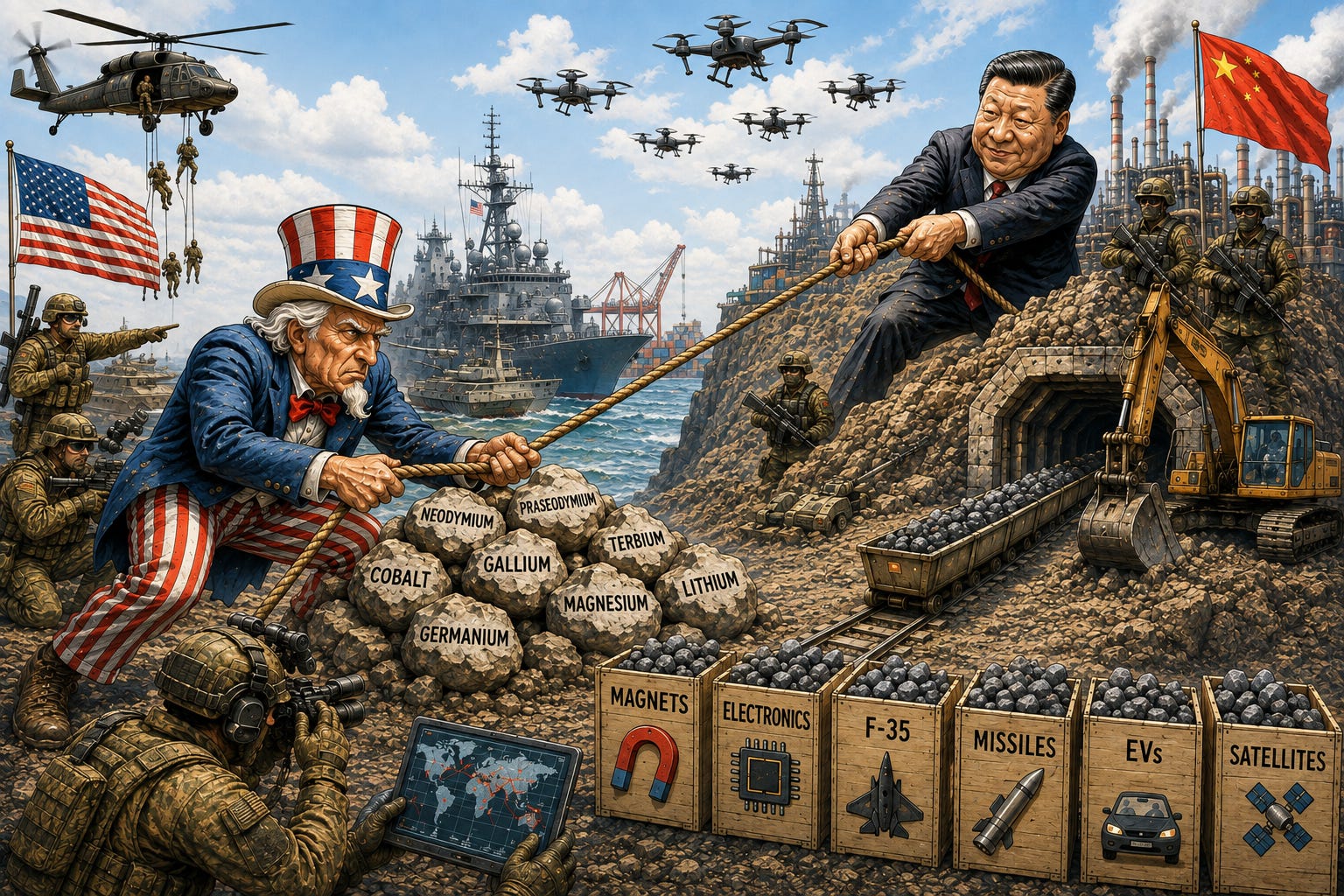
Strategists have a shorthand for the instruments a state uses to compete and coordinate abroad - diplomatic, information, military and economic power, or DIME. It’s a framework built for embassies, broadcasts, battalions and trade - the same one that, as I’ve recently written, now applies almost line for line to the space economy. Turns out it applies just as well to the ground beneath it, and in a way that’s harder to wave off: the same rock that goes into a magnet for an F-35 also runs through a supply chain a rival government can switch off whenever it wants.
The special operations and irregular-warfare crowd has landed on this framing too, which is its own kind of tell. At a recent conference hosted by the Irregular Warfare Initiative and the Special Operations Association of America, SOAA’s Doug Livermore - currently Chief of the Irregular Warfare Division in the Office of the Under Secretary of War for Intelligence and Security - told the room that critical minerals aren’t “merely economic commodities,” but “national security vulnerabilities” central to irregular warfare and strategic competition. He called for a “private-public partnership,” which is a phrase you hear at basically every frontier-industry conference now. What’s different is who’s saying it. These are people who plan for gray-zone conflict for a living, and somewhere along the way they decided a smelter deserves the same attention as a chokepoint.
You can see the diplomatic push most clearly in February, when Secretary of State Marco Rubio hosted representatives from 54 countries and the European Commission at a Critical Minerals Ministerial in Washington, alongside Vice President Vance and four Cabinet secretaries. Eleven new bilateral minerals frameworks got signed that day alone, and the U.S. announced the Forum on Resource Geostrategic Engagement, or FORGE, a successor to the Obama-era Minerals Security Partnership that will rotate its chairmanship, starting with South Korea. Call it a mineral-world Artemis Accords: less about any one deposit than about who writes the rules before Beijing does.
What’s harder to see, and probably more important, is how China built the leverage it now has. Maura Burns, the CIA’s former Chief Operating Officer, told the conference that the dominance “did not happen quickly or overnight” - it came from decades of state subsidies, cheap financing and loose environmental rules that Western producers simply couldn’t match. Beijing has since learned to “weaponize” that position, in her words: export licenses and price moves used as foreign-policy tools rather than ordinary trade friction. When China tightened licensing on gallium and germanium in 2023, U.S. imports of gallium collapsed from roughly 6,900 kilograms in July to 227 by October. Nobody announced an embargo. Somebody just stopped signing paperwork, and a Beijing regulator got to feel like a Bond villain without raising their voice.
None of this is abstract for the people actually fielding equipment. Nearly everything an operator carries downrange starts as raw ore somewhere in the ground, and right now the U.S. can’t build those platforms without buying material from the same countries it’s competing against. Mike Kuiken, vice chair of the U.S.-China Economic and Security Review Commission, put a version of this in blunter terms: modern weapons systems carry pounds of critical minerals, and Washington “cannot afford to depend on our primary adversary” for any of it. That takes me back to 2007, when a constituent asked Hillary Clinton why the U.S. couldn’t just get tough on China. Her answer - “how do you get tough on your banker?” - was about debt, not dysprosium, but the shape of the problem hasn’t changed.
One essay making the rounds in the irregular-warfare world pushes further: with zero domestic primary magnesium production - a metal used in missile casings and aircraft alloys - Pentagon estimates reportedly give Washington six months to decide whether to go to war if China cut off exports, and after that, it couldn’t. Whether that number holds up under scrutiny or not, the fact that people are circulating it says something on its own. Quiet infrastructure dependencies have a way of becoming combat contingencies.
Money is where Washington has moved fastest, and strangest. It isn’t just regulating this market anymore; it’s buying into it - taking equity stakes in rare earth and magnet producers, backstopping prices, financing new refineries the way it once financed highways. Between January 2025 and this June, the federal government put roughly $10 billion into the sector, by the Council on Foreign Relations’ count. Goldman Sachs’ metals team has a name for the resulting shift: a “mine-to-magnet” strategy, where companies integrate extraction through manufacturing to capture value that, for decades, simply left the country for processing. Washington spent forty years insisting it doesn’t pick industrial winners. It now owns a piece of several of them.
China refines roughly 91 percent of the world’s rare earths - a dominance it’s held since 1986, when it overtook the U.S. as the top producer. The ministerials, the equity stakes, the tabletop exercises the special operations community keeps running: they’re all, in their own way, a reaction to that single fact.
Critical minerals stopped being a commodities story a while ago. What’s happening now is a domain where coalitions, leverage, weapons and capital all draw on the same raw material at once, which is exactly why people who spend their careers on conflicts short of open war have started paying attention. A mine or a smelter is just the newest version of a battlefield, fought over supply agreements and export licenses instead of territory.
The countries that get the refining right, not just the mining, will set the terms of the next industrial era. Everyone else will be shipping their ore off to find out what it’s worth.