

The quiet work of the King's speech
King Charles reminded us disagreement isn't the problem. The relationship was built on it.

Please join me TODAY at 4pm ET for a conversation on Lebanon with Jeffrey Feltman — former Assistant Secretary of State, U.S. Ambassador to Lebanon, and UN Under-Secretary-General for Political Affairs.
We’ll unpack Lebanon’s role in the Iran war, the Israel–Lebanon talks, and what the fragile ceasefire may — or may not — change.
If you caught our last conversation — where Jeff recounted his rare meeting with Iran’s Supreme Leader, Ali Khamenei — you know the level of insight he brings, along with a dose of dry humor that makes even the most complex dynamics accessible. Hope to see you there.

And now… onto the King’s speech to Congress:
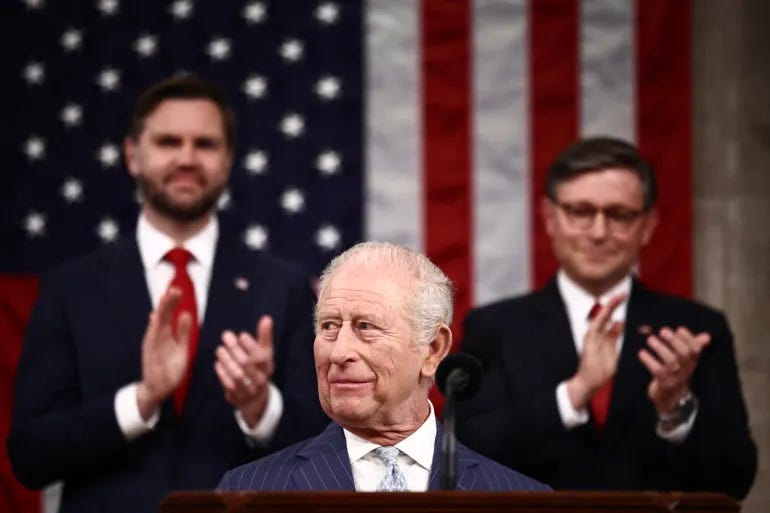
There was a moment, somewhere between the Oscar Wilde joke and the invocation of Abraham Lincoln, when the House chamber did something it almost never does anymore: it settled.
Not into polite attention, or choreographed bipartisanship, but into something closer to ease. For a brief stretch, the noise that usually defines that chamber — the parsing, the positioning, the anticipation of the next line as a political weapon — receded. In its place was something rarer: a shared recognition that what was being said was not quite politics, even as it carried political weight.
King Charles’ speech came at an awkward moment in the relationship it was meant to celebrate. The war with Iran has exposed real strains between Washington and London. Donald Trump has publicly pressed Britain to do more, while Prime Minister Keir Starmer has resisted being drawn into what he has made clear is not Britain’s war. There are disagreements over NATO, over burden-sharing, over the broader direction of Western policy. None of that was named directly, but all of it was present.
No diplomat could have delivered this message without sounding like he was pressing a case. No elected leader could have done so without inviting immediate interpretation through a partisan lens. The absence of overt positioning became its own form of authority — and it explains why King Charles could pull this off when almost no one else could.
What the King did, over the course of the speech, was neither ignore those tensions nor engage them head-on. He absorbed them into a longer story — one in which disagreement is not a rupture, but a recurring feature.
“Ours is a partnership born out of dispute, but no less strong for it,” he said.
That line quietly reframed the entire relationship. The break between Britain and its former colonies, the foundational moment of American independence, is not treated as estrangement but as the beginning of a pattern: conflict, followed by convergence. Divergence, followed by alignment. Not seamless, but sustained.
The speech was full of these moves — arguments embedded in prose that did not sound like argument. A reference to NATO’s invocation of Article 5 after 9/11 was, on its face, a historical reminder and a subtle recalibration of the current debate about alliance commitments: when America was attacked, its allies did not hesitate to stand with her.
His rebukes were delivered with empathy. A passage on Magna Carta doubled as a quiet affirmation of limits on executive power. A reflection on the Royal Navy served, in part, as a defense of British military credibility at a moment when Trump has publicly dismissed it. A call for support for Ukraine, framed in the language of shared resolve, reinforced continuity without confronting U.S. policy directly.
Even the line about security stretching “from the depths of the Atlantic to the disastrously melting ice-caps of the Arctic” did more than sketch geography. It folded together alliance, environment, and geopolitics in a single sentence — the Arctic as a shared domain of responsibility, not a prize to be claimed, as President Trump recently tried to do with Greenland.
That was the King’s pattern: acknowledge the landmine, avoid the trigger words, and expand the frame.
The same approach shaped his treatment of issues that have become flashpoints in American politics. Faith was presented not as a dividing line but as a source of shared moral language, immediately broadened to include “all people, of all faiths, and of none.” Nature, an issue close to his heart, was framed not as the ideology around climate change, but as an asset — tied to prosperity and national security rather than politics.
Even political violence — which he referenced in the wake of the recent White House Correspondents’ Dinner attack targeting President Trump and members of his cabinet — was not politicized. “Whatever our differences, whatever disagreements we may have, we stand united…” It is not that the King avoided politics, but that he refused to be confined by it.
Part of that authority is institutional. The British monarch, who is head of state but not head of government, speaks across longer timelines, less tethered to the immediacy of policy debates. But part of it is also particular to this moment — and to the dynamic surrounding President Trump.
The White House posting an image of the two men and calling it “two kings” was more than a throwaway line. It revealed how the encounter was being framed — not as a negotiation between governments, but as something closer to a meeting of stature.
That framing gave the King room to invoke NATO and reaffirm the alliance’s foundations without having to argue for them. And room to speak about Ukraine without triggering defensiveness. The same lines, delivered by another figure, might have sounded like criticism. Here, they registered as continuity.
This wasn’t a speech about agreement. It was a speech about endurance — an argument that the relationship is not strong because the politics align, but because they don’t always.
That’s a harder argument to make — and easier to dismiss when the tone is wrong. Here, it was simply stated, then reinforced, politely, through history, security, law, and culture.
It did not resolve the current tensions or pretend they were insignificant. It placed them in proportion.
Maybe that is why it felt so striking in that room — not just because of the delivery, or the writing, but because nobody in American politics, from either party, speaks this way anymore. The language of shared purpose has been replaced by the language of positioning — of blame, of reflex, of scorekeeping in real time.
For half an hour, that was set aside. The King’s argument was not about who was right, or which side would prevail. It was about what has held over time — and what might hold again.
In a chamber that rarely allows for that kind of perspective, it was a quiet shift. And for a moment, it was enough.
The easiest play in media right now is to pick a team and tell them what they want to hear. I’m not doing that.
Three decades covering foreign policy has taught me one thing: the story is almost never as simple as one side wants it to be. That’s why Cosmopolitics calls balls and strikes without keeping score — reporting and analysis that makes partisans on both sides a little uncomfortable. Clear-eyed, fact-based, and beholden to no one.
If that’s the kind of coverage you’re looking for, I hope you’ll subscribe.
Elise this was excellent! I was initially sorry to see that this visit took place because of how Trump would use it to pump himself up. Still true. But the King made his visit important, giving us a message in a way no one else could have.
I am (don't cringe) reminded of Michelle Obama's remark "when they go low we go high" which is now disparaged. The King went high as only he could. Trump who likes to project that he is king- could not, did not and does not, go high. And will not. Our shared values are not on his card. Divisiveness, threat and war are. I don't know if the King's message got through to Trump- or will. But it was masterful.
The King spoke “the language of shared purpose.” Thank you for that. And thanks for your thoughtful analysis of the speech. You cause me to think about things differently. Glad to have found my way into your orbit. Your writing always impresses. And in your videos especially, you can be very funny