


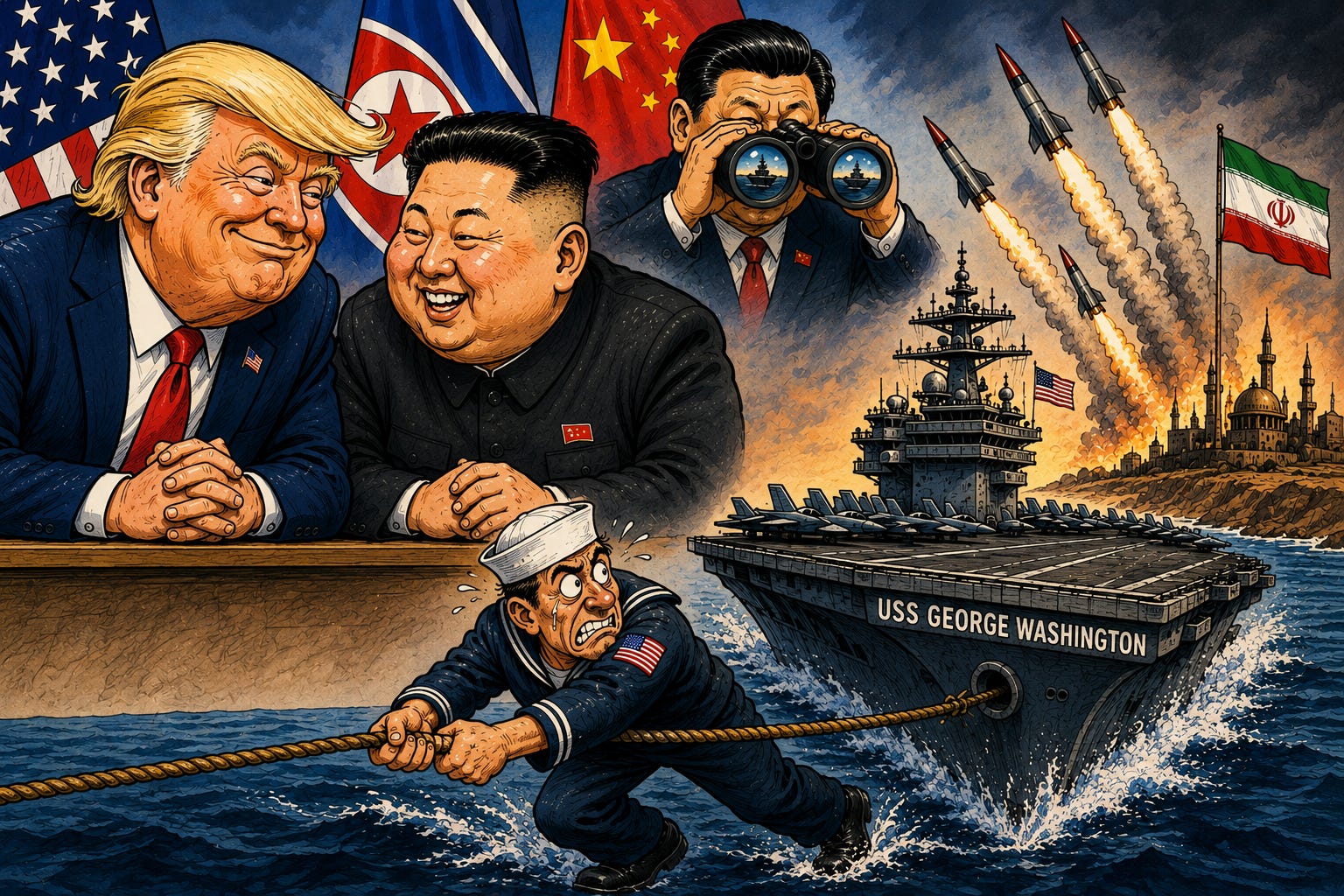
Donald Trump wants another date with Kim Jong Un, but not a channel through the State Department or months of working-level talks. He wants a summit, with cameras rolling and a red carpet somewhere in frame.
Eight years after Singapore, Trump is returning to a familiar delusion that his personal chemistry with an authoritarian leader can produce what conventional diplomacy hasn’t. His three meetings with Kim already put that theory to the test, as North Korea kept every one of its nuclear weapons.
More importantly, the Kim Jong Un he’d be meeting now isn’t the one from those photographs. This Kim has a bigger arsenal, better missiles, a much closer relationship with Moscow, and six months of watching what the United States does to a country that stays at the nuclear threshold instead of crossing it.
Trump went to war in February to keep Tehran from acquiring a weapon Kim already has several times over. He is now bombing and blockading the government that never built the bomb, while trying to schedule a summit with the one that did. Whatever lesson Washington hopes Pyongyang draws from that, giving up its weapons probably isn’t it.
Which leaves an open question: what would another summit actually accomplish? The first round collapsed because Washington wanted denuclearization and Kim wanted sanctions relief, and neither side moved. Full denuclearization is even less plausible now. A cap on the arsenal, limits on fissile material, and missile restrictions are real, defensible objectives, and South Korea has begun pushing for exactly that kind of narrower deal, one that treats a cap as a first step rather than a consolation prize.
But that requires Trump to say, plainly, that this isn’t Singapore II — that he’s negotiating with a nuclear North Korea rather than negotiating it out of existence. So far, the administration has offered little indication that it is prepared to say that plainly. The clearest objective on offer is still a summit, not a deal.
None of this makes talking to Kim foolish. A bigger arsenal is arguably a stronger case for diplomacy, not a weaker one. The problem is mistaking the summit for the strategy. Trump’s first three meetings with Kim produced striking photographs and warm letters. They produced zero fewer North Korean warheads.
He’s already making a down payment on the next one. U.S.-South Korean military exercises have been sharply curtailed, partly to entice Kim, while the move also comes amid Trump’s anger at Seoul for declining to back the Iran campaign. Those exercises aren’t atmospherics; they’re how the alliance maintains readiness against North Korea — the very country Trump is trying to court.
Pyongyang’s reaction so far has been a shrug — Kim Jong Un says the North has no interest in the smaller drills and denies any contact between the two leaders, while pointedly leaving the personal relationship alone.
Meanwhile the Iran war is pulling American military power out of the region where North Korea, and the much larger problem behind it, actually sit.
The USS Abraham Lincoln has been deployed in the Middle East more than 260 days, over 200 without a port call, after being redirected into the Iran war. The USS Gerald R. Ford spent 326 days deployed, the longest post-Vietnam carrier deployment on record, after moving straight from operations around Venezuela into the Iran campaign. At one point this spring, three American carriers were in the Middle East at once, something the U.S. hadn’t done since 2003.
The Lincoln finally needs relief. The Navy is sending the USS George Washington — from Japan. It’s the only forward-deployed carrier the U.S. has, the centerpiece of American naval presence in the western Pacific, and now it’s headed to the Middle East instead, leaving Asia without a carrier until another one shows up. This is the theater Washington has spent a decade calling the priority.
The Navy has eleven aircraft carriers, and that sounds like a lot until you learn that only two or three are ever actually deployed at once; the rest are training, under repair, or resetting from the last deployment. The longer a carrier stays out, the more maintenance it needs when it finally comes home. A carrier can’t be in two oceans simultaneously. Neither, it turns out, can American strategy.
Beijing is watching all of it. Washington has called China the “pacing challenge” for years — the adversary American military capability is supposed to be built around. Yet a regional power is now consuming the ships, munitions and maintenance cycles Washington says it needs for that competition. Every extended deployment gives Chinese planners another data point on how much pressure it takes to bend American force posture out of shape, and how quickly.
If China really is the priority, Washington can’t keep treating Iran, the Houthis, Russia, North Korea and China as five emergencies each deserving maximum military attention at once. That requires choosing. Trump is making those choices piecemeal — an exercise trimmed here, a carrier redirected there, a summit floated somewhere else — with no visible logic connecting them.
Talking to Kim isn’t the reckless part. Given how much his arsenal has grown, it may be one of the more sensible things on the table. The reckless part is spending exercises, carriers and alliance trust to chase a summit whose objective nobody has named — while Beijing gets to watch what all of it costs.
Danielle Pletka and I hope to see you today at 5p for Hot Takes Happy Hour!

This is the most bizarre strategy.
to top off all of his insecurities,idiosyncrasies,and paranoia,he's dangerously scatterbrained