

Things I want to know about the Iran deal
A lot of unanswered questions for a deal already being described as "historic"

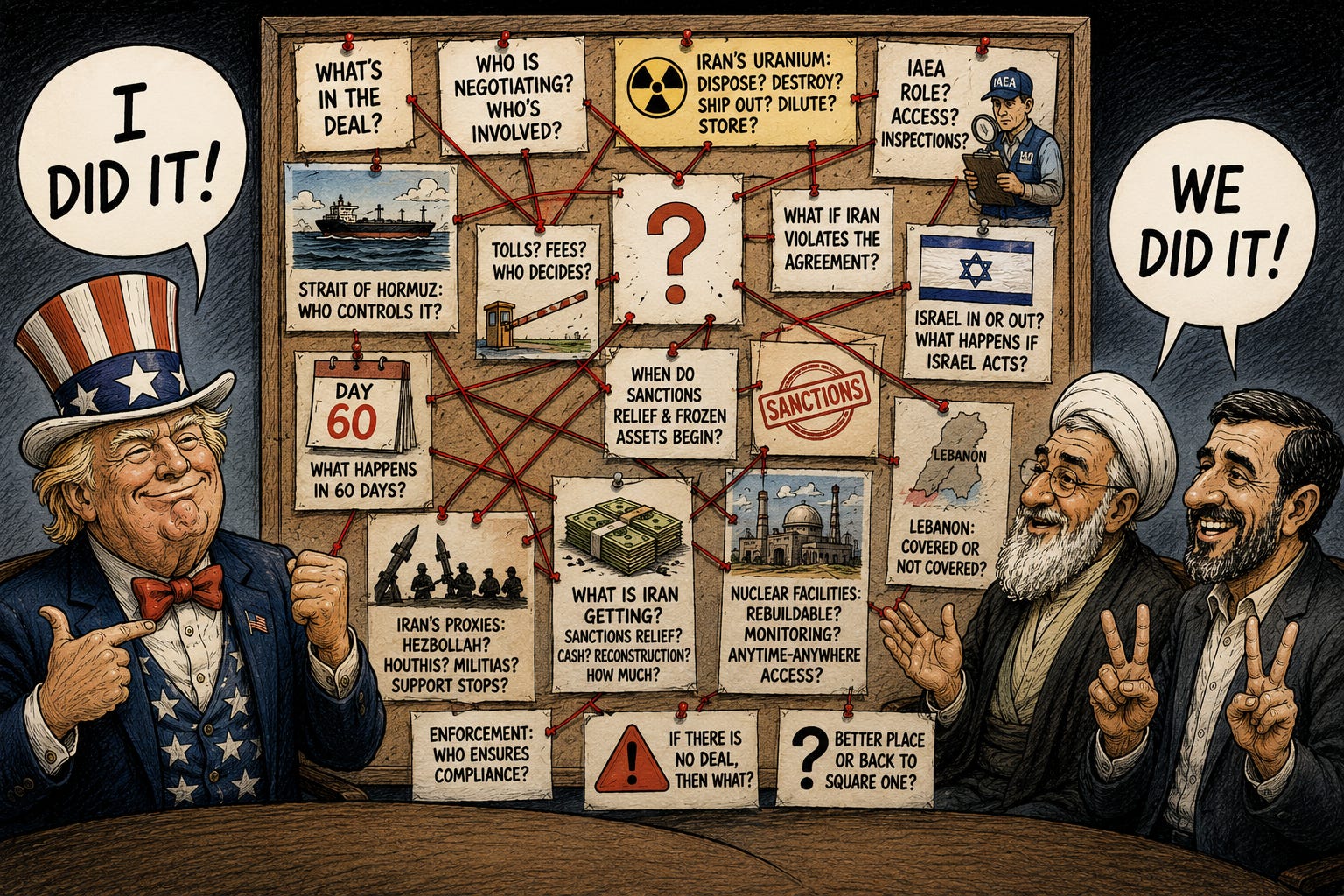
As laborious as the recent negotiations with Iran were (although probably not as exhausting as following President Trump’s play-by-play on social media), reaching the Memorandum of Understanding was the easy part.
Before the hard part - the actual nuclear negotiations - start, I have a number of questions that this framework doesn’t seem to address.
The first is embarrassingly basic: what exactly is in the MOU?
Nobody seems entirely sure because nobody has actually seen the text. That may sound like a minor detail, but it isn’t.
At the moment, Americans are describing one deal. Iranians are describing another. The White House says the Strait of Hormuz will reopen without restrictions. Iranian officials are talking about management arrangements and possible fees. American officials talk about disposing of enriched uranium. Iranian officials talk about future discussions.
Perhaps both sides are simply selling the same agreement differently to domestic audiences. Or perhaps they have negotiated what diplomats politely call “constructive ambiguity” and what the rest of us call “finding out later.”
Until the text is released, (will it be?) we don’t actually know whether Washington and Tehran agree on what the agreement means. Which is usually something you like to establish before announcing you’ve solved the crisis.
That leads to the second question: who is actually running the next sixty days?
We’re told there will be a signing in Geneva. Pakistan and Qatar were involved in mediating the initial talks. There are reports also involving Oman and Switzerland. At some point, someone may need to print a seating chart.
When and where do the negotiations start? Who is mediating? Are these direct negotiations or indirect negotiations? Signal messages? Snapchat?
Will people who actually have experience negotiating nuclear agreements - scientists, inspectors, sanctions experts, and the Europeans be in the room? What about the IAEA?
Then there is Iran’s nuclear program
If negotiating the ceasefire was difficult, the nuclear issues are considerably harder.
When officials say Iran will “dispose” of its highly enriched uranium, that sounds reassuring until you realize everyone appears to have a different definition of the word dispose.
Does it mean destroy? Ship it out of the country? Dilute it? Store it somewhere and promise not to touch it?
These distinctions matter.
The same goes for Iran’s nuclear facilities. Many have been heavily damaged. Are they gone forever? Can they be rebuilt? What role will the IAEA play? Will inspectors have anytime-anywhere access, or are we heading back toward years of arguments over monitoring and compliance?
And what about the Strait of Hormuz?
Everyone agrees it should reopen. Nobody seems to agree who controls it afterward.
Trump says nobody. Iran says Iran and Oman. The shipping companies seem to be saying, “Call us when you’ve figured it out.”
Will there be tolls? Service fees? Navigation fees? Some new category of fee invented by people who insist it is definitely not a toll?
And even if the politics are resolved, how long will it take to clear mines, restore confidence, and persuade insurers and shipping companies that the waterway is actually safe?
Then there is the question that will likely dominate Washington the moment the details emerge: what exactly is Iran getting?
When does sanctions relief begin? When do frozen assets get released? Is there reconstruction assistance? How much?
And what happens if Iran receives the economic benefits and then violates the agreement?
We can’t forget Israel
Iran says Lebanon is covered by the agreement. Israel says it is not bound by it.
Iran wants military operations in Lebanon to stop. Israel says it intends to remain where it is and preserve freedom of action against Hezbollah. Those seem difficult positions to reconcile.
Can Trump persuade Netanyahu to go along? What happens if Israel launches another major operation in Lebanon? What happens if Hezbollah attacks first? Can the deal survive if one of its most important regional players never signed onto it in the first place?
What exactly is Iran agreeing not to do?
The discussion has focused heavily on uranium, sanctions, and shipping lanes. Fair enough. Those are important.
But is Iran agreeing to stop supporting Hezbollah? What about the Houthis? What about the various militias that have attacked American forces and U.S. allies throughout the region?
Is support for proxies prohibited, reduced, monitored, or simply ignored because the negotiators have enough problems already?
The distinction matters because a deal that addresses Iran’s nuclear program but leaves its regional activities untouched is a very different deal from one that attempts to reshape the broader security landscape of the Middle East.
My understanding is that precious little of this is actually addressed in the current memorandum of understanding.
Which brings us to another awkward question: what exactly happens in sixty days?
Because unless someone has discovered a revolutionary new way to negotiate nuclear agreements, sixty days is not a lot of time.
The original Iran nuclear deal took roughly eighteen months to negotiate. These talks involve many of the same issues, plus a war, plus sanctions relief, plus regional security arrangements, plus the future of the Strait of Hormuz.
So what happens when Day 60 arrives and everyone is still arguing about uranium stockpiles, inspections, sanctions relief, Hezbollah, and who controls what?
Do we get an extension? Another extension? A framework for extending the extension? At what point does a temporary agreement simply become the agreement?
And if there is no deal, then what? Do sanctions snap back? Does military pressure resume? Do American troops stay in the region indefinitely?
Does everyone simply return to threatening each other on social media? Which, to be fair, may be the one part of this process that is already fully operational.
There is an old diplomatic rule that if both sides leave a negotiation claiming victory, the agreement is probably workable. If both sides leave describing entirely different agreements, the interesting part is still ahead of us.
At this point, I realize this column is starting to resemble one of those conspiracy boards in detective shows, where the protagonist has covered an entire wall with index cards, red string, and increasingly alarming facial expressions.
But seriously, the list of unresolved issues is getting impressively long.
We don’t know what the framework deal says. We don’t know whether both sides agree on what it means. We don’t know who is negotiating the next phase, what happens to Iran’s uranium, who controls the Strait of Hormuz, what Iran is getting, whether Israel is bound by any of it, whether support for regional proxies is addressed, or what happens when the sixty-day clock runs out.
At some point, a deal stops looking like a solution and starts looking like a syllabus.
That’s a lot of questions for a deal that everyone is already describing as historic.
Last, but not least
After months of war, thousands dead, energy markets rattled, shipping disrupted, and the global economy held hostage by a narrow stretch of water, are we actually ending up in a better place?
Or are we spending the next sixty days negotiating our way back to something that looks suspiciously like where we started?
That may be the question that matters most.
Three decades covering foreign policy has taught me one thing: the story is almost never as simple as your side wants it to be. That’s why I call balls and strikes without keeping score.
That means you get reporting and analysis that makes partisans on both sides a little uncomfortable. Clear-eyed, fact-based, and beholden to no one.
If that’s the kind of coverage you want to read- I hope you will subscribe.
Your cartoon said everything.
rest easy,elise-all will be resolved in the next 100 years-perhaps