


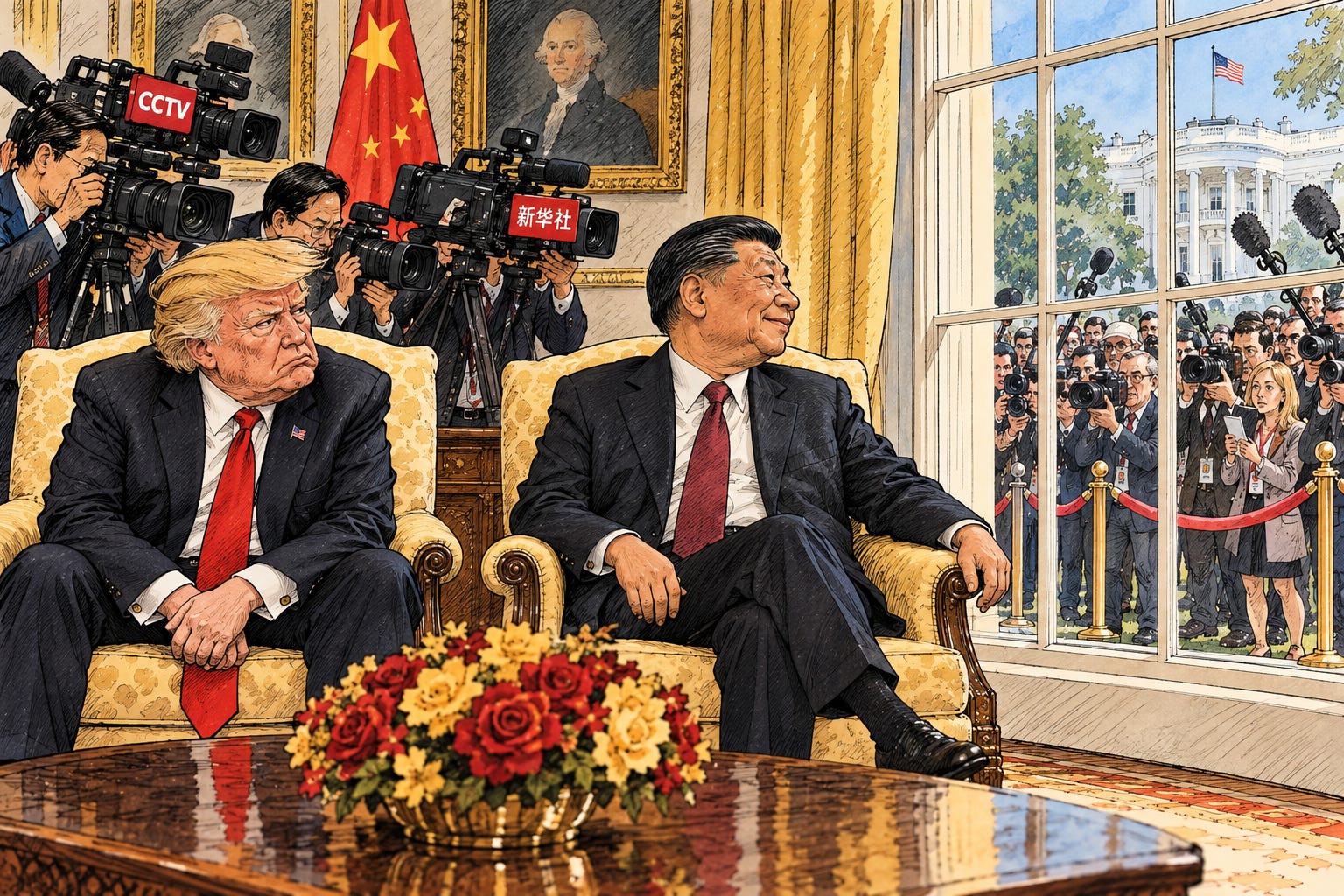
Xi Jinping arrived in Washington this week for his first state visit in more than a decade, and President Trump is rolling out everything but the ballroom. The president greeted him personally on the tarmac at Joint Base Andrews. Next came a military review and a flyover, and tonight, a state dinner stocked with tech titans.
The official agenda is crowded: artificial intelligence, rare earths, tariffs, Iran and, looming over all of it, Taiwan. The Trump administration is competing hard with China, restricting its access to advanced technology, working to loosen Beijing’s grip on critical minerals and trying to build an American-led AI ecosystem.
For all the pageantry, the story dominating the headlines is which American reporters got to cover it. Take a snapshot of America today, assuming you’re allowed to, and Xi has to like what he sees.
The United States is still more powerful than China. It has the stronger military, the bigger economy and a network of alliances Beijing has never come close to replicating. But many of those advantages look less commanding than they did a year ago. And some of the behavior Washington spent decades warning about in Beijing is getting harder to explain at home.
Five years ago, as Joe Biden braced the country for a long-term competition with China, I argued that Washington was fixating on the tangible parts of the contest: infrastructure, factories, chips, carriers. Those things mattered, and they still do. Trump is competing on much the same terrain. But the deeper competition was always over something China couldn’t buy or build. It was over what America represented.
That was never as sentimental as it sounds. The United States came out of World War II with overwhelming military and economic power, then multiplied it by building alliances and institutions other countries actually wanted to join. American democracy was messy and its record uneven, but there was a reason dissidents looked to Washington and not Beijing, why countries lined up for American security guarantees, and why the world’s most ambitious students and entrepreneurs wanted to come here.
Military and economic might mattered, but so did the power of the example. Today, it’s all looking a little shakier.
After September 11, Chinese strategists watched the United States pour blood and treasure into Afghanistan and Iraq and declared the arrival of a period of strategic opportunity. While America was busy elsewhere, China could build.
Twenty-five years later, Beijing is enjoying the sequel.
The war with Iran has burned through advanced American munitions and pulled ships and missile defenses out of Asia at precisely the moment Washington insists China is the main long-term challenge. Whatever the war is costing China, it is costing America far more in money, weapons and attention.
Taiwan makes the diversion harder to shrug off. Many of the weapons being fired in the Middle East are the same ones that would be needed in a fight over the Taiwan Strait. And Beijing is pressing Washington to hold off on a $14 billion arms package Trump has publicly called a “bargaining chip.” The chips in question are Taiwan’s ability to defend itself. The message to every American ally is that its security is now a line item in someone else’s trade deal.
For most of the postwar era, one of America’s great strategic luxuries was that its closest friends never had to wonder whether they needed to hedge against the United States itself. Now they do.
Canada has rebuilt ties with Beijing and moved closer to Europe. Europeans are also spending heavily on their own defense. In the Middle East, nations unsure about U.S. support are thinking about finding an accommodation with Iran.
Alliances initially built to contain Moscow and Tehran are now being rethought to survive Washington.
In Asia, China’s coercive behavior still gives Japan, South Korea and the Philippines powerful reasons to want the United States around. But America’s advantage has always been the confidence behind those alliances, the assumption that Washington would be there. Increasingly, America’s friends are building insurance policies.
American institutions were long the envy of the world, the thing foreign officials cited, sometimes grudgingly, as the real difference between Washington and everyone else. For years, Beijing and Moscow poured money into disinformation campaigns designed to convince Americans that their elections were rigged, their courts were political and their government was out to get them.
Now our government is doing some of that work for them. As Trump sat down with China’s communist leader at the White House Thursday, American news organizations he had barred because he objected to their coverage were still outside, despite a court order, while Chinese state media were inside. Instead of showing Xi the messy example of the First Amendment at work, Trump was treating the American press as the enemy.
And at the United Nations this week, Trump defended America’s claim to Venezuela’s oil after the ouster of Nicolás Maduro in four words: “To the victor belong the spoils.” Take out America and Venezuela, and you’d think Vladimir Putin was talking about Ukraine.
These are the sorts of things the State Department once cited in its annual human rights reports about other countries.
But America’s institutions are still pushing back. A federal judge ordered Trump to restore access to CNN, MS NOW and Politico. The courts have continued to check the administration, and the Fed has continued to set interest rates independently of Trump’s pressure to lower them.
That matters. America’s argument was never that its institutions were perfect, or that its leaders always respected them. It was that the system had the capacity to check them.
America always had one advantage China could never manufacture: people wanted to come here. They watched American movies and hummed American songs. Immigrants waited years in line for the privilege of becoming American. Parents dreamed of sending their kids to American universities.
China has spent years trying to lure its scientists home with money, shiny campuses and increasingly sophisticated technology. America never needed a recruitment strategy. It had the Statue of Liberty.
In a competition increasingly decided by AI, biotech and other fields where the scarcest resource is human talent, that pitch was worth more than any subsidy. Foreign students ended up staffing American labs, filing American patents and founding American companies.
Now Washington is squeezing universities through federal funding and making it harder for foreign students and skilled workers to come. It is the rare arms race in which one side is voluntarily disarming.
The shift is showing up abroad. A Pew survey this summer found China viewed more favorably than the United States in 25 of 36 countries surveyed. The United States led in just six.
Xi has adjusted his pitch accordingly, crisscrossing the globe to present China as the grown-up in the room: doing deals, courting governments Washington has alienated and offering Beijing as a global mediator. Reliability is now part of the sales package, and the bar has rarely been lower.
That doesn’t make China benign or trustworthy. But it doesn’t have to be for Xi to benefit from what he sees happening in the United States.
Let’s keep some perspective. China has not discovered liberal democracy. Xi runs an authoritarian state that censors the internet, jails critics and menaces Taiwan. Its economy is sputtering, and a leader who has purged half his top generals is not presiding over a system at peace with itself.
But in this great-power competition, America is increasingly playing away from its strengths. Xi doesn’t need to outmaneuver Washington. He only has to sit back and watch Washington outmaneuver itself.
Three decades covering foreign policy has taught me one thing: the story is almost never as simple as your side wants it to be. That’s why I call balls and strikes without keeping score.
That means you get reporting and analysis that makes partisans on both sides a little uncomfortable. Clear-eyed, fact-based, and beholden to no one.
If that’s the kind of coverage you want to read- I hope you will support my work with a paid subscription.
You are beyond powerful. You are brilliant. What a piece.
Informative and insightful pieces like this one are so important. No one's crystal ball is crystal clear, but facts and expertise beat the nonsense being spewed and your perspective helps readers have confidence in their current thinking. It certainly helps me. I'll add that Xi and other shrewd heads of state like Mark Carney, have Trump's number.