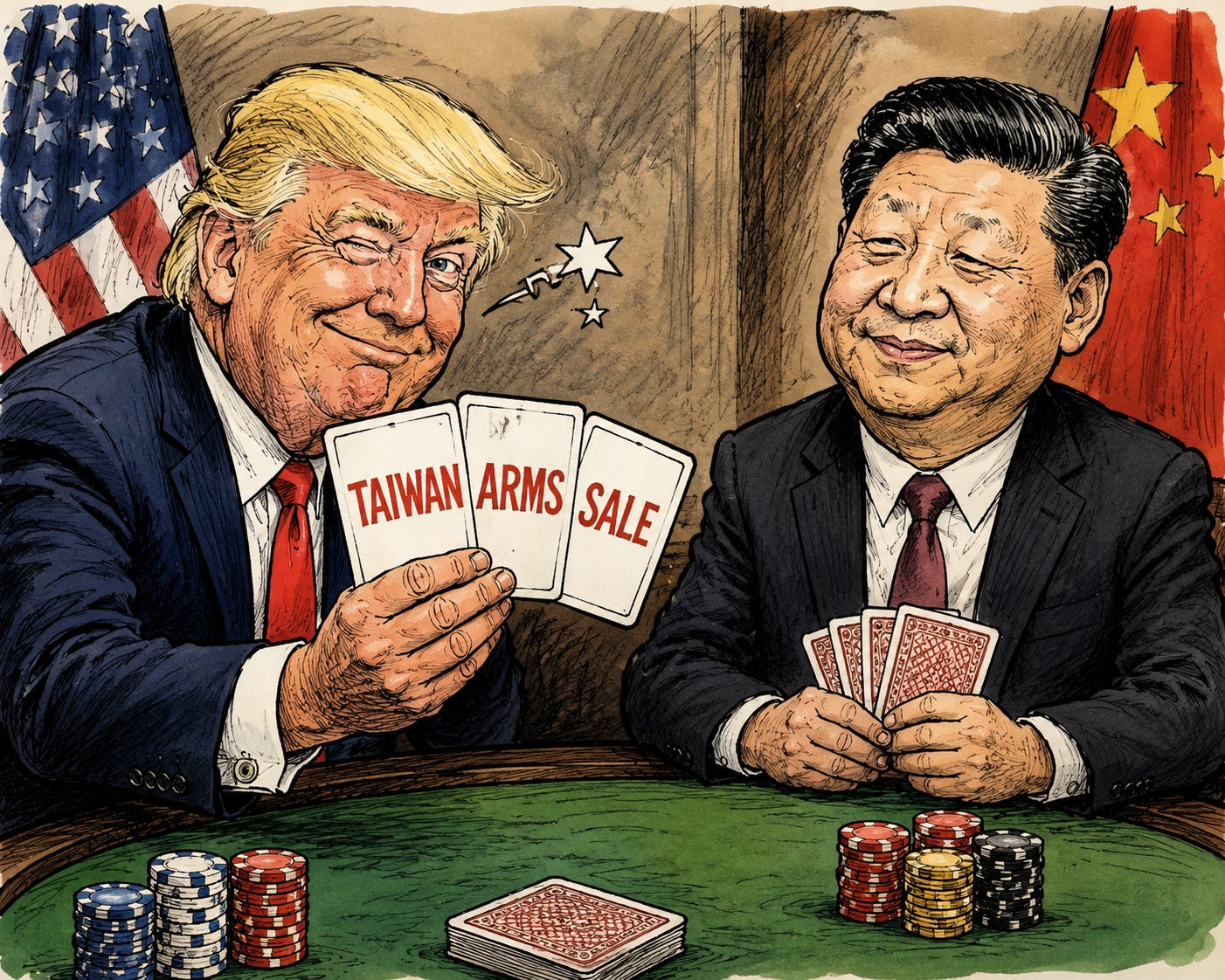
Trump shows his hand on Taiwan
Trump's Beijing summit lowered the temperature. It also raised the stakes.
Note: Danielle Pletka and I will have a special edition of Hot Takes Happy Hour. We hope to see you TODAY at 5:30 pm ET.
And now onto Taiwan:
President Donald Trump returned from Beijing this week having accomplished something genuinely rare in American diplomacy: he managed to unsettle both sides of the Taiwan Strait simultaneously. That takes a certain talent.
The headline from Trump’s first Beijing summit in nine years was the one he handed Fox News on the flight home. Asked whether he would approve a $14 billion arms package to Taiwan - missiles, anti-drone equipment, air-defense systems, the kind of hardware that keeps a small island from becoming a fait accompli - Trump was refreshingly candid.
“I’m holding that in abeyance and it depends on China,” he said. “It’s a very good negotiating chip for us, frankly. It’s a lot of weapons.”
He’s not wrong that it’s leverage. But real leverage doesn’t need to be announced on television.
The logic is pure Trump: you have something the other side wants, you hold it until you get something back. In real estate, that’s called a closing. In Indo-Pacific security, it’s called a concession.
Beijing doesn’t need to buy what it already believes it owns. Chinese officials have long maintained that American arms sales to Taiwan are non-negotiable - asserting that the U.S. and China already reached an understanding in the third joint communique of 1982 that Washington would reduce such sales over time. From Beijing’s perspective, Trump is dangling a concession it believes it previously secured.
There’s also the small matter of U.S. law. The Taiwan Relations Act - reinforced by Reagan’s “Six Assurances” in 1982, which explicitly pledged the U.S. would not consult Beijing in advance on arms sales to Taiwan - doesn’t contain a clause for “unless the president finds it handy as leverage.” Trump waved that history off on Air Force One: “I think the 1980s is a long way. That’s a big, far distance.”
Far enough, apparently, that four decades of bipartisan deterrence can be renegotiated over two days.
It is ironic that Trump spent months pressuring Taiwan to spend more on its own defense. Taiwan listened. Its parliament recently approved a $25 billion defense spending bill earmarked for U.S. weapons. Taipei did the homework, bought the textbooks, showed up early. Now the teacher is holding the homework hostage for lunch money.
Then there’s the chip problem, and not just the metaphorical kind. Trump accuses Taiwan of having “stolen” America’s semiconductor industry. He wants chipmakers to come home. And they are. TSMC has committed $165 billion to a campus in Arizona; Taiwan pledged $250 billion in broader U.S. microchip investment.
And yet Trump is simultaneously undermining the security of the island that produces over 90% of the world’s most advanced chips - the ones powering American AI, defense systems, and every smartphone in your pocket. The chips that would be essential to fighting a war with China come from the island China wants to take over.
You cannot covet Taiwan’s technology while telegraphing indifference to Taiwan’s survival. That’s not strategy. That’s wanting the eggs while negotiating away the chicken.
Trump didn’t specify what he wanted in return for delaying the weapons package, though he’s been pressing Beijing on American farm goods, aircraft, and help with Iran. So the offer on the table appears to be: Taiwan’s security, in exchange for soybeans and a maybe on Tehran.
As more than one China analyst put it this weekend, Taiwan is no longer at the negotiating table. It’s on the menu.
Reducing Taiwan to a transaction also strips away the larger case for why any of this matters. America defends democracies. We defend allies. There is a strategic interest in the line running from Japan through Taiwan to the Philippines - a chain that is not merely geographical but existential to American power in the Pacific.
Once allies become line items and democratic solidarity becomes a rounding error, the architecture that would allow an American president to make the case for action, if it ever came to that, quietly begins to collapse.
Trump says he’s not interested in a war nine and a half thousand miles away. That’s understandable. It’s also precisely the calculation Beijing has been running for years.
In many ways, this has been China’s strategy all along: not necessarily to defeat the United States militarily, but to convince Washington that Taiwan is ultimately not worth the cost. That American commitment is conditional. Transactional. Fragile.
Trump may not realize it, but he is reinforcing exactly the worldview Beijing has spent years hoping would take hold in Washington. By any honest measure, it is an even weaker posture than Biden’s was, and that was already a fairly low bar. Trump speculated that China probably won’t attack Taiwan while he’s in office, though he suspects it might after he leaves. Reassuring!
The summit did accomplish something. Temperatures are lower. Both sides agreed Iran shouldn’t have a nuclear weapon - a bar so low it barely qualifies as diplomacy. Xi didn’t need a joint statement - there wasn’t one. He got something more valuable: a public window into how the American president actually thinks. And what he saw apparently pleased him enough to agree to a return visit to the US in the fall.
Beneath the children and the flags and the flattery, Xi came to this summit with one message: Taiwan is Chinese territory. If you’re sitting in Beijing right now, you could be forgiven for concluding this American president would not lift a finger to defend the island.
The main deterrent against Chinese military action has always been uncertainty - or, in diplospeak, strategic ambiguity - backed by credible arms and credible will. One of those pillars just got considerably shakier.
Trump’s instinct to avoid a war with China is the right one. But the way you avoid a war with China is not to signal that deterrence is negotiable. It’s to make absolutely sure Beijing believes it isn’t.


Oh Ms. Labott, you're so last century. And I'm there right along with you. At the bare minimum, United States policy should be standing with allies and with free nations everywhere. Were not the lessons of Munich learned? I recommend Winston Churchill's "The Gathering Storm" for the younger crowd. Take care.