


When Washington chose to fight Iran, it didn’t get to choose how the regime — and the forces aligned with it — would fight back. Increasingly, the answer is simple: hit the ally, not the patron.
That’s the elephant in the room waiting for President Trump when he sits down with Gulf leaders this week on the sidelines of the UN General Assembly. How Washington handles it could help determine something much bigger than this crisis: how much American leadership — and leverage — survives the war.
A month ago, I warned in The Washington Post that Washington risked focusing on Hormuz until it was too late to protect the backup route. We are getting closer.
Saudi Arabia is under direct attack. The Houthis have swept down Yemen’s Red Sea coast and now sit astride Bab el-Mandeb, the gateway between the Red Sea and the Indian Ocean. They’ve hit Saudi cities and energy sites, and this weekend claimed strikes near Riyadh’s main airport. They also damaged the East-West Pipeline, the one Saudi Arabia built specifically as insurance, so its crude could reach the Red Sea whenever Hormuz got too dangerous to use. Aramco has already started cutting shipments to Europe.
Iran has already shown it can squeeze the world’s oil supply through Hormuz. Now the Houthis are squeezing the other side of the peninsula, sitting on the exact route Saudi Arabia was counting on as its backup.
The Houthis aren’t marionettes. They have their own war with Riyadh and their own reasons for fighting it. But autonomy and alignment aren’t opposites. A Houthi missile can serve Houthi interests and Iranian interests at once, hurting Tehran’s adversaries without putting a single Iranian asset in American crosshairs.
Riyadh wants more direct American intervention. It’s gotten high-level visits, intelligence and targeting support, but little else, because Washington is treating the Houthis as a separate war.
U.S. officials also talked directly to the Houthis in Oman, where the group reportedly promised to leave American and other commercial vessels alone while continuing to target Saudi shipping. Trump seemed satisfied with the distinction. The Houthis, he told reporters, “don’t want to fight with us.”
Say what you want about a group that spent years being dismissed as a ragtag militia — the Houthis have a sophisticated understanding of exactly where Washington’s lines are and how to stay on the safer side of them.
There are legitimate reasons America doesn’t want another Yemen war. The military is already stretched fighting Iran, with interceptor stocks now strained. A decade of military campaigns never made the Houthis disappear, and no serious expert thinks another one would end differently.
That’s a strong argument against launching another air campaign. But it doesn’t exempt America from what happens in the Red Sea. And it definitely doesn’t mean Washington can dodge the cost.
Bab el-Mandeb isn’t a Saudi waterway. It connects the Red Sea to the Indian Ocean and, through Suez, Europe to Asia. When ships avoid it, voyages take longer. Insurance climbs. So does freight and, eventually, the price of whatever is sitting in the container.
America drills plenty of its own oil. It doesn’t set its own oil price. Brent closed the week near $104 a barrel. And that’s just the gas bill. The bigger cost may be to something Washington is still trying to build in the region.
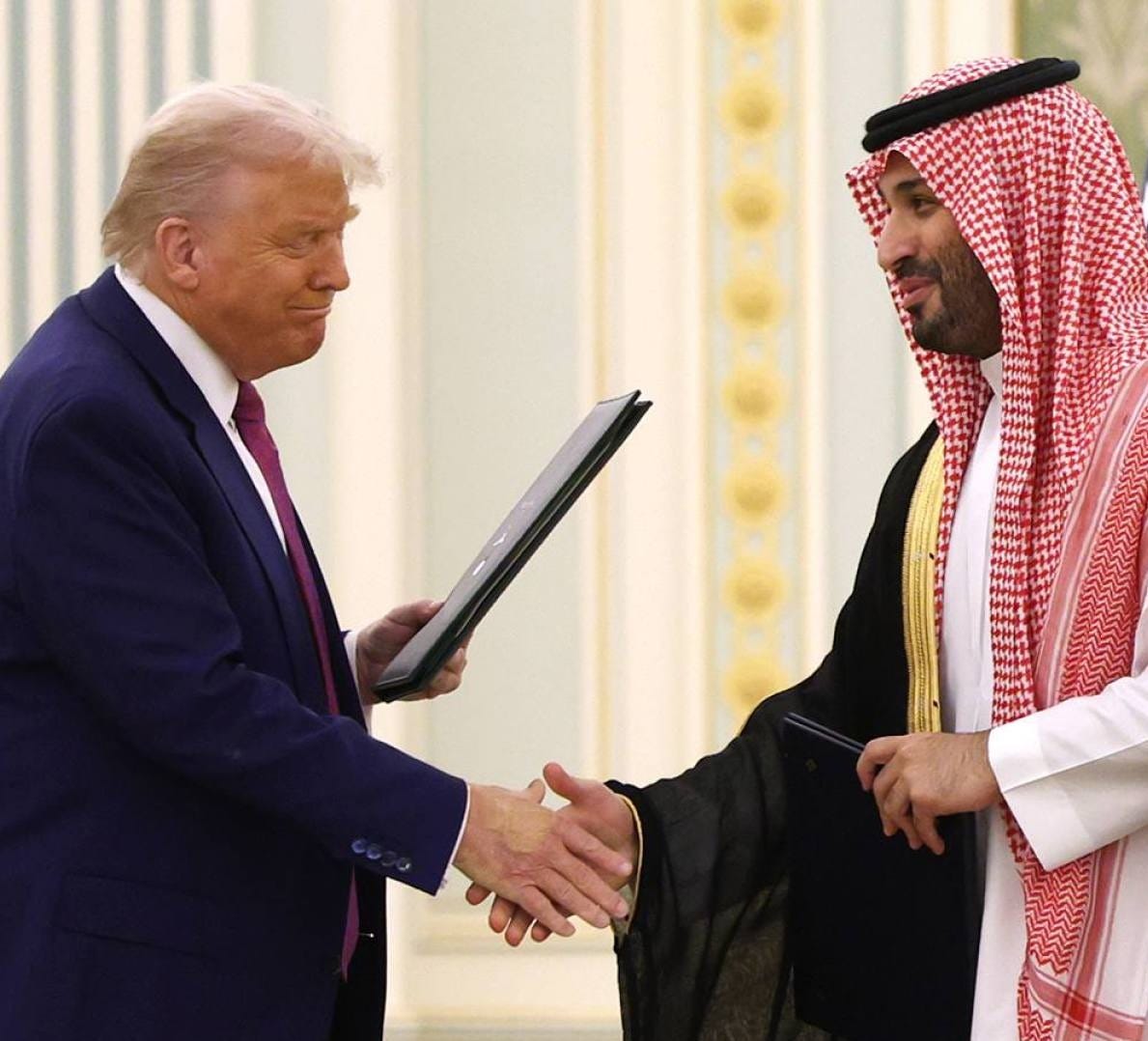
Less than a year ago, Trump and Crown Prince Mohammed bin Salman rolled out a sweeping economic and security partnership. Nearly a trillion dollars in Saudi investment commitments. F-35s. Hundreds of American tanks. And at the center, a “historic” Strategic Defense Agreement meant to “fortify deterrence” and cement the United States as Saudi Arabia’s primary strategic partner.
The agreement never promised anything like NATO’s Article 5. But the fine print doesn’t matter much right now. Saudi cities, refineries and shipping are under attack and, whatever the letter of the agreement says, I’m pretty sure this isn’t what fortified deterrence is supposed to feel like.
It’s also not what the economic bargain assumed. A kingdom burning through its own interceptor missiles and worrying whether its oil can reach its customers has different priorities from one pouring billions into American chips and data centers.
So Riyadh is doing what countries do when they become less certain about the security architecture around them. It’s finding a Plan B.
Last month, Saudi Arabia signed the Mecca Joint Defense Agreement with Turkey and Pakistan, with language reportedly resembling NATO’s Article 5 — an attack on one is an attack on all.
When the Houthis hit a Saudi Aramco refinery in Jazan 48 hours after the signing, neither new partner rushed to help. Now, the Mecca pact may be starting to gain weight. Turkey said this weekend it is ready to help meet Saudi military needs, even while pushing for a diplomatic end to the fight with the Houthis.
Steven Cook at the Council on Foreign Relations thinks focusing on the specifics of the agreement misses the point. Mecca’s importance, he argues, “does not lie in its security guarantees.” It is a signal of something larger: a “change underway in the Middle East’s regional order—one that reduces the United States’ decades long leadership role.”
This isn’t the birth of an Islamic bloc. Saudi Arabia has spent much of the past decade trying to move away from religion as the organizing principle of its foreign policy. Still, strategic necessity can make for interesting company, and it can’t be ignored that three major Muslim powers are building a defense relationship with neither Washington nor Israel at the table.
Riyadh isn’t stopping there. This month it asked China to lean on Iran and get the Houthis to stand down, and Beijing quietly did, because a war choking two major oil chokepoints at once is terrible for an economy that runs on Middle Eastern crude. China also has something particularly useful right now: leverage in Tehran. It is Iran’s largest trading partner and the main buyer of its oil. And it brokered the 2023 deal that restored relations between Saudi Arabia and Iran in the first place.
None of that means Saudi Arabia is leaving Washington behind. Turkey, Pakistan and China can’t replace decades of American arms sales, intelligence-sharing and military cooperation. The shift is more subtle: Riyadh is building more places to turn.
Washington has spent years telling its Middle Eastern partners to carry more of their own security burden. That’s a fair ask. But burden-sharing only works to America’s advantage if Washington is still providing the leadership that holds the pieces together.
That doesn’t mean another war in Yemen. It means treating Hormuz, Bab el-Mandeb, Saudi air defenses and Iran’s economic leverage as one strategic problem — and organizing a regional response before everyone starts improvising their own.
That’s the choice waiting for Trump this week: Lead a security order in which America’s allies carry more of the burden, or watch them shape one where America has less say.
Three decades covering foreign policy has taught me one thing: the story is almost never as simple as your side wants it to be. That’s why I call balls and strikes without keeping score.
That means you get reporting and analysis that makes partisans on both sides a little uncomfortable. Clear-eyed, fact-based, and beholden to no one.
If that’s the kind of coverage you want to read- I hope you will support my work and subscribe.
The solution to this strategic problem is fairly simple. Stop supporting apartheid Israel. Stop selling weapons to the region’s dictators and withdraw all American troops from the region. Hormuz would be open right now if America hadn’t started an illegal and unjust war against Iran and the Houthis would never have evolved into what they are today if Saudi hadn’t spent years bombing Yemen (with American weapons and support) and killing 377k people.
The more America interferes in the region, the worse its strategic problems get.
Is Saudi Arabia Royal family and MBS in jeopardy of political backlash by the tribes? The Middle East is losing power and influence but still has plenty of money. Oil isn’t as important as it used to be and with the conflict even less so.