When the lights go out
Hanukkah, Bondi Beach, and the darkness we refuse to name
The last few days have brought senseless tragedy and heartbreak: the massacre of Jews celebrating Hanukkah at Bondi Beach in Australia, a mass shooting at Brown University while students were studying for finals, six teenagers shot at a sweet sixteen in Brooklyn and the murder of filmmaker Rob Reiner and his wife Michelle in Los Angeles - their own son now arrested for the crime. Real loss, real fear, real pain - across countries, communities, and faiths. The weight of this moment feels unusually heavy.
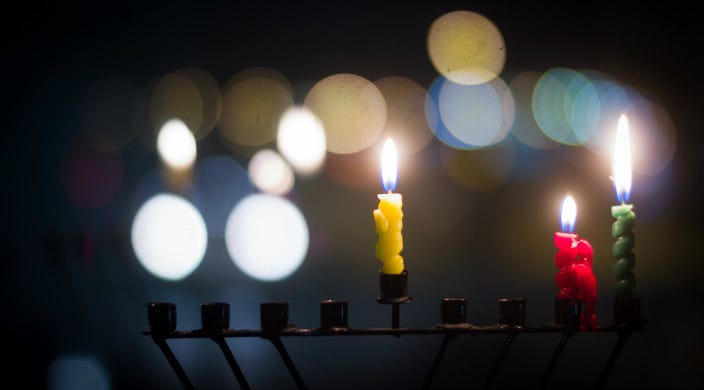
Last night I lit my late grandmother’s Hanukah menorah - one with Hebrew letters spelling ‘shalom’ that she brought back from Israel in the 1980s - with a knot in my stomach. Hanukkah is supposed to be about light persisting against darkness, about a small band of Jews refusing to let their faith be extinguished. It’s a holiday celebrating the miracle of oil that burned for eight days when it should have lasted only one.
But on the first night of Hanukkah this year, as families gathered at Sydney’s Bondi Beach to celebrate that ancient miracle, two gunmen opened fire on a community simply trying to observe their faith. Fifteen people were killed - including a 10-year-old girl, a rabbi and a Holocaust survivor. Forty others were injured.
The imagery is almost too painful to process: a beach celebration, families with children, the first night of a holiday about religious freedom and survival - shattered by violence explicitly targeting Jews for being Jews. One of the shooters died at the scene. The other remains in a coma, but Australian authorities confirmed he’d been investigated in 2019 for possible ties to Islamic State. He held a gun license for ten years and had legally amassed six firearms.
The light in the darkness
Before we descend entirely into despair, there’s Ahmed al-Ahmed - a local shopkeeper who single-handedly disarmed one of the terrorists, taking two bullets in the process. Watch the video that’s since gone viral and you’ll see what courage actually looks like: not a trained soldier or security professional, but an ordinary man who saw people being murdered and decided that doing nothing wasn’t an option.
Ahmed al-Ahmed is Muslim. The people he saved were Jews celebrating Hanukkah. That matters - not because it’s surprising that a Muslim would save Jewish lives, but because it demonstrates what should be obvious: humanity transcends religious boundaries. His act of heroism saved countless lives and stands as proof that the hatred being weaponized against Jews isn’t inherent to any faith tradition. It’s a choice.
But here’s the uncomfortable question his heroism forces us to confront: Why were Jewish families vulnerable to mass murder while celebrating a holiday on a public beach in a Western democracy in 2025?
A pattern, not an anomaly
The Bondi Beach massacre wasn’t an isolated incident - it was the logical endpoint of a pattern Australian authorities chose to ignore. The Executive Council of Australian Jewry documented 1,654 antisemitic incidents between October 2024 and September 2025, in addition to 2,062 the year before. That’s nearly five times the average annual number before October 7, 2023.
Let’s be specific about what “incidents” means: masked individuals setting fire to Melbourne’s Adass Israel Synagogue while congregants prayed inside. Sydney synagogues defaced with swastika graffiti. A childcare center near a Jewish school targeted with arson and antisemitic graffiti. Cars set ablaze in Jewish neighborhoods, homes vandalized. Healthcare workers in Sydney caught on video boasting they’d killed Israeli patients in their care.
Days after Hamas’s October 7 attack, mobs gathered outside the Sydney Opera House chanting “Where’s the Jews?” Australian officials recorded these threats. They documented the firebombings. They investigated the suspects. And then, apparently, they decided these were merely “incidents” - not a pattern of escalating violence that any honest assessment would recognize.
Rabbi Levi Wolff of Sydney’s Central Synagogue told Reuters after the attack, “When antisemitism goes unchecked from the top, these are the things that happen.” The Australian Jewish Association posted on Facebook: “How many times did we warn the government? We never felt once that they listened.”
They’re listening now that 15 people are dead.
The rhetoric that kills
This isn’t just an Australian problem. It’s a global phenomenon fueled by rhetoric that’s been normalized, even celebrated, on college campuses and city streets from Melbourne to Manhattan.
“Globalize the Intifada.” To most Jews - and to anyone who understands the history - this means “bring armed Jewish killing everywhere.” But activists chant it at rallies, print it on signs, and spread it across social media as if it’s merely a political expression rather than a call for violence.
“From the River to the Sea.” This isn’t advocacy for Palestinian statehood - it’s a slogan from the Hamas charter calling for the elimination of Israel and, by extension, all Jews who live there. Yet it’s become ubiquitous at demonstrations worldwide.
When protesters chanted these slogans in Sydney on October 9, 2023 - when they demanded to know “Where are the Jews?” - they were creating the conditions for what happened at Bondi Beach. They were teaching people that targeting Jews is resistance, that violence against civilians is justified, that antisemitism is actually anti-imperialism.
The willingness of Western democracies to tolerate this rhetoric - to treat it as protected political speech rather than incitement to violence - has consequences written in blood. As Deborah Lipstadt, the former US Special Envoy to Combat Antisemitism, told CNN after the attack, there has been “a concerted effort to make Jews afraid.” At kosher restaurants, Israeli-style cafes, synagogues - Jews are being assaulted simply for being visible. She spoke of people she knows who now tuck their Star of David necklaces under their shirts or leave them at home entirely. Parents asking each other whether buying a Jewish star as a Hanukkah gift might endanger their children.
No other religion is forced to think this way. No other group questions whether their children should hide symbols of their faith to stay safe.
The complexity we can’t ignore
I need to say something uncomfortable: Israeli Prime Minister Benjamin Netanyahu has weaponized antisemitism for his own political ends.
I wrote about this earlier this year after the Washington shootings at the Capital Jewish Museum. In the wake of Bondi Beach, Netanyahu immediately blamed Australia’s recognition of a Palestinian state for “pouring fuel on the antisemitic fire.”
That’s obscene. The recognition of Palestinian statehood - which 159 countries have now granted - is a diplomatic position about a political conflict. The murder of Jews celebrating Hanukkah is antisemitic terrorism. I continue to argue that conflating legitimate diplomatic disagreement with incitement to violence doesn’t combat antisemitism - it trivializes it and makes the real threat harder to address.
Australian Prime Minister Anthony Albanese rightly rejected Netanyahu’s attempt to connect these issues, calling it “an unfounded and dangerous shortcut.” But Netanyahu’s cynical exploitation of Jewish fear doesn’t negate the reality of that fear, the violence driving it or Australia’s failure to address it.
This is the complexity we as Jews have to hold: Yes, Netanyahu has repeatedly used antisemitism as a shield against legitimate criticism of his government’s policies. Yes, criticism of Israel’s conduct in Gaza is not inherently antisemitic. And yes, there is a very real surge in violent, deadly antisemitism targeting Jews worldwide - not because of what Israel does, but because of what Jews are. Israeli policies are a convenient excuse, but are not the cause of this hatred.
Getting to the root
Antisemitism has its own particular insidious character. It shape-shifts to fit whatever narrative is ascendant. In medieval Europe, Jews were Christ-killers. In the 19th century, we were capitalist exploiters. In the 20th century, we were communist infiltrators. Today, we’re colonial oppressors. The content changes, but the conclusion remains the same: Jews are the problem, and the world would be better off without them.
Jews make up less than 0.2% of the global population - a number that would be much higher if six million of us hadn’t been murdered within living memory. We should barely register in public consciousness. Yet we remain constant targets for the world’s rage, convenient scapegoats onto whom every grievance can be projected.
The current wave of antisemitism is particularly dangerous because it’s cloaked in the language of social justice. By framing all criticism of Israeli policies as “anti-imperialism” or “anti-colonialism,” activists have found a way to make Jew-hatred defensible in some progressive circles. They’ve created a permission structure that allows educated people to rationalize violence against Jews as resistance against oppression.
This isn’t about Middle East policy. It’s about the oldest hatred finding a new disguise. And until we’re willing to name it clearly - until we’re willing to acknowledge that the line between “criticism of Israel” and “globalize the Intifada” is the difference between political discourse and incitement to murder - we’ll keep counting Jewish bodies and wondering how it happened again.
Light in the windows
Tonight I’ll light the menorah again - three candles instead of one. The tradition teaches that we add light each night, that darkness can be driven back incrementally, that miracles happen when we refuse to let the flames die out. Jewish families understand this when they light menorahs in their windows, show up to synagogue despite the threats and gather on Bondi Beach to celebrate their faith even after the unimaginable happened.
This is the choice we face: Do we let darkness win through fear and silence? Or do we insist - as Jews have for thousands of years, as Ahmed al-Ahmed did when he threw himself at an armed terrorist - that some things are worth the risk?
Menorahs are still burning in Melbourne and Sydney, in Manhattan and Paris, in Jerusalem and Buenos Aires - burning despite the threats, despite the violence, despite everything. This year, that miracle looks less like ancient oil and more like ordinary people refusing to let hatred have the final word.
Happy Hanukah to all who celebrate. Light and latkes for all.


Amen!
Unfortunately it is not only Australia. It is most of Europe and the US too. It feels like 1933 in Germany all over again. Jews are afraid. Jews are being humiliated. And Qatar and Iran are paying for it. To terrorists all over and to universities in the US and elsewhere. The Jews have, again, become the scapegoat of all losers and all left and right parties. The AfD and Die Linke in Germany. And almost nobody gives a shit. Bondi Beach is just the latest example. Where will it end??