

Cuba is next. Then what?
Washington knows how to apply pressure. It has no theory of aftermath.

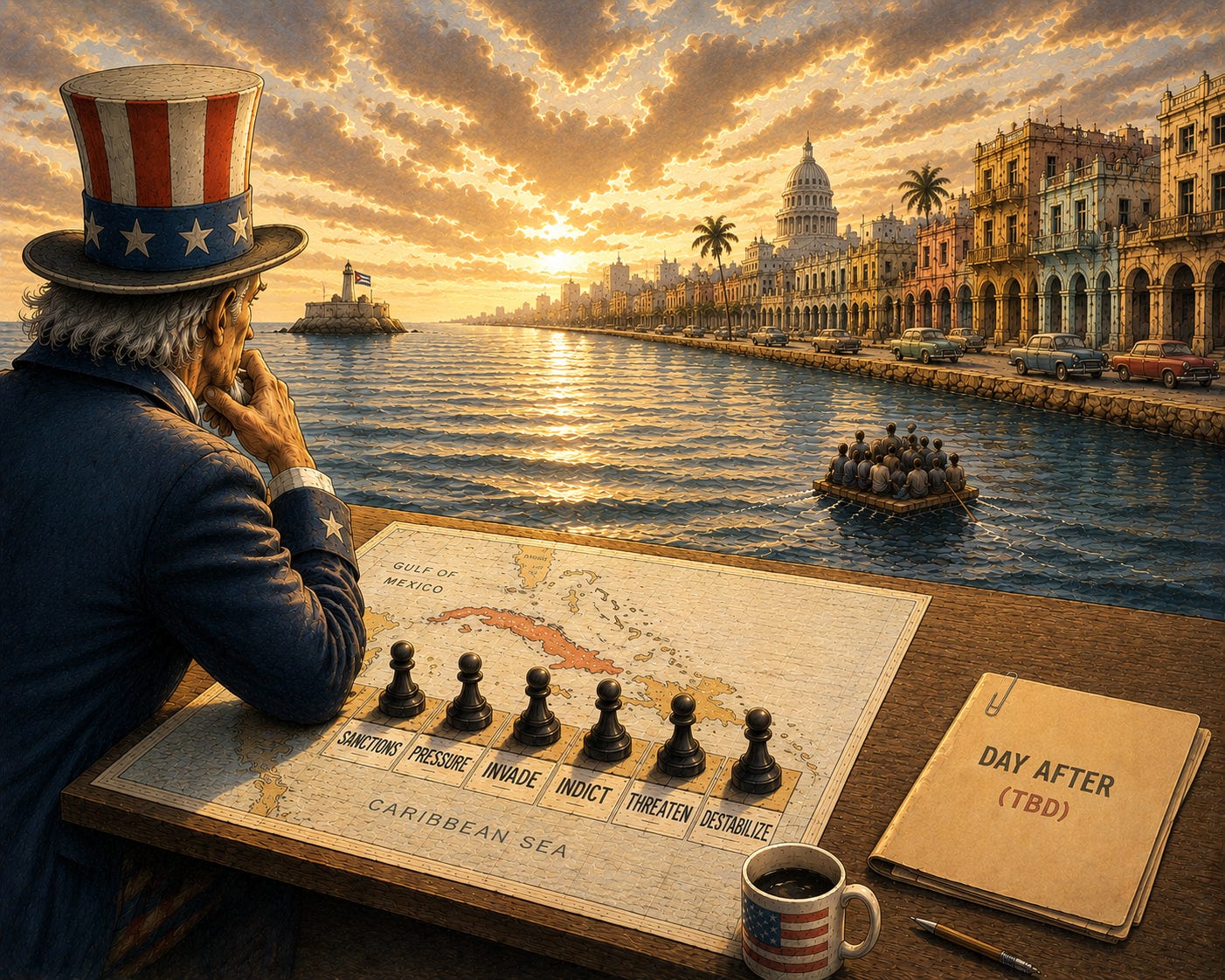
The Trump administration has spent months methodically squeezing Cuba — cutting off its oil supply, sanctioning the military conglomerate that controls much of the island’s economy, and now indicting 94-year-old former president Raúl Castro on murder charges connected to the 1996 shootdown of two civilian planes flown by Miami-based exiles.
The message from Washington is unmistakable: Cuba is next. But the deeper question is not whether Cuba can be squeezed harder. It’s what happens if the pressure actually works.
The administration appears to believe Cuba is simply Venezuela with better cigars and worse WiFi: another brittle authoritarian state that can be pressured, isolated and pushed toward collapse. But collapsing governments and replacing governments are not the same thing — something Washington has spent the better part of two decades relearning from Baghdad to Caracas.
And what’s striking about this moment is not simply the escalation itself, but how familiar the rhythm suddenly feels. Washington spends its mornings talking about AI competition with China and semiconductor supply chains and its evenings floating regime change 90 miles off the Florida coast like it’s 1962 with Starlink.
Somewhere along the way, “America First” started sounding a lot like “back to the hemisphere.”
The indictment of Castro, announced Wednesday at a ceremony in Miami timed to coincide with Cuban independence day, follows a by-now familiar Trump administration script. In January, U.S. special forces seized Venezuelan President Nicolás Maduro in a raid on his Caracas compound after a secret grand jury indictment. The legal charge created the pretext; the military operation executed it. The administration has been signaling ever since that the same logic could apply to Havana.
But the differences matter enormously. When Maduro fell, there was a ready-made successor structure willing to cooperate with Washington. Cuba has no equivalent. Raúl Castro, despite formally retiring years ago, still appears to function as the regime’s final veto point. His grandson, Raúl Guillermo Rodríguez Castro — known as “Raúlito” — has emerged as Havana’s backchannel to Washington, quietly meeting with Secretary of State Marco Rubio and later CIA Director John Ratcliffe. But he is a gatekeeper, not a successor. Not only is there no obvious Cuban equivalent of the post-Maduro arrangement Washington engineered in Venezuela, the government is warning Washington a military assault on Cuba would cause a “bloodbath with incalculable consequences.”
And then there’s the optics problem. Removing Maduro allowed the administration to present the operation as a kind of hemispheric counter-narcotics mission wrapped in regime change. Dragging a 95-year-old revolutionary across the Florida Straits in handcuffs is something else entirely. Even some of the indictment’s loudest supporters tacitly acknowledge the real target is not Castro himself, but the survival of the regime he represents. “Real justice,” Republican Congresswoman Nicole Malliotakis said this week, would mean “seeing the regime ending, being brought to its knees.”
That is not really a prosecution. It is an endgame. And endgames are much easier to announce than to manage — especially when the target is a collapsing island of 10 million people sitting one short boat ride from Florida.
Meanwhile, the humanitarian pressure is becoming impossible to ignore. Since Washington effectively cut off Venezuelan oil shipments to the island — Cuba’s primary energy lifeline — the country has descended into what increasingly resembles a slow-motion systems failure. Blackouts in Havana can last up to 22 hours a day. Hospitals are postponing surgeries. Refrigerators fail. Families charge phones whenever electricity briefly flickers back to life like campers spotting civilization after days in the wilderness. Cuba’s own energy minister has acknowledged the island has exhausted its diesel and fuel oil reserves. Two major European shipping firms have suspended Cuba-linked operations in response to expanded U.S. sanctions.
And yet Havana is still refusing the one thing Washington most wants: political surrender.
In interviews over the past month, Cuban officials have been remarkably consistent. They say they are open to talks, open to investment, even open to broader economic reforms. What they are not open to is negotiating away the structure of the state itself. “The nature of the Cuban government, the structure of the Cuban government, and the members of the Cuban government are not part of the negotiation,” Vice Foreign Minister Carlos Fernández de Cossío told NBC’s Meet the Press recently.
That position may sound rigid. But it is also internally logical. The Cuban leadership increasingly appears to believe that meaningful economic opening is indistinguishable from regime suicide. And from Havana’s perspective, the administration’s rhetoric hasn’t exactly reassured them otherwise.
The irony is that some American officials once believed precisely the opposite. The theory behind the Obama administration’s rapprochement was not that engagement would save the Cuban system, but that exposure to American tourism, investment, information and consumer expectations might gradually erode the revolutionary model more effectively than isolation ever had. The bet was that normalization, over time, could delegitimize the revolution from within.
That experiment was never really given time to mature. Trump reversed the opening before its long-term political effects could fully play out, and Biden largely maintained the architecture of Trump’s harder line. Now the administration appears to be betting once again that deprivation, rather than integration, is the faster route to transformation.
Even some figures connected to the Cuban elite have hinted at the contradiction. Raúl Castro’s black sheep influencer grandson — which in itself feels like an accidental metaphor for modern Cuba — suggested in a recent CNN interview that Cubans are “capitalists at heart.” The comment was partly performative, partly provocative, but it reflected a longstanding assumption among engagement advocates: that the revolutionary state may ultimately be more vulnerable to normalization than to siege.
Because pressure can weaken a regime. But it can also reinforce the regime’s oldest and most durable narrative: that Cuba is a small island under permanent assault by the United States.
CIA Director Ratcliffe’s recent trip to Havana suggested Washington still sees some negotiated path forward. But the public messaging coming from elsewhere inside the administration often sounds less like diplomacy than psychological warfare.
Rubio — a Cuban American who has spent decades politically and emotionally invested in the Cuban question — now speaks less like a secretary of state managing a bilateral dispute than the avatar of Miami’s unresolved Cold War memory. Cuba, for him, is not just a foreign-policy file. It is the last unfinished chapter of a political inheritance that shaped modern Florida Republicanism. And in today’s Republican Party, successfully engineering the end of the Castro system would not just reshape Rubio’s foreign-policy legacy. It could look a lot like a presidential credential.
What makes this moment different is that Rubio appears to believe history has finally handed him the endgame. And Trump, meanwhile, appears increasingly willing to indulge it.
What’s strange about all of this is where Trumpism has landed on foreign policy. The movement that once defined itself against forever wars, nation building and interventionism has now authorized a war in Iran, seized a foreign leader from his capital, imposed a wartime-style blockade on a neighboring island, and openly discussed military planning for another potential regime confrontation in the Caribbean. Trumpism increasingly looks less like isolationism than a highly personalized version of selective imperial management.
Not everyone inside MAGA seems comfortable with that evolution. Some Trump allies have quietly questioned whether the administration is opening too many fronts simultaneously. Others appear to see Cuba less as a strategic necessity than a politically useful spectacle — another high-drama geopolitical confrontation at a moment when the Iran conflict has become more complicated than many inside the White House anticipated.
But the deeper problem is simpler: what happens if this adventure actually works Washington has become very good at applying pressure. What it still lacks is a theory of aftermath.
Failed states do not politely remain inside their own borders. They leak — through migration crises, organized crime networks, black markets, intelligence vacuums and geopolitical opportunism. And terrorism. Unlike Iran or other distant geopolitical flashpoints, Cuba is not a crisis Americans would experience abstractly through oil prices and cable news graphics. A Cuban collapse would arrive directly on America’s shoreline — politically, economically and physically.
The administration may ultimately be right that Cuba’s current trajectory is unsustainable. The island is running out of fuel, running out of cash and increasingly running out of time. But history’s uncomfortable lesson is that weakening a regime and replacing a regime are two entirely different projects.
Toppling governments is often treated as the climax of American foreign policy. In reality, it is usually the beginning of a much messier story.
Three decades covering foreign policy has taught me one thing: the story is almost never as simple as your side wants it to be. That’s why I call balls and strikes without keeping score.
That means you get reporting and analysis that makes partisans on both sides a little uncomfortable. Clear-eyed, fact-based, and beholden to no one.
If that’s the kind of coverage you want to read- I hope you will subscribe.
Danielle Pletka and I are back TODAY at 5:30 - told you there would be plenty more to talk about (and reasons to drink 🤦♀️)

Thor was very good Elise.
Hello, Thanks for this article on Cuba's current situation. A few comments:
1. You state Cuba "has no equivalent" successor structure as if it's established fact. What's the sourcing? This reads as speculation, not analysis.
2. The regime's "bloodbath" warning is standard deterrence rhetoric, or should we say "propaganda"?
3. The blackouts are not primarily a Trump-era creation. Cuba's energy grid has been failing since the 1990s. Framing a decades-old structural crisis as a consequence of recent sanctions lets the Cuba government mismanagement off the hook.
4. On the energy minister's claim that reserves are "exhausted", let me point that the regime somehow has enough fuel to deploy its repressive apparatus against recent street protesters. And Cuban private enterprises, many of them tied to the political elite, have been importing oil with U.S. authorization.
5. Most importantly: the claim that Obama's opening "was never given time to mature" because Trump reversed it is factually wrong. Fidel Castro published "El hermano Obama" in Granma on March 27, 2016 — days after Obama's visit — a scathing rejection that became the hardliners' blueprint for blocking reform. The Cuban government killed the thaw before Trump ever took office.
6. And last but not least, as usual in American analysis about Cuba: the voices of actual Cubans — protesters, independent journalists, civil society — are nowhere in this piece. If we're asking "then what," shouldn't we ask the people who'll live with the answer?