

Iran's new atomic bomb
The war was about nuclear weapons. The negotiation is about something else entirely.

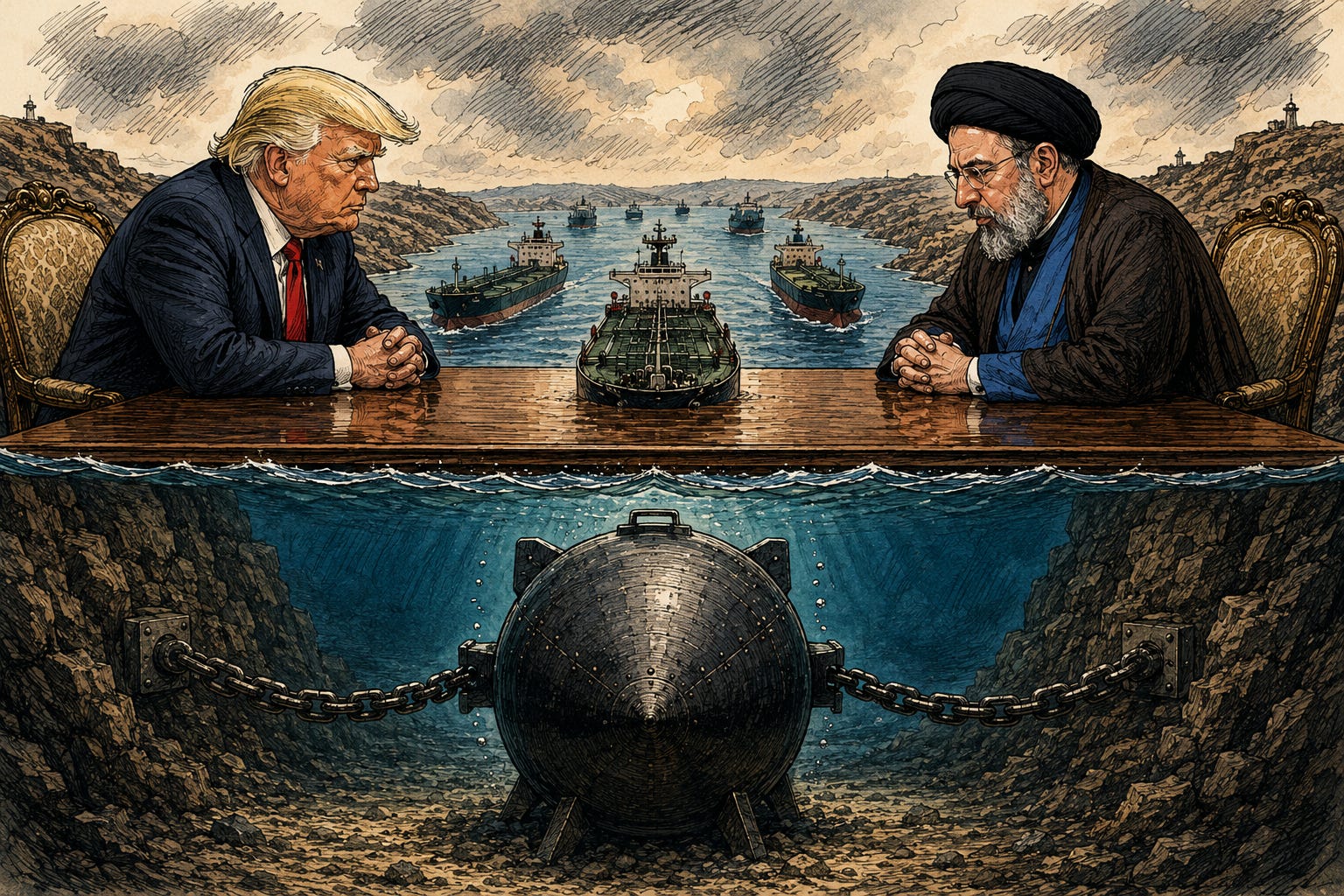
Let’s start with what President Trump actually accomplished in Iran.
He set out to eliminate the Islamic Republic’s nuclear threat — the thing that had kept American presidents up at night for three decades, survived the Obama nuclear deal, survived Trump’s first-term maximum pressure campaign, and survived endless rounds of diplomacy that produced agreements nobody fully trusted and timelines everyone knew were temporary.
Trump sent in the bombers. He hit the enrichment facilities. He killed the Supreme Leader. He did what each of his predecessors debated, deferred, and ultimately refused to do.
And then Ali Nikzad, deputy speaker of Iran’s parliament, offered perhaps the clearest articulation yet of how some in Tehran now view the conflict. Speaking after last week’s maritime confrontations in the Gulf, he declared: “The Strait of Hormuz is Iran’s atomic bomb.”
Sit with that for a moment. Because if Nikzad is right, then the war may have produced an unexpected result. Trump set out to eliminate Iran’s most important source of strategic leverage. Instead, he may have accelerated Tehran’s shift toward a form of leverage that is both more usable and, in some respects, more effective.
The odd thing about Iran’s nuclear program is that its greatest value was never necessarily the bomb itself. A usable nuclear weapon would almost certainly trigger the very confrontation Tehran spent decades trying to avoid. The real value was in remaining perpetually on the threshold of a bomb — close enough to keep the world, particularly the United States and Israel, awake at night, not quite close enough to trigger the apocalypse. For years, Iran turned nuclear ambiguity into a foreign policy asset.
The Strait of Hormuz operates differently. A bomb is a latent threat. Hormuz is an active one. Iran does not need to enrich uranium to weapons grade, evade inspectors, or build underground facilities to remind the world of its importance. It simply needs to create uncertainty in a narrow waterway through which roughly one-fifth of the world’s oil supply passes. During this war, Tehran discovered that mines, insurance premiums, nervous shipping executives, and strategic ambiguity could produce economic shockwaves that traveled much farther than any missile.
None of this means nuclear weapons suddenly do not matter. A nuclear capability still changes military calculations in ways a shipping lane never can. It deters attacks, reshapes alliances, and alters the regional balance of power. But deterrence and leverage are not the same thing. A bomb is a threat Iran may never use. Hormuz is leverage Tehran is already using and can exercise again tomorrow morning. One threatens future catastrophe. The other creates immediate pain. And immediate pain tends to concentrate minds.
None of this should be confused with an Iranian victory. Tehran has absorbed enormous damage. The Supreme Leader is dead. Key military infrastructure has been degraded. The economy, already struggling before the war, is under even greater strain. The blockade is biting. A regime facing those realities cannot reasonably be described as operating from a position of strength.
Yet weakness and leverage are not mutually exclusive. Iran may be weaker than it was before the war while simultaneously possessing more negotiating leverage than it did before the war.
American debates about Iran often collapse into a false choice. Either Tehran is on the verge of collapse or it is ten feet tall and strategically brilliant. Reality is more complicated. Iran remains a difficult problem for the same reason it has frustrated multiple administrations. The Obama-era nuclear agreement bought time but never resolved the underlying question. Maximum pressure failed to produce capitulation. Trump didn’t create that menu. He ordered from it badly.
The frustration surrounding the latest negotiations reflects this reality. Just weeks ago, both sides appeared to be inching toward a limited understanding that would freeze the conflict and create space for broader nuclear talks. Then some form of diplomatic Groundhog Day kicked in. New demands emerged. Old disagreements returned. The goalposts moved. And anyone trying to follow the process woke up each morning to a slightly different version of the same demands, denials, and strategic leaks masquerading as progress.
What didn’t change was the underlying problem: Washington is no longer negotiating only over centrifuges and enrichment levels. It is negotiating over leverage, and Tehran believes the war left it with more of it than many in Washington are prepared to acknowledge.
Which brings us to Trump’s problem. The administration appears to be searching for a Goldilocks deal on Iran: tougher than Obama’s, acceptable to Tehran, and straightforward enough to survive the trip from the Situation Room to the campaign trail.
The difficulty is that the war may have changed the negotiating landscape. Before the conflict, Washington was asking Iran to negotiate over one source of leverage: the nuclear program.
Hormuz has become a bargaining chip as well. Unlike uranium enrichment, Tehran has already demonstrated a willingness to use it. That changes the negotiation fundamentally. Washington is no longer trying to roll back one source of Iranian leverage. It is trying to roll back two.
A deal that ignores Hormuz is incomplete. A deal that formally acknowledges Iran’s ability to influence traffic through Hormuz risks leaving Tehran with greater regional leverage than it possessed before the war. Neither outcome is particularly attractive.
Which is why the perfect deal Trump keeps describing may not exist.
“The worst thing you can possibly do in a deal is seem desperate to make it,” Trump wrote in *The Art of the Deal.* One suspects Tehran’s negotiators have highlighted that passage.
For three decades, the world treated Iran’s nuclear program as the central fact of Middle Eastern geopolitics. Entire administrations were built around slowing it, monitoring it, sanctioning it, negotiating it, or threatening to destroy it.
Trump went to war to solve that problem. He may yet succeed. But in the process, he may also have awakened a sleeping source of Iranian leverage — one that does not require enrichment facilities, underground bunkers, or IAEA inspections. One that sits in plain sight on every map of the Persian Gulf.
Wars have a habit of solving the problem everyone is talking about while creating the one nobody anticipated. The nuclear question brought the United States and Iran to the brink of war. The negotiation now is about leverage — who has it, who gives it up, and what each side is willing to pay to keep it. That conversation looks very different than it did before the war.
The easiest play in media right now? Pick a team. Tell them what they want to hear. Watch the clicks roll in.
I’m not doing that.
Three decades covering foreign policy has taught me one thing: the story is almost never as simple as your side wants it to be. That’s why I call balls and strikes without keeping score.
That means you get reporting and analysis that makes partisans on both sides a little uncomfortable. Clear-eyed, fact-based, and beholden to no one.
If that’s the kind of coverage you want to read- I hope you will subscribe.
A brilliant analysis. Another one, which is why I subscribe. Your preface to the piece speaks to me. I deal in facts. As a young Marine officer I was taught to evaluate 4 variables: mission, enemy, terrain and weather. Enemy and Terrain are keys when talking Iran. We are dealing with an enemy who practices “strategic patience” and believes they are winning. We need to understand the enemy’s mind as well as the terrain, the Strait of Hormuz, that provides leverage and deterrence
Interesting analysis. I agree - Hormuz has proven to be America’s and the GCC’s center of gravity and Iran seems unlikely to give that up without serious and politically risky concessions by Trump. I guess electing an incompetent reality TV personality (who also happens to be a serial rapist and pedophile) to be our commander in chief wasn’t such a smart move after all.
I do think; however, that Iran’s smartest move would be to build 5-10 nuclear devices. Given the unhinged sociopaths who rule America and Israel, that seems like the surest path to ensuring its safety and making sure they never attack it again.