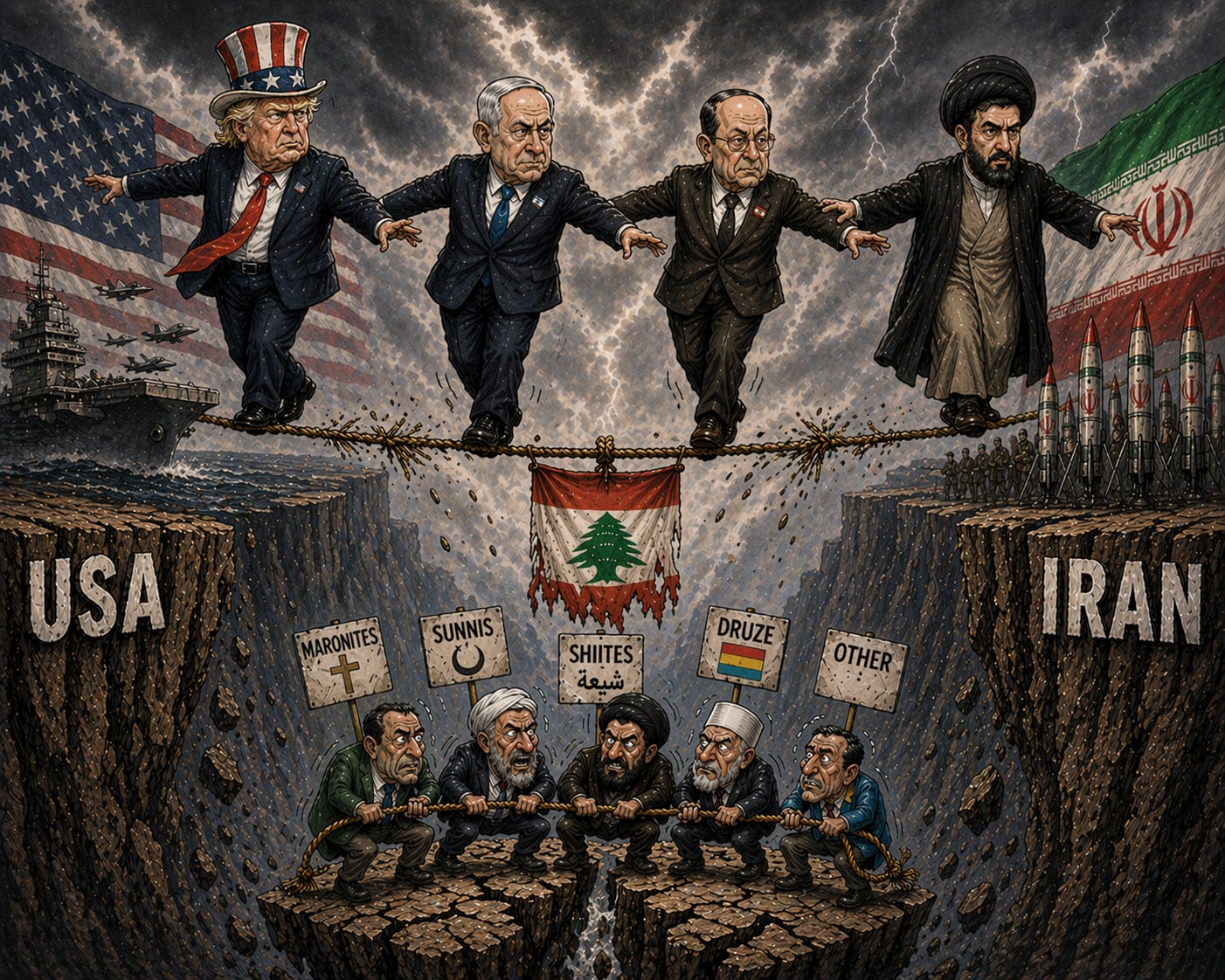
Lebanon's moment
They can meet it - if the US and Israel help Aoun walk the tightrope
For the first time in decades, Lebanon and Israel sat down together in Washington this week and talked. Directly. No back channels, no polite fiction that they weren’t actually in the same room. Two countries that have technically been at war since 1948 — and practically been at war on and off ever since — looked at each other across a table and began to negotiate.
That alone is worth pausing on. Because in the Middle East, the distance between “unprecedented” and “irrelevant” can close very quickly.
Last Thursday, President Trump announced a 10-day ceasefire — posting on Truth Social, in characteristic fashion. The ceasefire was framed as an agreement between Israel and Lebanon. There was one notable problem with that framing: Israel isn’t fighting Lebanon. It’s fighting Hezbollah, the Iranian-backed militant group that operates inside Lebanon, dominates parts of its government, and was not formally party to the agreement.
Hezbollah’s response was roughly what you’d expect from a terrorist organization that wasn’t invited to its own peace deal: non-committal, conditional, and shot through with implicit threat.
Israeli Prime Minister Benjamin Netanyahu, who reportedly didn’t have time to brief his cabinet before Trump went public, said Israel agreed to the ceasefire — but that Israeli troops weren’t going anywhere. The security zone Israel has carved out in southern Lebanon, stretching roughly 18 miles along the border, stays.
That position puts Lebanon’s government in an immediately awkward spot — having agreed to a truce while Israeli forces remain on Lebanese soil, with Hezbollah calling that presence an occupation and invoking the right to resist.
Meanwhile, more than 70,000 Israelis who were forced from their homes in the north — some for over a year — are still waiting to find out if it’s actually safe to go back. For them, the ceasefire isn’t a diplomatic milestone. It’s another promise from a government that has made this promise before.
So — cautious optimism, emphasis on cautious.
The Hezbollah problem, explained simply
To understand why this moment matters and why it’s so fragile, you have to understand what Hezbollah actually is, what it isn’t, and why Lebanon has been both unwilling and unable to disarm it.
Hezbollah is not simply a militia. It is an army, a political party, a social services network, and a foreign policy instrument, all at once. It holds seats in Lebanon’s parliament. It runs hospitals and schools across the Shia south. It built an arsenal once estimated at over 150,000 missiles, hiding them in residential neighborhoods, behind UN posts, in people’s homes. And it has always answered not to Beirut, but to Tehran — functioning as Iran’s most powerful proxy and the crown jewel of what Iran calls its Axis of Resistance.
Hezbollah is the most formidable of Iran’s network of armed proxies — a network that also includes Hamas in Gaza, the Houthis in Yemen, and Shia militias across Iraq — each one cultivated over decades to extend Iranian influence, bleed its adversaries, and ensure that any war with Iran would never be fought on Iranian soil alone.
Those multiple identities — service provider and armed force, political actor and terrorist organization — are what has made Hezbollah so impossible to dislodge. You can’t simply vote it out. You can’t legislate against it without risking a sectarian crisis. And you certainly can’t send the Lebanese army after it — Hezbollah outguns the Lebanese Armed Forces by almost any measure, and any attempt at forced disarmament would risk triggering exactly the kind of civil war Lebanon spent fifteen years trying to recover from.
Voluntary disarmament is no more realistic: Hezbollah defines itself as a resistance force, its weapons are its identity, and Iran has no interest in surrendering its most valuable regional asset without significant concessions in return.
Asking Lebanon to disarm Hezbollah has always been a little like asking someone to perform surgery on themselves. The instrument and the patient are the same. That is why the real challenge isn’t convincing Lebanon to disarm Hezbollah. It’s helping them do it in a way that doesn’t burn the country down in the process.
The United States has spent decades subsidizing both the Lebanese government and the Lebanese Armed Forces hoping to build a counterweight to Hezbollah. It never worked — not because the Lebanese army lacks soldiers, but because deploying them against one of the most powerful constituencies in the country risks doing what decades of Israeli bombardment hasn’t: tearing apart Lebanon’s sectarian balance and triggering a new civil war.
This dynamic has produced a predictable cycle. Ceasefires get negotiated — in 1996, in 2000, after the 2006 war when UN Security Council Resolution 1701 explicitly called for Hezbollah’s disarmament south of the Litani River. Each time, the agreement held just long enough for Hezbollah to regroup, rearm, and resume. The fault lines were never resolved. They were managed, imperfectly, until they weren’t.
And yet. Something may have shifted.
What’s actually different this time
The damage Israel has inflicted on Hezbollah in this war — degrading its leadership, its weapons stockpiles, its command structure — has changed the calculus in ways that previous ceasefires didn’t. Hezbollah is not destroyed. But it is weakened, politically exposed, and facing something it hasn’t confronted in a long time: criticism from within its own community.
Lebanese Shia who once supported Hezbollah’s confrontation with Israel have watched their villages demolished, their families displaced, their country carved up. More than 1.2 million people — roughly a quarter of Lebanon’s entire population — have been forced from their homes in this round of fighting alone.
Lebanon’s new government, under President Joseph Aoun, has moved more decisively than its predecessors. It has banned Hezbollah’s military activity. It has targeted Iranians supplying the group with weapons and intelligence. And it went directly to Israel — over Hezbollah’s explicit objections — for this week’s talks in Washington.
“The strategy now is to give an opportunity for Hezbollah to deliver its weapons to the government,” said Kamal Shehadi, a minister in President Aoun’s cabinet, “and to recognize that it is not only unable to protect the community it claims to protect, but that in fact it’s doing quite the opposite.”
That is a significant statement from a Lebanese official. Whether it translates into action is the question that every previous Lebanese government has answered the same way.
The Iran dimension
None of this happens in isolation from the broader US-Iran negotiations, which are running on a parallel track that keeps intersecting with Lebanon in complicated ways. Iran insisted Lebanon be included in the initial ceasefire — a reminder that Hezbollah’s fate is still, ultimately, an Iranian decision as much as a Lebanese one. Tehran may be negotiating its own terms with Washington, but it has not surrendered its most valuable regional asset and is likely to throw Hezbollah a lifeline.
Trump’s announcement that Iran had agreed to hand over its stockpile of enriched uranium — which he weirdly likes to call “nuclear dust,” a formulation Iran has not confirmed — added another layer of uncertainty to an already murky situation. Are we negotiating the Strait of Hormuz? The nuclear file? Both simultaneously? The answer seems to be yes, in a way that is either brilliantly leveraged or dangerously improvised, depending on which day you ask.
What is clear is that the pressure on Iran is designed to extract concessions. What is less clear is what happens to Lebanon if those broader negotiations collapse. A deal that works for Tehran might or might not include meaningful constraints on what Hezbollah does next.
Aoun’s tightrope
Trump wants to meet with Netanyahu and Lebanese President Aoun at the White House within the next week or two — the first direct talks between Israeli and Lebanese leaders in decades. The agreement they are seeking to finalize requires Lebanon’s government to prevent Hezbollah and other armed groups from attacking Israel. That language sounds decisive. In practice, it is an enormous undertaking for a state that has never successfully enforced it.
None of this means the current ceasefire is meaningless. It may give civilians on both sides temporary relief, allow displaced populations to return, and create space for diplomacy that wouldn’t exist otherwise. That’s not nothing — in Lebanon, it’s often the most you can hope for.
But none of this resolves the underlying contradiction. Hezbollah is not at the table. Israel is not leaving southern Lebanon. And a million displaced Lebanese are still waiting to find out whether it’s safe to go home.
Here is what ten days might accomplish that previous ceasefires didn’t: it puts the Lebanese government formally on record as the party claiming responsibility for asserting sovereignty over its own territory. That shifts the political burden in ways that matter — and sets a standard against which Beirut can be held accountable.
Whether this Lebanese government has the courage, capacity, and support to sustain that effort — not for ten days, but for the months and years it would take to actually change the facts on the ground — is the only question that matters. Every previous government answered it the same way. This moment can be different, if Aoun can walk the tightrope — and the US and Israel help him.
The easiest play in media right now? Pick a team. Tell them what they want to hear. Watch the clicks roll in.
I’m not doing that.
Three decades covering foreign policy has taught me one thing: the story is almost never as simple as your side wants it to be. That’s why I call balls and strikes without keeping score.
That means you get reporting and analysis that makes partisans on both sides a little uncomfortable. Clear-eyed, fact-based, and beholden to no one.
If that’s the kind of coverage you want to read- I hope you will subscribe.


As if…