


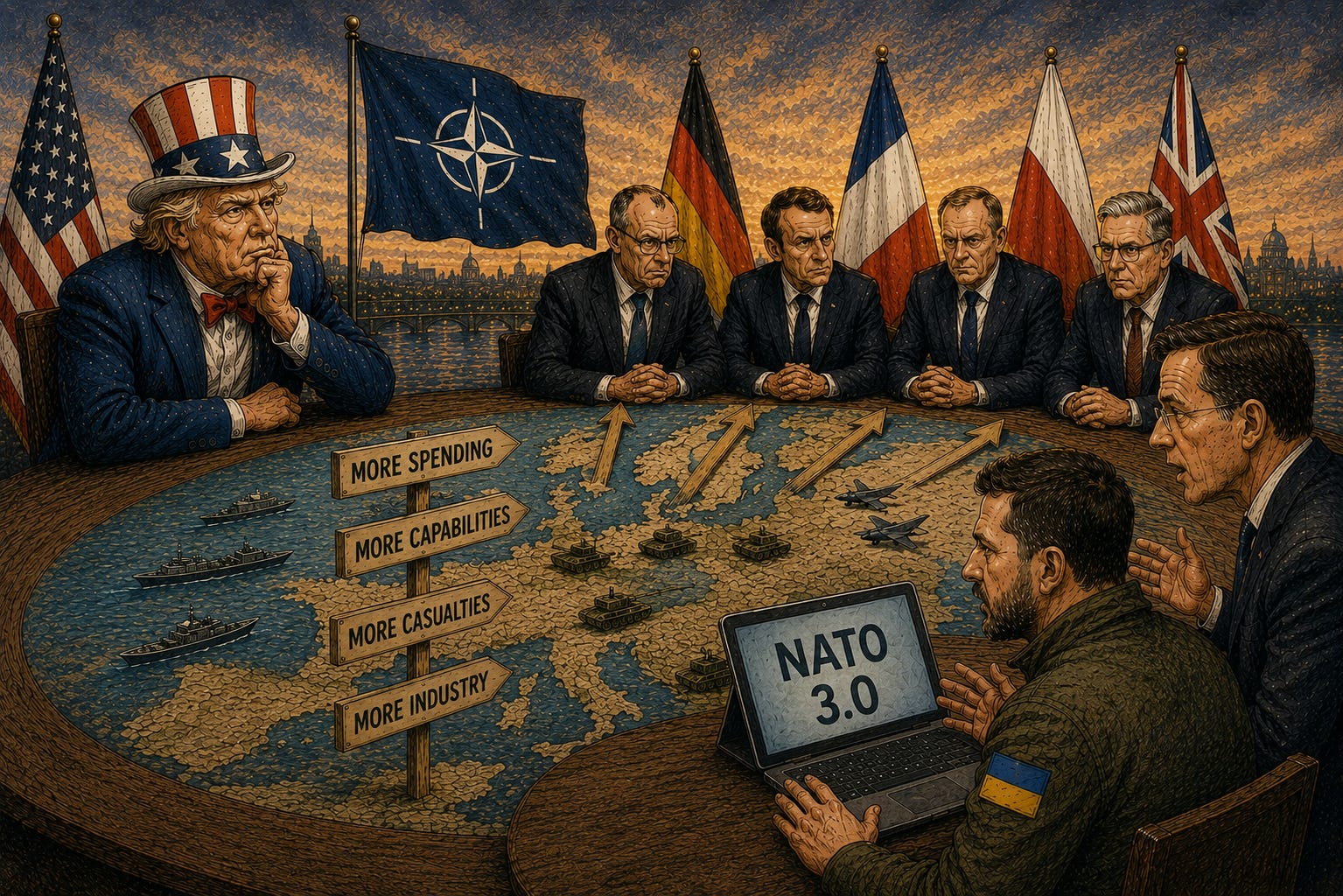
NATO turns 77 this year, and the coverage out of Ankara reads like another obituary in progress: Trump doesn’t believe in the alliance, Europe can’t defend itself, the whole arrangement is coming apart. This genre shows up every few years, usually around a spending fight, and it’s usually wrong.
It’s wrong this time too, but not for the reason the optimists think. NATO isn’t ending. The pretense is.
The pretense wasn’t that America would always defend Europe—nobody outside a few fringe corners ever seriously doubted Article 5, though President Trump has made a habit of keeping everyone guessing about whether he’d actually honor it. The pretense was narrower and more useful: that the post-Cold War model could run indefinitely.
America would remain the alliance’s backbone. Europe would get around to spending more—eventually, someday. The whole thing could keep coasting on the settings it had adopted after 1991.
That model is what’s ending. Not the alliance itself.
Radek Sikorski, Poland’s foreign minister, has a useful way of describing NATO’s evolution. NATO 1.0 was built to contain the Soviet Union. NATO 2.0 was the post-Cold War alliance searching for a new mission, eventually finding one in Afghanistan as Russia receded from view. NATO 3.0, as he describes it, is an alliance in which Europe assumes primary responsibility for the conventional defense of its own continent while the United States becomes, in his words, more of a “cavalry over the hill” ally.
Whether “NATO 3.0” sticks as a label is almost beside the point. All alliances evolve, and NATO has reinvented itself before. The question in Ankara isn’t whether it survives. It’s what version emerges next.
Trump’s skepticism of NATO didn’t begin with his presidency. In 1987, he bought a full-page advertisement in the New York Times arguing that wealthy allies were exploiting American defense spending. That’s four decades of consistency, which is more than you can say for most of his positions.
Nor was Trump the first American president to make the argument. Every administration since at least Eisenhower has pressed Europe to shoulder more of its own defense. Obama renewed that pressure after Russia’s annexation of Crimea. Trump didn’t invent the pressure, but he did change its character. He made it personal, transactional, and very public.
That matters less because it weakened NATO than because it weakened the assumption underneath it: that American leadership was politically automatic, a permanent feature of the landscape rather than a policy subject to renegotiation every election cycle. Once a country says its commitments are conditional—out loud, on camera—it’s very hard to unhear it, whichever way the next election goes.
When NATO Secretary General Mark Rutte arrived in the Oval Office carrying cardboard charts documenting how much Europe has spent since Trump’s first term—what he called, gamely, “the Trump trillion”—it became an oddly revealing image. The head of the most powerful military alliance in history was effectively presenting poster boards to convince one American president that Europe had finally listened.
His broader point, however, was more important than the performance. Europe may finally be spending more, but spending is only the beginning. As Rutte wrote recently in the Washington Post, “Cash is crucial, but you can’t stop a missile or a tank with a dollar or a euro.”
The decades-long assumption—that America would define the alliance’s strategy, capabilities and priorities while Europe gradually caught up—may be eroding. But resist the temptation to interpret all of this as Europe finally standing on its own.
It isn’t there yet, and pretending otherwise is its own kind of pretense. A British Army smaller than at any point since Waterloo doesn’t become a serious land force because politicians announce bigger defense budgets.
What Europe is actually doing is more modest—and, in my view, more interesting. It’s buying insurance. Not replacing the United States, but preparing for a future in which Washington may be less willing—or less able—to play the role it has played since 1949.
Germany is borrowing hundreds of billions of euros for defense. Canada is buying German submarines instead of American ones. Seven frontline states meeting in Gdańsk pledged to spend 5 percent of GDP on defense and security. Poland’s foreign minister put the objective with refreshing clarity: Europe doesn’t need to match America. It simply needs to be stronger than Russia.
Even those numbers deserve a measure of skepticism. Military pensions count toward many countries’ defense totals. Infrastructure spending intended to improve military mobility often serves broader domestic purposes as well. Britain’s own defense leaders argue current funding still falls well short of what they believe is required.
More importantly, money doesn’t create military capability on demand. Defense industries take years to build. Production lines don’t expand overnight. Command structures evolve even more slowly. NATO’s own supreme allied commander in Europe has described the alliance’s dependence on American capabilities as an “unhealthy co-dependence” that needs to end. Yet even as Europe spends more, the United States continues reducing refueling aircraft, maritime patrol assets and fighter squadrons assigned to the continent. You can announce a rebalancing long before you achieve one.
The hardest problem isn’t money. It’s command. For seventy-seven years, NATO has been built around an American supreme commander. Even many of the Europeans arguing most forcefully for greater strategic autonomy have little interest in changing that. Nobody has drawn up a serious plan for a NATO that isn’t ultimately led from Washington.
There’s a third shift underway that receives far less attention. Ukraine has quietly become one of NATO’s most valuable strategic assets—even without becoming a member.
Twenty years ago, NATO talked about training Ukraine. Today, it studies Ukraine—having gone from exporting military expertise to importing some of its most important lessons from the battlefield.
The alliance is learning from Ukraine in drone warfare, electronic warfare, logistics, dispersed command structures and industrial mobilization—lessons drawn from a country fighting the largest land war Europe has seen since 1945. The flow of expertise increasingly runs in both directions. Ukraine is still receiving Western weapons, training and intelligence. But it is also reshaping how NATO itself thinks about modern war.
For years, the debate centered on whether Ukraine was ready for NATO. After more than three years of war, the more interesting question is how much NATO has already been transformed by Ukraine. That may be the clearest sign yet that the old model is giving way to something new.
Ankara won’t resolve any of this. Summits rarely do. They usually ratify changes already underway and package them as breakthroughs. There will be new spending pledges, carefully negotiated language on Ukraine and declarations of allied unity. The real negotiation—how quickly Europe assumes greater responsibility, how much the United States steps back, and what kind of alliance emerges on the other side—will continue long after the cameras leave.
NATO isn’t dying in Ankara. The pretense that it could run forever on the settings it adopted in 1991 is. Washington will remain the alliance’s indispensable capital. It just won’t be the sole driver of what comes next.
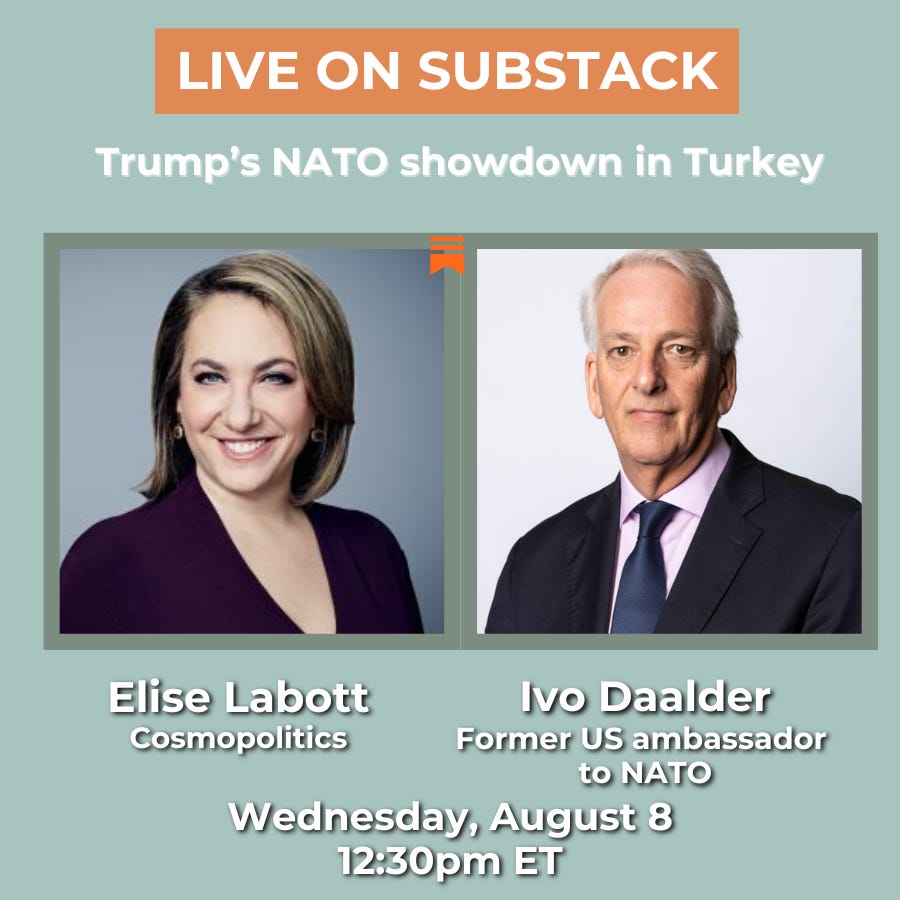
Join me TODAY at 12:30 for a discussion of the NATO summit and the future of the alliance with Ivo Daalder. We will break down all of the above, President Trump’s flirtation with Turkey’s President Erdogan and more. Hope to see you there.
Three decades covering foreign policy has taught me one thing: the story is almost never as simple as your side wants it to be. That’s why I call balls and strikes without keeping score.
That means you get reporting and analysis that makes partisans on both sides a little uncomfortable. Clear-eyed, fact-based, and beholden to no one.
If that’s the kind of coverage you want to read- I hope you will support my work and subscribe.
This is the most honest version of the comforting read, but it’s still kinda comforting. “Washington remains indispensable” is carrying the whole piece, and it’s a lagging indicator.
I’ve been tracking this for years and like is said… Canada buying German submarines instead of American. Germany borrowing hundreds of billions. “buying insurance” , so read the metaphor literally. You don’t insure against a partner. You insure against a risk. The moment Europe started pricing America as a risk rather than a guarantor, the alliance you’re describing already ended. Everything after is amortization.
The load-bearing claim here is that “nobody has drawn up a serious plan for a NATO not led from Washington.” But you don’t draft a plan to replace a guarantor you’ve stopped believing in, you build redundancy. And redundancy doesn’t get written on paper; it gets poured into procurement contracts and industrial base, which is exactly where it’s happening. “Not ready to stand alone” and “no longer counting on you” aren’t opposites. They’re the precise posture of someone heading for the door while staying polite.
Indispensable describes the past. The allies keep repeating it because it’s cheap, and because it buys time.
Johan
I’m just floating this out there. But Elise could you turn these into actual cartoons??? I think people would watch.