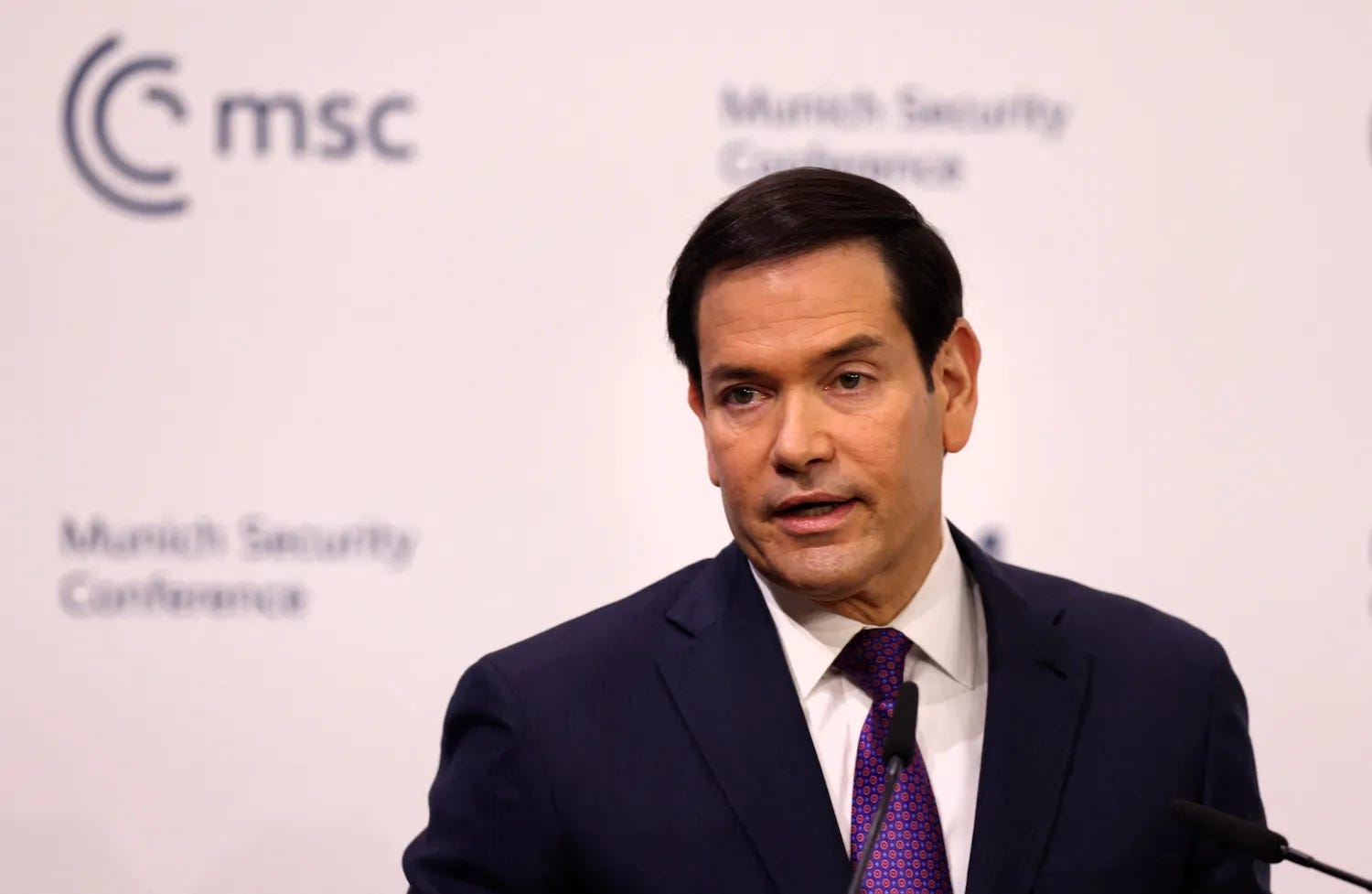
Rubio's velvet glove
His charm offensive can't erase what Europe learned at Munich
Friends: please join me TODAY at 4p ET/1p PT for a special Substack live with Larry Diamond of Stanford University. There’s a particular kind of expertise that comes from watching democracies unravel in real time across multiple continents. Larry has that expertise. And right now, he’s seeing the same patterns playing out in America. “A rapid slide to authoritarianism” isn’t speculation from him – it’s pattern recognition. Watch our conversation about what happens when the warning signs become impossible to ignore.
But first, Rubio:
Secretary of State Marco Rubio earned a standing ovation at the Munich Security Conference on Saturday. The audience visibly relaxed as he spoke of shared history and transatlantic bonds. After the Greenland crisis and a bruising year of threats and tariffs, European leaders seemed relieved to hear an American official use words like “we” and “together” instead of ultimatums.
But relief isn’t the same as trust. And a softer tone doesn’t change what the Trump administration is demanding.
Rubio delivered essentially the same message Vice President JD Vance shocked Europe with last year - just wrapped in velvet instead of sandpaper. The post-World War II rules-based order is over. The new relationship will be based on interests, not values. And if Europe wants American security guarantees, it needs to get on board with MAGA’s vision: based in Christianity, hostile to immigration, skeptical of climate action, and willing to align with far-right movements that reject liberal democracy.
European leaders heard the subtext. And they’re not buying it.
The hangover from Davos
Rubio arrived in Munich with a credibility problem. Just weeks earlier at Davos, President Trump castigated European leaders over migration policy and complained the U.S. had been taken advantage of. The Greenland crisis had brought the alliance to what European officials called “the point of no return” - Trump threatened military force against NATO ally Denmark and imposed tariffs on eight European countries.
So when Rubio took the stage, the bar was low: don’t make it worse.
Rubio cleared that bar. He emphasized that “our home may be in the Western Hemisphere, but we will always be a child of Europe.” He spoke of battlefields where Americans and Europeans “bled and died side-by-side.”
Wolfgang Ischinger, the conference chairman, noted the shift: Vance talked about NATO as “them,” while Rubio referred to the alliance as “we.”
But beneath the diplomatic niceties, Rubio delivered the same diagnosis: Europe is in crisis, threatened by immigration and cultural erosion, governed by institutions that stifle sovereignty.
“We are bound to one another by the deepest bonds that nations could share, forged by centuries of shared history, Christian faith, culture, heritage, language, ancestry,” Rubio said.
He denounced “a climate cult” and “an unprecedented wave of mass migration that threatens the cohesion of our societies.” He criticized countries that “outsourced sovereignty” to international institutions - while speaking at the heart of the 27-nation European Union.
And he made clear what Trump wants: “We in America have no interest in being polite and orderly caretakers of the West’s managed decline.”
Translation: Get on board with our program, or watch your civilization erode.
What Europe heard
European leaders parsed every word. Some initially declared themselves “reassured.”
But as the day wore on, reactions grew cautious as the realization set in that Europe and America may not share the same values they once did.
The fundamental problem is that Rubio’s vision of “Western civilization” excludes large portions of actual Europeans and Americans. Nearly one in three Munich residents isn’t German. In Europe’s three largest economies, less than half of residents identify as Christian. About 6% of Europeans are Muslim.
When Rubio celebrated bonds forged by “Christian faith, culture, heritage, language, ancestry,” he was describing an idealized Europe that increasingly exists only in MAGA imagination.
EU foreign policy chief Kaja Kallas rejected the premise: “Contrary to what some may say, woke, decadent Europe is not facing civilizational erasure. In fact, people still want to join our club.”
The message was clear: Europe will defend its own values - multiculturalism, climate commitments, international institutions, human rights - regardless of what Washington demands.
Rubio’s next stop
The clearest signal of the Trump administration’s priorities came after Munich. Rubio didn’t travel to Paris, Berlin, or London. He went to Slovakia and Hungary.
Both countries are run by populist far-right leaders who maintain close ties to Russia, have blocked EU aid to Ukraine, and align with MAGA’s anti-immigration, anti-EU ideology. Hungarian Prime Minister Viktor Orban is considered a model by American conservatives whose playbook Trump has adopted as his own.
Interests, not values
The most revealing message came from Elbridge Colby, the undersecretary of defense for policy and the most senior Pentagon official at Munich.
Colby dismissed talk of shared values as “hosannas or shibboleths.” Instead, he said, “let’s ground our partnership on something more enduring and durable and kind of real, like shared interests.”
That’s the new framework: America and Europe as partners of convenience, aligned where interests overlap, diverging where they don’t. No pretense of shared democratic values. No assumption that alliance commitments are permanent.
German Chancellor Friedrich Merz had opened the conference by declaring that “the culture war of the MAGA movement is not ours.” British Prime Minister Keir Starmer emphasized that Europe’s strength comes from showing “that people who look different to each other can live peacefully together.”
These weren’t casual rebuttals. They were direct rejections of Rubio’s framing. Merz laid out the stakes:
“A divide has opened up between Europe and the United States. The United States’ claim to leadership has been challenged, and possibly lost.”
He added: “The international order based on rights and rules is currently being destroyed. This order, as flawed as it has been even in its heyday, no longer exists in that form.”
And now, Starmer warned, Europe can’t get in the warm bath of complacency.”
French President Emmanuel Macron was more direct: “In this new geopolitical environment, Europe has to become a geopolitical power. It’s ongoing, but we have to accelerate.”
Ursula von der Leyen, president of the European Commission, called Rubio a “good friend” and “strong ally,” but emphasized that “Europe must become more independent” on defense and technology. She pledged to deepen ties with “our closest partners, like the U.K., Norway, Iceland or Canada” - notably not mentioning the United States first.
The damage assessment
Rubio’s speech succeeded in one narrow sense: He didn’t make things immediately worse. European leaders left Munich without new crises to manage, without fresh insults to process.
But the fundamental damage remains. Europe has learned that American partnership is conditional on accepting MAGA ideology. Security guarantees come with strings attached.
The European Union is accelerating trade negotiations with Malaysia, Indonesia, and India. The Mercosur deal with South America is moving toward ratification. Canada has celebrated a “strategic partnership” with China.
These aren’t temporary hedges. They’re strategic diversification based on a clear assessment: The United States under Trump is an unreliable partner whose commitments cannot be trusted.
Rubio’s softer tone might have bought some goodwill. But it can’t erase what Europe has learned: The post-war Atlantic alliance is over. What comes next will be transactional, conditional, and based on interests rather than values.
Europe heard Rubio’s message. And it’s preparing accordingly.


Great job speaking out on it.
Rubio may also be looking ahead 3 years. Vance, the currently annointed Republican candidate for the presidency after Trump, has now created juicy quotes that opponents can use against him in the future. It's surprising that Vance seems so oblivious of these time bombs. But opponents to Rubio can also have a field day comparing Rubio positions pre and post his appointment by Trump. But of course, much depends on opponents being able to mobilize strategy - not a Democratic strength in past campaigns.