

The cost of "a piece of ice"
Trump found his Greenland off-Ramp. The damage Is done.

Friends: You don’t want to miss today’s Hot Takes Happy Hour. Me and Danielle Pletka will be breaking down all the developments out of Davos, the latest on Iran and more. We are starting a bit earlier today at 5:00 pm ET. Hope to see you there. Check out Dany’s fantastic piece beforehand about Trump’s “imperialist agenda” and some of his Machiavellian advisers trying to “egg the President into sowing discord in our alliances, to urge him to alienate America’s demanding and tiresome friends, and to further pave the road to an isolationist and isolated fortress America.” It’s a brilliant read we will break down during #HTHH

Now for the latest developments.
You may remember, I called it yesterday: Trump would find a deal with NATO on Greenland - something short of outright “ownership” that lets him claim victory while backing away from the threat that was fracturing the transatlantic alliance.
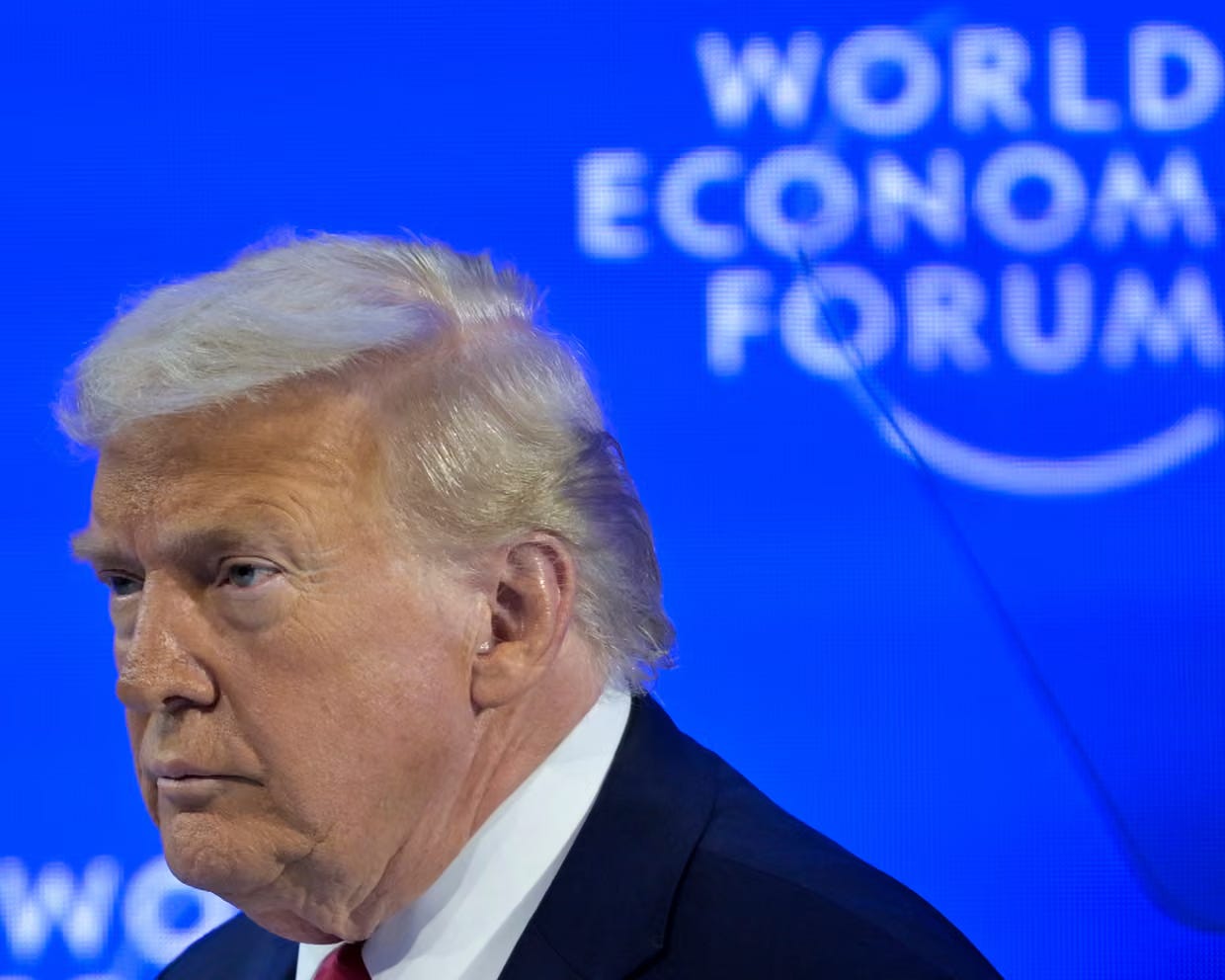
And that’s exactly what happened. After his Davos speech on Thursday, Trump announced on Truth Social that the United States and NATO had formed “the framework of a future deal with respect to Greenland and, in fact, the entire Arctic Region.” He told CNBC the arrangement could last “forever” and might involve mineral rights and his proposed “Golden Dome” missile defense system. Reports suggest it could include U.S. ownership of small pockets of territory for its military bases - similar to UK sovereign base areas in Cyprus.
Trump got his face-saving exit. Danish Foreign Minister Lars Løkke Rasmussen said “the day is ending on a better note than it began” - diplomatic code for relief that the threat of military force and punishing tariffs were lifted. But he felt the need to add, “respecting the red lines of the Kingdom of Denmark.”
The insults that won’t be forgotten
Trump’s interest in the Arctic isn’t foolish - everyone recognizes the region’s strategic importance for defense against Russia and China, its critical minerals, and shipping lanes that will only grow more vital as global warming accelerates. But it was how he did it and what he said along the way.
He threatened to seize territory from a NATO ally. He mocked Denmark’s military capabilities and their Arctic defense contributions. He called Greenland “a piece of ice.” At Davos, he dismissed European concerns and suggested allies should have acted sooner if they were “smart.” He told the crowd the U.S. wouldn’t take the territory by force and that he wanted to open negotiations to purchase it. And then, in the same breath, came the threat dressed as diplomacy: “You can say yes and we will be very appreciative. Or you can say no and we will remember.”
French President Emmanuel Macron had been clear earlier: “No intimidation or threat will influence us - neither in Ukraine, nor in Greenland, nor anywhere else in the world when we are confronted with such situations.”
It’s ironic that after years of being dismissed as too deferential to Washington, it took a rift over tiny Greenland — an island with a population smaller than most American towns but outsized importance as a test of whether sovereignty still means anything — for Europe to finally show some spine.
EU foreign policy chief Kaja Kallas made the stakes explicit: “China and Russia must be having a field day. They are the ones who benefit from divisions among Allies.”
It’s notable what the European statements after a supposed deal was reached didn’t include: any expression of gratitude for American leadership, any language suggesting the episode strengthened the alliance, or any indication that trust had been restored.
The strategic shift already happening
The real cost of Trump’s Greenland gambit won’t show up in NATO communiqués. It will show up in what allies do next - and who they’re talking to.
The European Union finalized ratification of its massive trade agreement with Mercosur - the South American trade bloc including Brazil, Argentina, Paraguay, and Uruguay. The deal had been stalled for 25 years. Europe pushed it across the finish line in months.
European Commission President von der Leyen didn’t hide the motivation at the signing ceremony: “We choose fair trade over tariffs. We choose a productive, long-term partnership over isolation.”
She didn’t name the United States. She didn’t have to.
France and Germany are accelerating trade negotiations with India. The EU is fast-tracking discussions with Malaysia and Indonesia. And in perhaps the most remarkable development, Canada - America’s largest trading partner and closest geographic ally - is celebrating a new “strategic partnership” with China.
Canadian Prime Minister Mark Carney was careful in his framing, but the message was clear. When your closest ally threatens to annex you as the 51st state and imposes tariffs to coerce cooperation, you start looking for other friends.
“A complete rupture?”
In my conversation with former Under Secretary of State Tom Shannon this week, he echoed what Carney warned the Davos crowd: we are witnessing “a complete rupture in the transatlantic relationship.”
Shannon sees Trump’s approach as coherent - a deliberate “power-and-assets” strategy that trades away legitimacy and long-term influence for short-term gains. The problem is what you’re left with when allies decide they can no longer rely on American partnership.
“Power without principle is a weak vessel,” Shannon told me - a line that captures what’s happening as allies watch American foreign policy operate through threats and coercion rather than shared values.
European defense ministers are accelerating plans for autonomous defense capabilities that don’t rely on American systems or guarantees. European companies are diversifying supply chains away from American dependency. That won’t happen quickly, or easily. But the fact that in private Davos conversations, European CEOs and finance ministers weren’t asking how to work with the Trump administration, but how to work around it, says all you need to know.
NATO Secretary General Mark Rutte was careful to note that Danish sovereignty “did not come up anymore” in his conversations with Trump. The NATO statement focused narrowly on ensuring “Russia and China never gain a foothold - economically or militarily - in Greenland.”
But here’s the thing: the U.S. can already bring as many troops as it wants to Greenland under existing agreements. Denmark just pledged $13.7 billion to upgrade Arctic security. What exactly did Trump get that he didn’t already have?
The answer is the appearance of concessions on issues where allies were already moving. He could have claimed a major victory in focusing attention on a strategic area with a lot less drama and angst. Instead, he lost the assumption that American security guarantees are reliable and that alliance management will be conducted with respect for sovereignty.
That assumption - that the United States is a reliable partner that operates within shared principles - was the foundation of the post-World War II international order. Trump’s Greenland episode didn’t just crack that foundation. For many allies, it shattered it.
You can’t rebuild that kind of trust with a joint statement. Trust is built over decades through consistent behavior. It’s destroyed in weeks through unpredictable threats.
Trump found his off-ramp. He avoided the worst-case scenario. But the damage is done. Allies watched how the United States treated a loyal partner. They heard the threats. They saw the coercion. And they’re making long-term strategic decisions based on what they learned: American partnership is conditional, American commitments are unreliable, and American power can be turned against allies as easily as adversaries.
The Greenland crisis may be over. But the crisis of American trust and credibility is just beginning. And that not something up for negotiation.
Good analysis, but if our current/former allies are now forced to step up their own defense capabilities instead of relying on us, that’s not so bad.
Trump is a pathetic character. And he is so out of touch, he is unaware, advertising it, to an enlightened audience abroad but with still enough support here in the Congress to keep him in power. This is a shame on us for keeping him twice and this long with his increasing horrors.
What Trump and his myrmidons are doing across all fronts is destroying for the sake of destroying, destroying the ground we stand on here and shaking the ground internationally.
Trump will insist he won Greenland. A certain number will believe him.
This is on us. It took awhile, decades to come to this place. It took all this from Trump and this threat to Greenland for the Euros to get a sense of what they must do. We need their help in fact. Gavin Newsom was right in his lecture to the Euros. Marc Carney of Canada gives us hope.
Meanwhile Trump and his people are a shame and a disaster visited upon us, very painful every minute he and his administration are still in power.
The folks in Minneapolis give me hope. There we all go-- us here in another space maybe soon to come. No way.