Trump, Xi and history's oldest trap
Xi opened the summit with history. Trump talked about phone calls. Only one is a strategy.
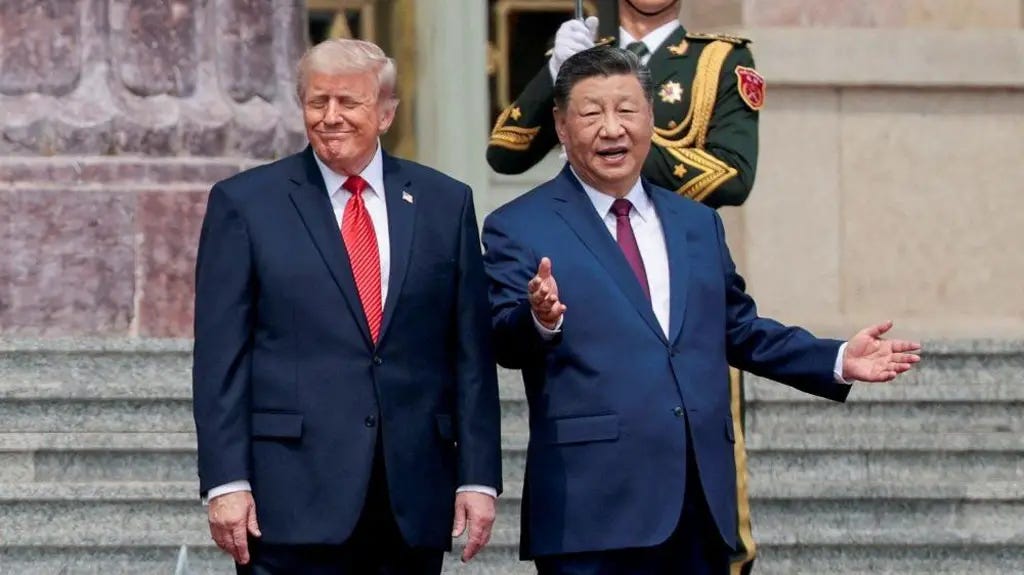
President Donald Trump arrived in Beijing looking for something he has always valued almost as much as leverage: optics.
The red carpets. The military bands. The carefully choreographed images of two strongmen seated across from each other deciding the future of the global order over tea and translated pleasantries.
Trump loves this kind of stagecraft because it reinforces the story he tells about himself — the lone dealmaker who can bend history through force of personality and instinct. And to be fair, Chinese President Xi Jinping understands the value of spectacle too. Beijing has long treated summit diplomacy as political theater wrapped inside strategic signaling.
But beneath the pageantry of this visit sits a more uncomfortable reality for Washington: China increasingly believes time is on its side.
This summit was originally supposed to unfold under very different conditions. Trump wanted the war with Iran stabilized — if not fully resolved — before sitting down with Xi. Instead, he arrived in Beijing still navigating a fragile ceasefire, oil markets rattled, and the Strait of Hormuz hanging over the global economy like a loaded weapon.
That matters because Beijing is watching more than the diplomacy. It is watching the strain.
Chinese strategists have spent decades studying American power with almost anthropological obsession: how Washington projects force, sustains alliances and manages crises. Now they are watching a United States once again pulled back into the Middle East, burning through munitions and losing patience while trying to convince the world the Indo-Pacific remains its top strategic priority.
Publicly, Trump is trying to project confidence. Before departing for Beijing, he insisted the United States did not need China’s help on Iran and claimed the situation was “very much under control.”
But like most things with Trump, saying something — even in front of cameras — does not necessarily make it strategically true.
China is Iran’s most important economic backer and one of its few remaining major diplomatic lifelines. Beijing buys the overwhelming majority of Iranian oil exports. It has helped cushion Tehran from sanctions pressure for years and quietly positioned itself as a critical node in any future economic off-ramp.
Which means Xi arrives at this summit knowing something Trump does not want to publicly admit: if Washington wants a durable resolution in the Gulf, China will almost certainly have to be part of it.
The looming question is what Beijing might want in return. Because this is how Xi tends to operate — not through dramatic public ultimatums, but through accumulated leverage, patient pressure and long timelines. If China decides to help stabilize the Iran file more aggressively, Washington will inevitably wonder what price comes attached to that cooperation: trade concessions, technology access, tariff relief, softer language on Taiwan, or simply more strategic space in the Indo-Pacific.
And that is where this summit becomes potentially far more consequential than the choreography surrounding it.
Trump has always believed personal chemistry can overcome structural rivalry. Xi appears to believe structural rivalry eventually overwhelms personality. And unlike Washington, Beijing does not appear especially rushed.
That may be the single biggest contrast between the two systems. Trump operates on short timelines and immediate momentum. Xi operates like someone planting trees whose shade he expects to sit under twenty years from now.
That difference showed clearly during last year’s rare earths confrontation. When Trump escalated on tariffs, Beijing didn’t fire back rhetorically. It went after America’s technological pressure points — restricting exports of critical minerals embedded in everything from missile systems to smartphones to AI infrastructure. China had been quietly building dominance over those supply chains for decades, treating globalization not as a law of physics but as a strategic opportunity. When the moment came, Beijing didn’t need to threaten. It just reminded Washington who owned the choke points.
Beijing is not trying to win every news cycle. It is trying to shape the underlying architecture of dependency.
Trump, by contrast, often approaches geopolitics the way a casino approaches a hot streak — press the advantage, dominate the headline, improvise later. Sometimes that unpredictability creates genuine leverage. But it also produces an American foreign policy that can feel less like long-term strategy than a rolling series of tactical impulses stitched together by presidential confidence.
The Chinese have noticed. Online, Trump earned the nickname “Trump the Nation Builder” — a darkly comic acknowledgment that many Chinese commentators believe his disruptions have weakened America’s global standing while inadvertently strengthening China’s. Even News York Times columnist Thomas Friedman argued last year that parts of Trump’s economic agenda risked inadvertently “making China great again” by ceding ground in industries Beijing has spent years strategically cultivating.
It is not hard to see why some in Beijing feel emboldened. While Washington oscillated between engagement and economic warfare, China expanded its industrial dominance in batteries, solar panels, critical minerals, electric vehicles, robotics and advanced manufacturing. At the same time, Beijing has been steadily building the military architecture to protect that rise — expanding its navy, modernizing its missile forces, investing heavily in cyberwarfare, AI and space capabilities.
The goal is not simply to become richer than the United States. It is to become harder to pressure, isolate or contain, so that by the time a confrontation comes, the terms have already been tilted in China’s favor.
None of this means China is ten feet tall. Its economy is slowing. Debt is rising. Youth unemployment is serious. The property market remains shaky. Demographics are a long-term problem. But Beijing still appears to believe the broader trajectory favors them — especially if America continues exhausting itself politically and strategically.
Trump arrived in Beijing with some of the most powerful figures in American business, including Elon Musk, Apple’s Tim Cook, Meta President Dina Powell McCormick and BlackRock CEO Larry Fink. Nvidia’s Jensen Huang was added late — a last-minute inclusion that signals how central the advanced chip question has become. His presence is the clearest symbol of the summit’s central contradiction: despite years of decoupling rhetoric, the American and Chinese economies remain deeply entangled, nowhere more uncomfortably than in AI.
Then the two men sat down — and the dynamic the piece had been building toward played out almost on cue.
Xi opened the formal session at the Great Hall of the People without mentioning Iran or trade. He reached instead for history, invoking the Thucydides Trap — the theory that a rising power and a ruling power are almost fated to collide. “Can China and the United States overcome the Thucydides Trap and establish a new paradigm for relations between great powers?” he asked. It was a signal: China sees itself in a civilizational competition, not a transactional dispute.
Trump’s opening was something else entirely. He lavished praise on Xi — “you’re a great leader, I say it to everybody” — and described their relationship as phone calls and problems quietly worked out. Xi framing the relationship in decades and historical forces. Trump framing it in personal chemistry.
Then came Taiwan. Xi warned that if the issue were handled poorly, the two countries could “collide or even clash,” pushing the entire relationship into “an extremely dangerous situation.” The Trump administration had already quietly delayed a $13 billion arms package to avoid antagonizing Beijing before the summit. Trump told reporters he planned to discuss arms sales with Xi — a notable departure from the longstanding American position that such decisions are not subject to Chinese input..
Xi called on the two countries to be “partners rather than adversaries” — a phrase that lands differently now, when China is negotiating from a position of considerably more confidence than the last time a U.S. president came to Beijing.
Xi increasingly looks like a leader betting on historical patience. Trump still looks like a leader betting on personal instinct.


