


Yesterday’s conversation with Steven A. Cook drew the biggest turnout we’ve had yet! So many familiar faces and so many new ones. Smart questions, sharp pushback. The kind of crowd that reminds me why we started Cosmopolitics in the first place - to slow the news cycle down just enough to actually think.
If you haven’t already, subscribe and join us. This community only works because you show up.
Steven and I tried to map the region the way it actually is - not the way press conferences describe it. And here’s where I think we landed:
Everything right now looks like diplomacy. Everything right now also looks like war prep. Both things are true at the same time, which is… not exactly calming.
But first: Iran
After his three-hour meeting with Netanyahu this week, President Trump posted:
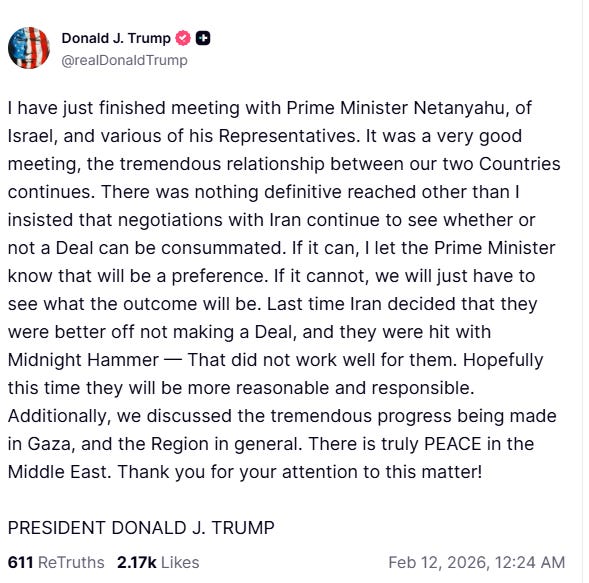
Preference. Not commitment. Not strategy. Preference.
Meanwhile - and this is the part people in the region notice - the United States is massing serious hardware in the Gulf. Carrier groups, destroyers, air defenses. The kind of posture that says: we’re talking, but don’t mistake that for hesitation.
It’s classic leverage politics: talk softly, park an armada offshore.
The problem is that leverage has a shelf life. You can’t keep tens of thousands of troops and billions of dollars’ worth of assets floating there indefinitely. At some point you either use it or you don’t, and everyone knows it.
Still, it’s unclear what Trump’s bottom line is. That uncertainty is supposed to scare Iran, but it also scares allies - and occasionally, U.S. officials.
Because here’s the quieter truth beneath the rhetoric: a big war with Iran would be hard, much harder than the slogans suggest.
Tehran may be politically fragile - protests, sanctions, a battered economy - but militarily it still has teeth. Missiles, drones, proxies. Plenty of ways to make life miserable for U.S. bases and Gulf energy infrastructure.
So Washington is threading a needle: threatening war while quietly rediscovering how complicated war actually is. And in the meantime, negotiations themselves may be giving the regime breathing room - which is exactly what makes Israel nervous.
Netanyahu’s position hasn’t changed: a narrow nuclear deal isn’t enough. He wants missiles and proxies on the table too. Tehran has already said no. So the two leaders are aligned on pressure, but not necessarily on what “success” looks like. And when the objectives aren’t clear, leverage starts to look a lot like drift.
Meanwhile: the West Bank
While everyone watches Iran, something quieter - and potentially more combustible - is happening closer to home for Israel.
The West Bank story isn’t dramatic. No aircraft carriers, no summits. Just paperwork, permits, jurisdiction tweaks, expanded enforcement. Incremental steps that, taken together, look a lot like annexation without anyone wanting to use the word annexation. Call it bureaucratic geopolitics.
At the same time, the administration is talking up diplomacy - Gaza stabilization, regional normalization, Trump’s nebulous “Board of Peace.” It’s a very Washington phrase that sounds great on a panel but is less clear on the ground.
Publicly, Netanyahu is playing along. Privately, many in his coalition still believe force, not frameworks, is what actually changes facts.
So again: diplomacy on top, pressure underneath. Same pattern as Iran. Talks in the daylight, tanks idling in the background.
The throughline: Everyone is negotiating. No one fully trusts negotiations.
Trump prefers deals but likes threats even more. Iran wants sanctions relief without real concessions. Israel wants guarantees that probably aren’t negotiable. The Gulf wants everybody to please calm down because they live inside the blast radius.
It’s less a strategy than a standoff, and it produces this strange, unstable middle ground where talks continue right up until the moment they don’t.
Which is why moments like yesterday matter. The headlines make everything sound binary - deal or war, diplomacy or strikes. The reality is murkier, more incremental, more human. It’s officials hedging, allies whispering, militaries planning for things leaders hope never happen. It’s uncertainty dressed up as strategy.
Thank you
One reason I’m so grateful for this community is that we get to have these conversations without pretending there are easy answers. We can say: this is complicated, this is risky, nobody really knows, and still keep reporting, asking, pressing.
If you haven’t subscribed yet, please do. Cosmopolitics runs on readers who want depth, along with some hot takes. Speaking of which, Danielle Pletka and I will be back next week with Hot Takes Happy Hour.
Thank you for showing up yesterday. For reading. For caring about foreign policy when it’s easier not to. We’ll keep convening smart people, keep asking uncomfortable questions, and keep trying to figure out – together - whether all this “diplomacy” is headed somewhere real… or just buying time before the next crisis.
More soon …
Thank you David Galinsky, Kimberly Briedis, Emma Schreiber, ahyeahatx, and many others for tuning into my live video with Steven A. Cook! Join me for my next live video in the app.


