


Folks: If you missed my conversation with former US envoy to Venezuela Elliott Abrams, I encourage you to watch the recording. Elliot’s knowledge and insights bring essential context and nuance to this complex story.
I write more about how the administration’s strategy, or lack thereof, will impact the region well beyond Trump’s term in the post below. Tomorrow I will discuss the administration’s designs on Greenland and the potential consequences of the US moving to acquire it.
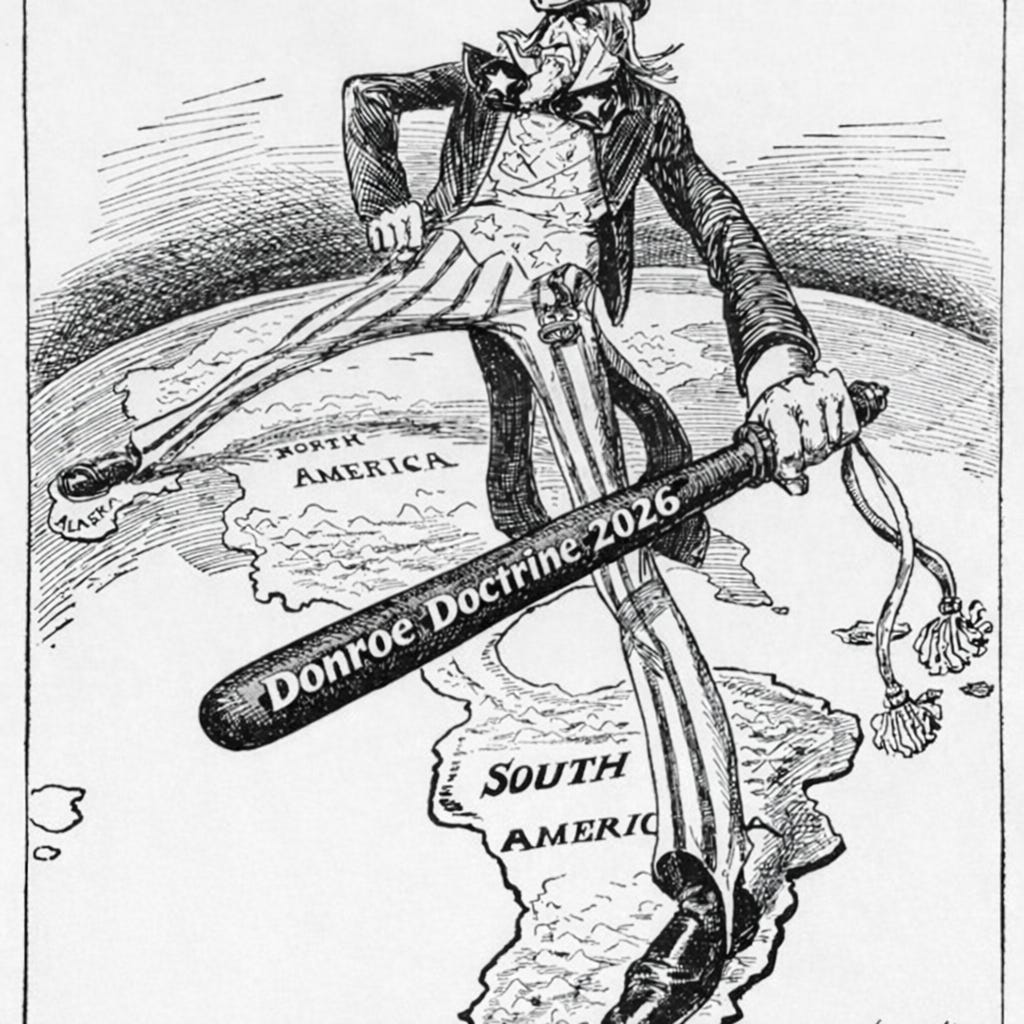
Three days into the new year, President Donald Trump did something that should make every American who remembers Iraq deeply uneasy: we invaded Venezuela, seized its president, and casually announced the United States would “run” the country until “we can do a safe, proper and judicious transition.”
The successful raid was remarkable, but the phrase - “run Venezuela” - should haunt us. The last time American presidents talked confidently about managing other countries after toppling their leaders, we got two decades in Iraq and Afghanistan. Colin Powell famously called it the “Pottery Barn rule”: “You break it, you own it.” We owned both countries for decades. Trump himself was elected on promises to end these “forever wars.” This time he thinks he’s discovered a loophole.
The LatAm Pivot
Exactly two years ago, I wrote that Latin America was “the overlooked wallflower in American diplomacy” - viewed through the lens of immigration and drugs but sidelined for Middle East crises and the pivot to Asia. I argued it was time to wake up and smell the café con leche: the region’s strategic importance had been grossly underestimated.
For decades, U.S. policy oscillated between heavy-handed interventions and benign neglect - like a gardener who only notices the garden when it’s overrun with weeds. This left a vacuum China gleefully filled. As Larry Summers put it: while the U.S. offers lectures, China builds airports.
To Trump’s credit, his team finally recognized what I and others had been arguing: Latin America matters. The problem is how he’s acting on that recognition. Instead of strategic investment and partnership, Trump has embraced a military-backed spheres of influence approach- carving up the world where America dominates the Western Hemisphere, Russia gets Europe, and China takes Asia. Everyone stays in their lane.
It sounds almost rational until you remember what spheres of influence produced in the 20th century: imperial powers dividing up other people’s countries without consent, leaving catastrophe in their wake. The Monroe Doctrine of 1823 was meant to keep European powers out of the Americas - not give American presidents license to invade them. Trump calls his version the “Donroe Document” and declared: “Under our new National Security Strategy, American dominance in the Western Hemisphere will never be questioned again.”
Putin and Xi’s responses were surprisingly muted because Trump just adopted their playbook. “Ukraine belongs to Russia’s sphere” is Putin’s main argument. “Taiwan is part of China’s sphere” will be Xi’s justification. Trump just gave them permission slips.
This is where Trump’s spheres of influence collide with Powell’s Pottery Barn rule.
What Trump really wants
When asked why an “America First” president would take over a South American country, Trump didn’t equivocate: “We want to surround ourselves with energy. We have tremendous energy in that country. It’s very important that we protect it. We need that for ourselves.”
This obviously isn’t about democracy - drugs are a secondary concern. For sure it’s blunting Chinese, Russian, and Iranian influence. But it’s mostly about oil and establishing that if you nationalized American oil assets in 1976, we can take them back 50 years later. Commerce Secretary Howard Lutnick helpfully noted steel and aluminum industries could also be revived “for U.S. benefit.”
Here’s the problem: Venezuela nationalized its oil in 1976. So did Mexico in 1938, Iran in 1951, and Bolivia, Argentina, and Ecuador at various points. Trump just established that decades-old resource grievances justify military intervention. That’s not a doctrine. That’s a protection racket with an exceptionally long memory.
The leftist regime domino theory
Trump’s ambitions extend beyond Venezuelan oil fields to a broader campaign driving out leftist governments across the hemisphere. His administration is engineering a political realignment across an entire hemisphere with military force as the lever.
Cuba tops the list. Thirty-two Cuban military and intelligence personnel died in the Venezuela raid - that’s not just alliance, that’s entanglement. Trump noted Cuba’s critical vulnerability: “Cuba only survives because of Venezuela.” Secretary of State Marco Rubio - whose primary interest has always been Cuba - warned this weekend: “If I lived in Havana and I was in the government, I’d be concerned.” Cut off the oil, watch the economy collapse, wait for the 66-year-old communist government to fall.
Colombia - our decades-long partner on counter-narcotics - got sanctioned because President Gustavo Petro maintains an “alliance with Maduro.” Think about this strategic disaster: Colombia hosts 2.8 million Venezuelan refugees and possesses the critical intelligence we need. Many cartels operate in Venezuela precisely because Colombian cooperation pushed them out. We’ve eliminated our most important partner at the most critical moment.
Mexico, our second-largest trading partner, is also on notice. Trump claims cartels run the country, and officials confirm he’s “very interested” in sending Special Forces. President Claudia Sheinbaum insists “it’s not going to happen,” but Trump’s Venezuela operation suggests sovereign consent is optional.
Nicaragua’s Ortega also faces threatened 100 percent tariffs and increasing isolation.
The pattern is unmistakable: pressure leftist governments while rewarding right-wing allies. Argentina’s Javier Milei got $20 billion. El Salvador’s Nayib Bukele got his travel warning removed. The Summit of the Americas - the premier hemispheric forum - was canceled for the first time in 31 years due to “deep divisions.”
No exit strategy
Trump is celebrating the capture of Maduro and declaring the U.S. is “in charge” of Venezuela. But he has no clear plan for what comes next.
Trump apparently believes he can topple Maduro, install compliant leadership, extract oil concessions, and move on. But Venezuela is a failed state of 28 million people - twice the size of Iraq - where the regime maintains only fragile control beyond Caracas. The country is simultaneously heavy-handed authoritarian and absolute anarchy.
And the regime hasn’t actually been removed. Defense Minister Vladimir Padrino remains - also under U.S. drug indictment. Interior Minister Diosdado Cabello stays - also indicted. The military is intact. So is the Cuban-designed surveillance apparatus (albeit one that failed to detect the American raid).
Trump says he’ll work with Delcy Rodríguez, Maduro’s vice president, as interim leader. This isn’t regime change - it’s dictator change. The same officials who created the worst migration crisis in Latin American history get to keep running things, just now with American blessing and oil company access.
If Rodríguez doesn’t “behave,” Trump threatened a “second strike.” We’re not managing a transition - we’re threatening ongoing military intervention to coerce compliance. That’s textbook mission creep. The Pentagon has already built the largest U.S. military presence in the hemisphere in decades - more than 15,000 troops. Trump says America is “not afraid of boots on the ground if we have to.”
And this is just Venezuela. Cuba’s government looks vulnerable without Venezuelan oil, and Florida Republicans are salivating for action. Ortega’s Nicaragua faces escalating pressure. Petro in Colombia continues criticizing U.S. policy, inviting potential escalation. Meanwhile, migration will continue because nobody’s actually fixing the conditions that drive people to flee.
Before long, we could be managing - or more accurately, failing to manage - multiple weak states across Latin America, all demanding American attention, resources, and military presence. Unlike the Middle East, which we could at least pretend to pivot away from to focus on other concerns like Asia, this is our neighborhood. If being stuck in the Middle East felt endless, imagine being bogged down in simultaneous interventions in our actual backyard - each one supposedly quick and clean, each one metastasizing into something nobody intended.
This is how a quick raid to grab one guy turns into a decades-long quagmire where nobody remembers the original objective.
No three-year return policy
President Trump will be gone in three years, term-limited out in January 2029. If Venezuela descends into chaos, if Colombia destabilizes, if we’re managing cascading crises across Latin America - none of it will be his problem. He’ll be in Mar-a-Lago, taking credit for “ending the Maduro regime.” He won’t be thinking about 2035, just his next golf game.
But America will still be there with troops deployed and credibility further shredded by another regime-change adventure that morphed into something nobody intended. We thought we’d learned this lesson after Iraq’s phantom WMDs, after Afghanistan’s collapse during evacuation, after Libya became a militia playground. We supposedly internalized that toppling dictators is vastly easier than building stable governments.
Trump has a different theory he’s now testing across the hemisphere: that power projection without responsibility is what dominance means. That the Pottery Barn rule was always just bureaucratic excuse-making. That you can break things and walk away.
Whether Trump admits it or cares, America will own these pieces - sharp, dangerous, expensive pieces - long after he’s gone.. That’s not partisan criticism, friends. That’s how history works. Ask George W. Bush whether “Mission Accomplished” aged well.
Three years from now, Trump will hand someone else this mess. And we’ll spend a generation cleaning it up.
Thank you BY GLENN KESSLER, Cash Flow Collective, David Galinsky, Jaime HG 🇺🇸, GeorgeCarlinWasRight, and many others for tuning into my live video with Elliott Abrams! Join me for my next live video in the app.


